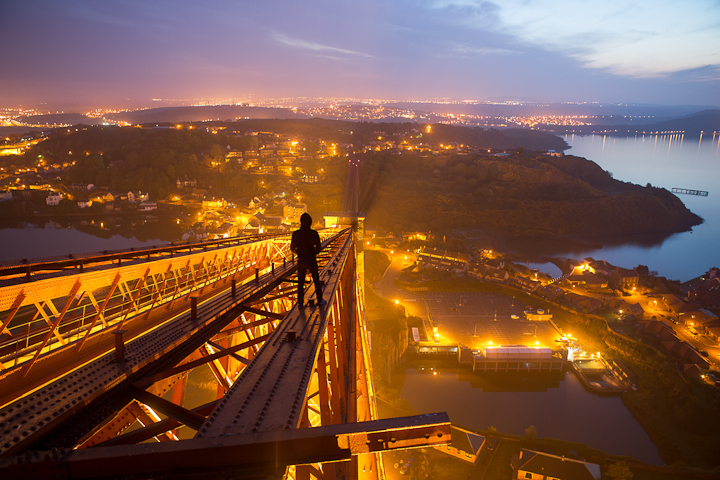
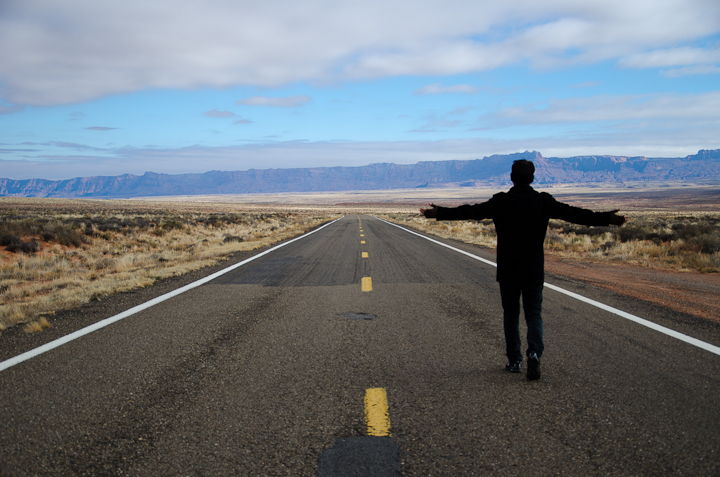
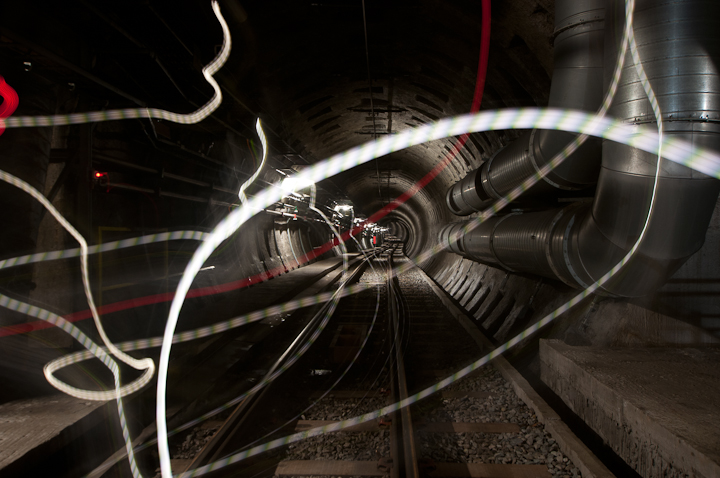
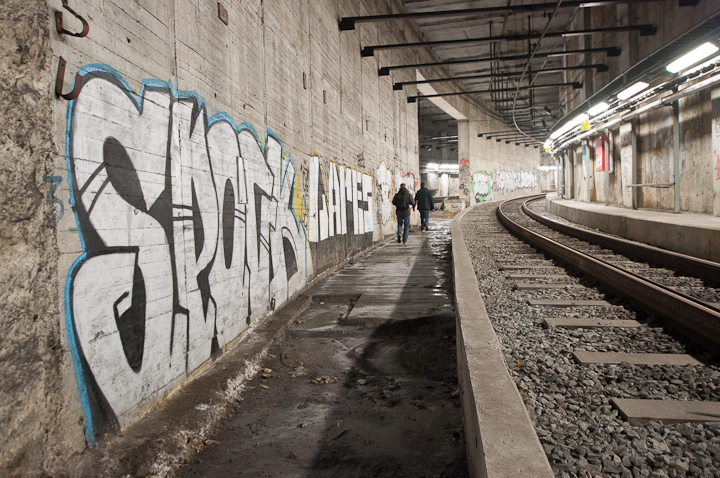
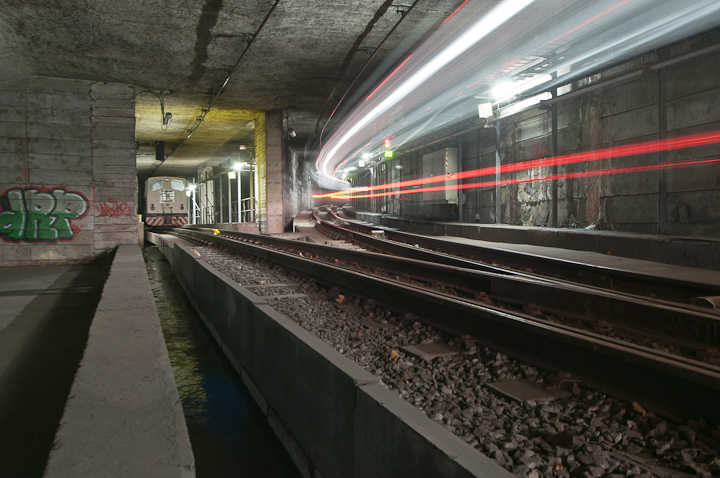
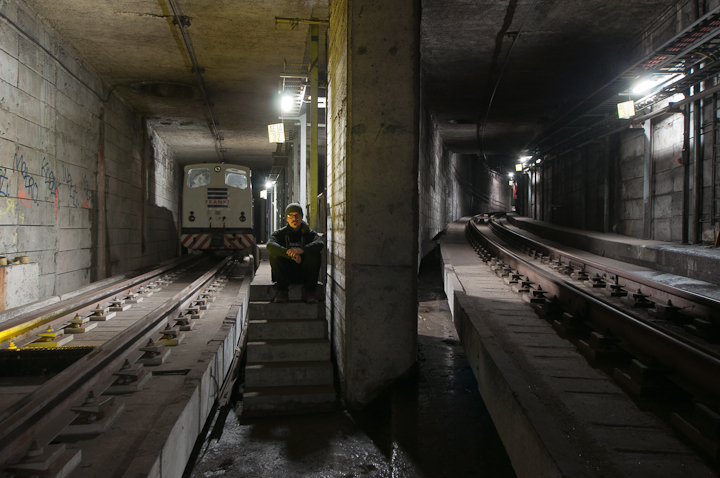
Pure

28 08 2010

The expanding subterranean metropolitan world consumes a growing portion of urban capital to be engineered and sunk deep into the earth. It links city dwellers into giant lattices and webs of flow which curiously are rarely studied and usually taken for granted. – Graham 2000

Vision

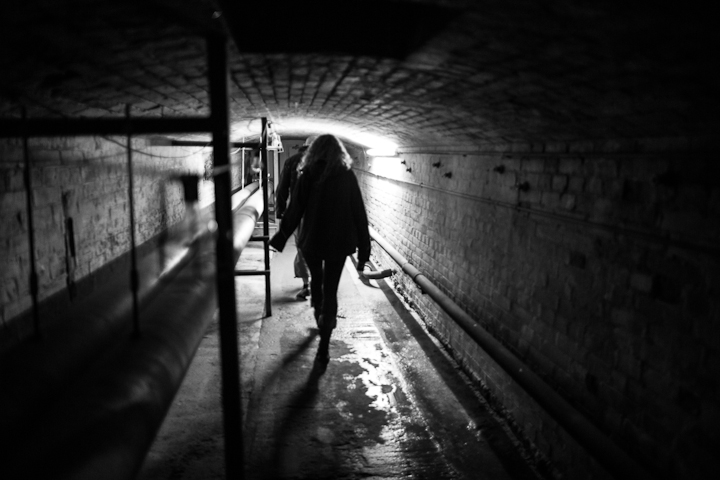
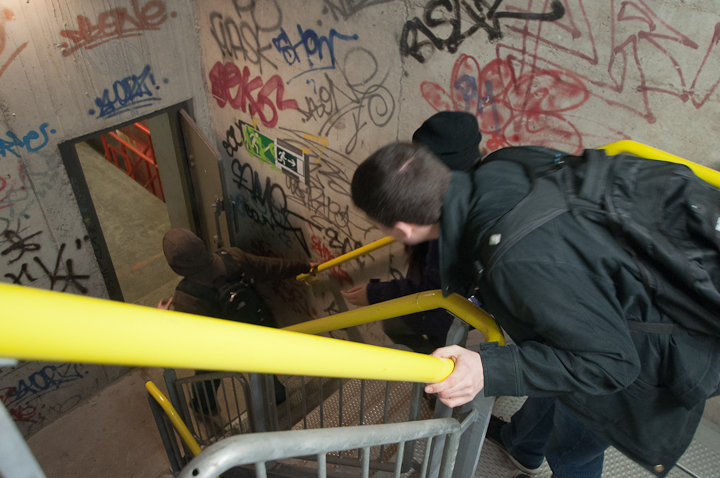
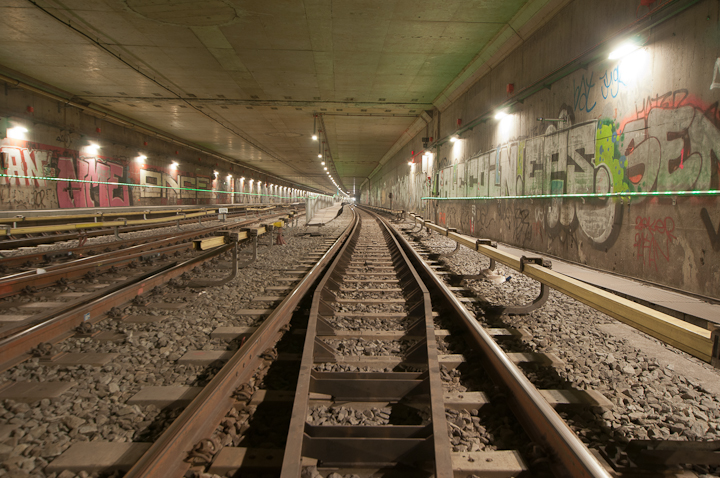
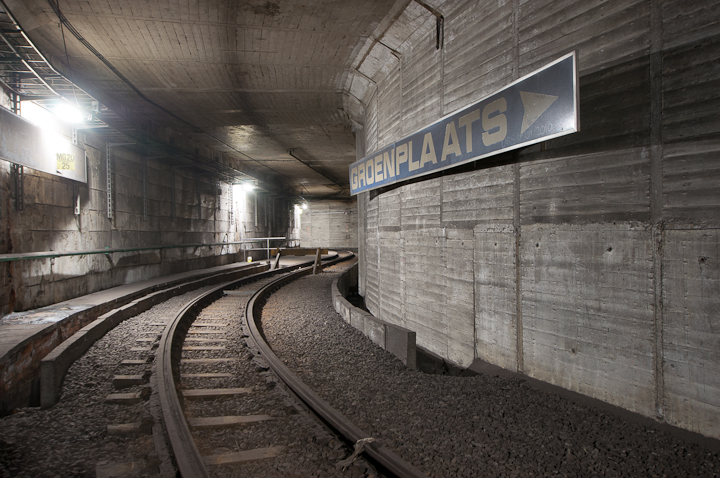
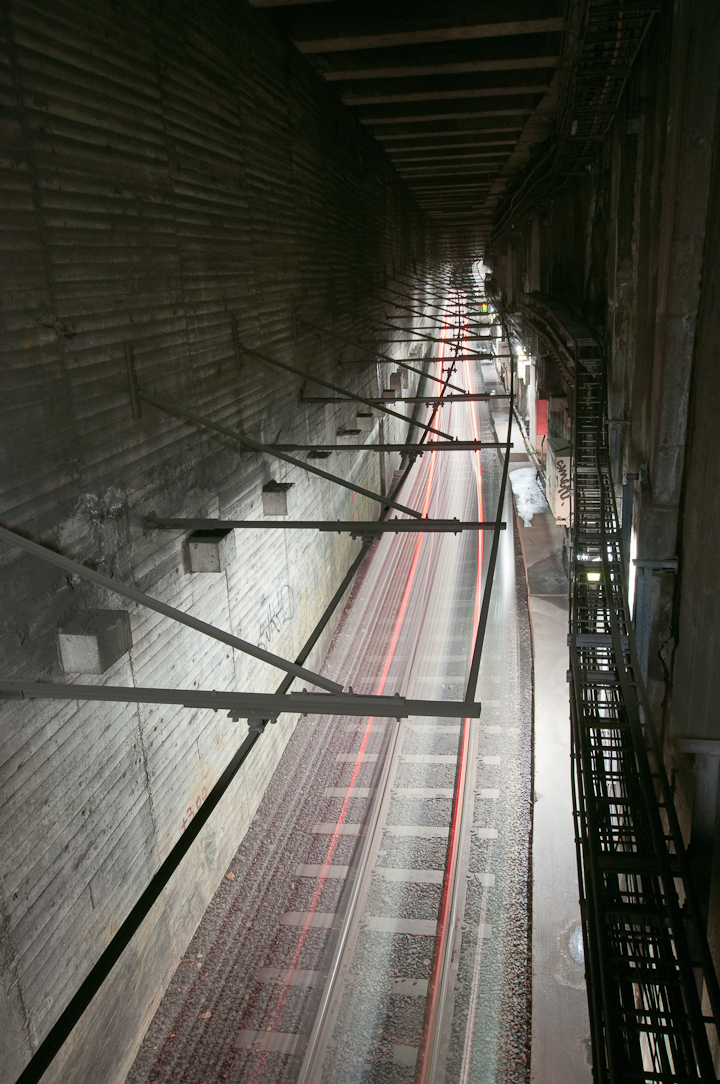
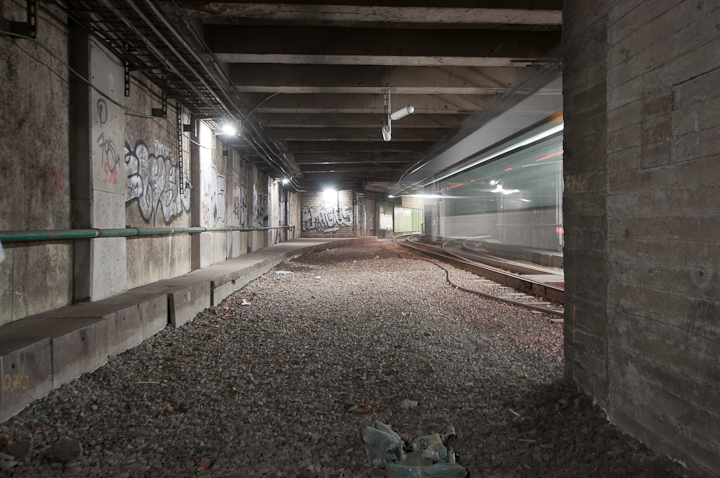
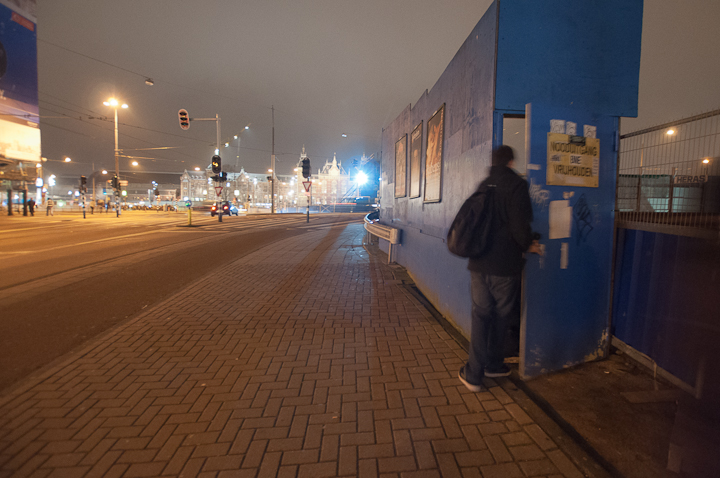
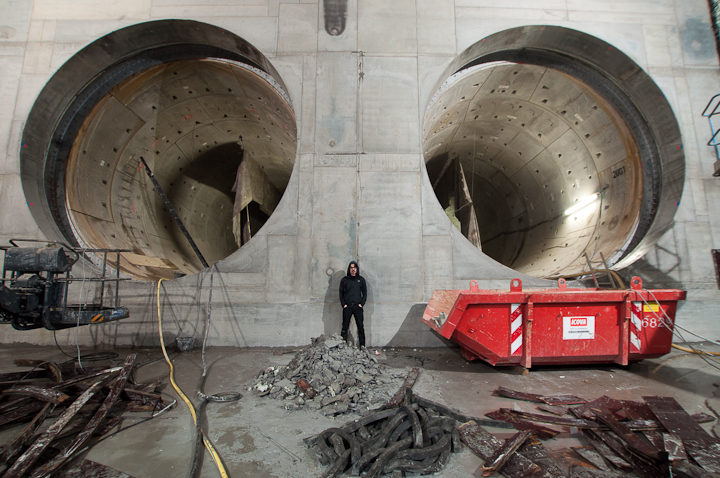
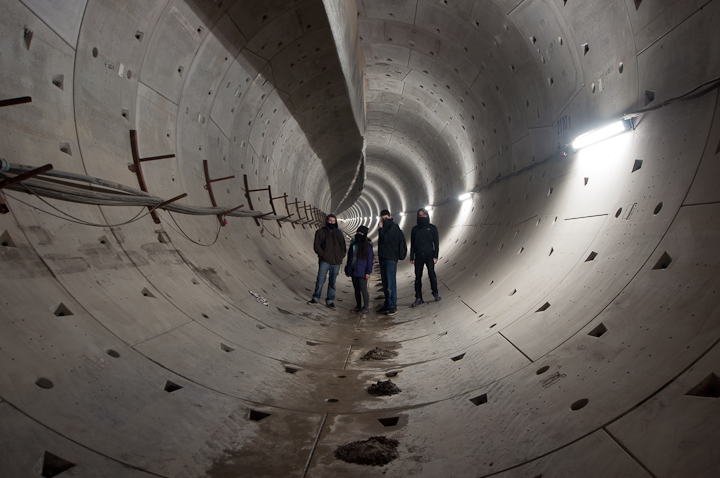
3am. Antwerp. Pissing down rain. Lovingly cared for yet hopelessly abandoned, the Antwerp metro never came to be. Halfway down the 30 meter drop into the network, my hands burning down the slick rope, stomach twisted in knots, fear welled up in my throat with my held breath, I already know that I am in love. It’s that feeling that you have known each other for ages, finishing each other’s sentences, laughing until we cry about the absurdity of it all. That’s the moment that I knew you and I were destined for this encounter.

Lemon

Drop

The love affair with places begins as a tumultuous panicked grab, pinned against the wall in a desperate attempt to hold on to something we both know is sacred. The problem with smooth, clean glass, polished metal and concrete that there is nothing to hold on to, fingernails scratching in a desperate attempt to make a mark.

Here I find chunks of concrete delicately separated by little tendrils of green vines which grab at my legs as I repel down the wall, terrified that the rope hanging over the edge above is fraying against the sharp concrete edge of the drop zone. But she wouldn’t let that happen to me, she is already too curious to let this pass.

When I my feet touch the ground again, wet and smiling, I look to either side and realise that we have entered a new world, a world all our own. That is how I begin this love affair, with a tacit acknowledgement that neither I, or this beautiful unfinished beauty, will ever tell anyone about this love affair.

False

Junction

And yet those pictures in the scrapbook of our memories are just too much. All those photos of us laughing and playing together, falling in love for the first time. It was all so new, so pure. Not only do I need to experience that again, I need to share it. I need to scream out loud to the world that someday, somewhere, I found something sacred. So listen up planet earth: she was modern and stoic, sleek and brutal but knew sadness and tribulation just like us. I love her dearly and fear, above all else, that this was a one night stand.

Waiting

For Love


Urban Verticality

14 08 2010

“To get back up to the shining world from there my guide and I went into that hidden tunnel, and following its path, we took no care to rest, but climbed: he first, then I – so far, through a round aperture I saw appear some of the beautiful things that Heaven bears, where we came forth, and once more saw the stars.” -Dante, Inferno, Canto XXXIV

Sloping

The blood bubble

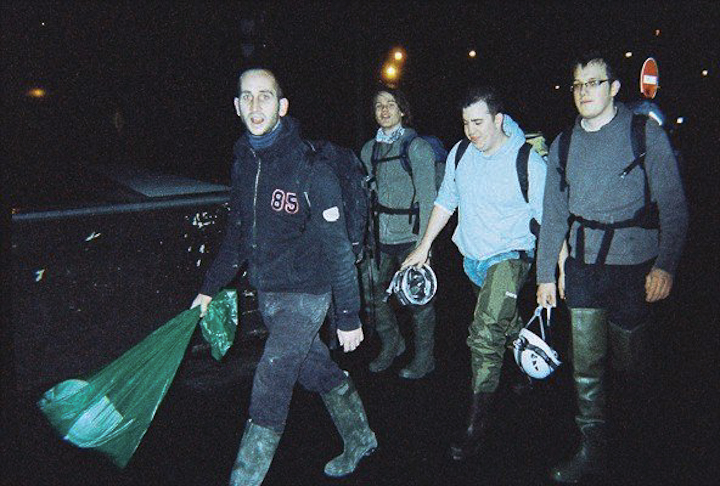
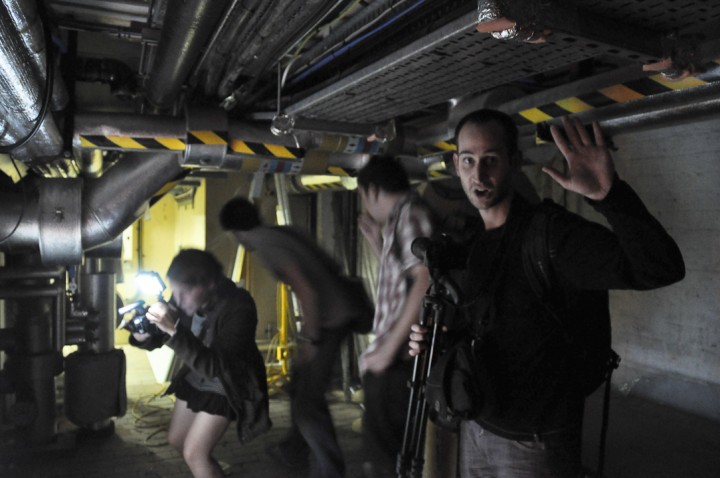
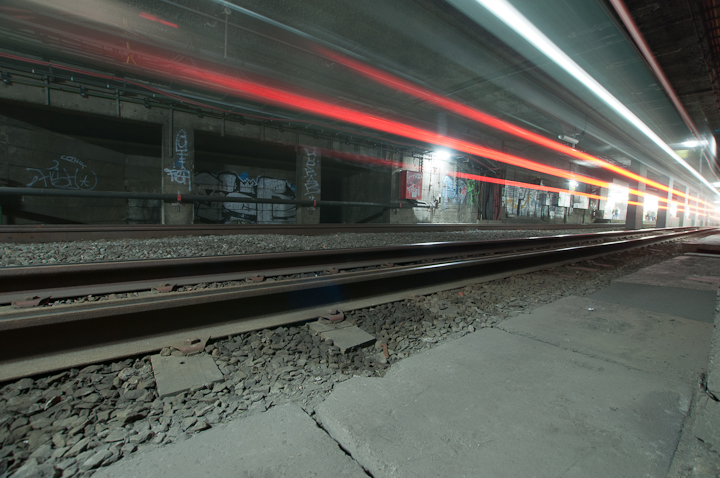
It was a night to remember, wandering around in a team of 5 dressed as construction workers. Even at 2am, the yellow vest and hard hat that signifies us part of an invisible working class, rendering accessible the cavernous depths and dizzying heights of the city never ceases to amaze. It was a drift tonight tinged with a particularity lovely glow, plans of sewers flooded by rain landed us underground where trains sped by as we ran down the tunnel laughing.

Our desires for a complete and situated urban verticality led us from low to high in search for adventure, insatiable in our lust to escape a capitalist suicide by instalment plan, spontaneously mapping sites of urban tenderness one after another.

Tender

That night, we once again forsook the pact the modernism asked us to make, seeing it as yet another impotent utopia, and found our own phantasms, cultivated during chemical visions in the sands of the Black Rock Desert, the swirling concrete flow  and smooth-waxed rails of skateboard parks, in the melted organic mental materialities of peyote festivals.

We weren’t really resisting anything because the resistance would eventually “turn to irony, irony to realism, realism to pragmatism, and pragmatism to solace in spectacular visions, consumerist monsters, development triumphs, and nostalgic dreams.” Perhaps, Vidler tells us, in his article Air War and Architecture, “such anxieties, brought once again to the surface, will stimulate new resistances, desperately needed right now – resistances that will not take the critical understanding of the past as mere pessimism or wrongful authority, but as salutary instruments against a globalising development frenzy that insists on burying history” (Viddler 2010 :39). All true, yet that as we rise and rise again to meet this city in all of its grandeur, in all of our might, these histories can’t be buried because we are building them one exploration at a time, a history of hidden dreams, of decay and of class and capital in all of its tropes and treats. And that is a geography of love.

Tropes

Treats

With love, ever-renewable


Meeting the East

11 08 2010

You give a man his daily bread so that he can be creative and he just goes to sleep; victorious a conqueror grows soft, a magnanimous man turns miser as he gains in wealth.    -Antoine de Saint-Exupéry

Are we at the top of the ladder or at the bottom of a new ladder?    -Silent Motion

Saddle up for

On our recent ProHobo trip into Europe, lovingly (if in the end somewhat flippantly) referred to as 3.0: ProhoBohemia, we pulled back from the infrastructural infiltrations that have become our daily grind here in London and went looking for ruins again. Coming back to ruins was like returning to a pleasant dream.

Magical realism

In our hired car, which we intended to push 3300 miles into Poland, our most ambitious trip to date, we cut through the corner of France as we have twice before and headed into Belgium. After a brief climb up a notable public building in a major capital city, we crept into an old train yard to spend the night. As you do.

Industrial nights

We woke up early full of enthusiasm and over the next week, we moved through Europe like a storm with an efficiency built over the course of three trips to the continent over the past year. We knew the sites we wanted to hit, we knew how to avoid security where necessary, we knew what to pack and, more importantly, what not to. We had, in fact, taken being temporary nomadic vagabonds to a whole new level. During the trip, we read passages from Tim Cresswell’s book The Tramp in America where he discusses the work of homeless-turned-Chicago-School-sociologist Ben Anderson. As we came to the realization that we could all likely keep this nomadic lifestyle going for a very long time (if not forever) I couldn’t help but think that we were working the other way around – there was a real possibility, is a real possibility that we could in fact drop it all and live like this indefinitely.

Probo

Looking for

Pure living

But the further East we went, the heavier our bourgeois baggage became. As we crossed the border into Poland, the car was filled with excited cheers quickly followed by confused murmurs. While the landscape here offered what we have come to expect from Europe – endless ruins – we found ourselves confronted with a place in which the relationship to derelict space was entirely different.

Secular

Imaginaries

Remembered

Here ruins were spaces not of bounded exclusion but of potential utilization. After driving for hours through a forest hunting for a soviet base called Keszwca Lesla, we arrived at 10pm to find rows of buildings, clearly Soviet-built, surrounding an undecipherable war memorial that looked like our standard fare with the addition of satellite dishes hanging off the sides of buildings. It seemed the local population here had turned this place into a summer holiday encampment after the collapse of the USSR and the abandonment of the base. Gangs of teenagers roamed the streets late at night in track suits and mullets, running in and out of the derelict buildings and bunkers. Inhabited buildings looked derelict, folding them right into the fabric of a lived landscape. There were no fences or security to be found, no rules, boundaries or exclusionary practices in evidence. It should have been paradise for us. Except that things felt different here.

Clearly

Something else

To be found

As we moved on from this site, we became more brazen, braving the sullen stares of thick-necked Polish men who could clearly throw us across a room to run in Soviet concrete blocks, shutters snapping. But what we captured in these places looked less like the western notions of the aesthetic sublime than we were accustomed to encountering and more like the war-ravaged Chechnyan ruins depicted in The 3 Rooms of Melancholia.

USSR

Afloat

No more

Site after site, I kept feeling that something was different here, something was missing here, but I couldn’t pinpoint it. It was something missing beyond a buoyant economy and door frames.

And then it hit me. It was nostalgia. As David Lowenthal writes, ‘nostalgia is memory with the pain removed.’ There wasn’t a hint of nostalgia to be found here. No one cared about stripping soviet blocks of all they were worth because they were still in pain here. It was probably, rather, a delicious catharsis to smash out those windows and excavate the rusting hunks of artillery from the ground.In the same way that we, in London, feel a need to write our own stories of places and to define our own boundaries for space, the Polish people who lived under communist control probably felt a need to assert their rights to newly reclaimed space by destroying the remnants of control that the Soviet Union has exerted over them for so many years. Like Scipio Africanis at the end of the 3rd Punic war, the only thing that would satisfy the pain of generations of struggle is to do everything possible to erase the memory of that pain, razing the buildings and sewing the Earth with salt.

The heritage manager in me is terrified by these ideas but the anthropologist and geographer in me tells me I have no right to dictate how others should interpret and interact with their places. We can’t know their memories; we can’t know their pain.

Pain

Lived

There a was a particular guilt that came with exploring Poland.  I think that guilt came from the clashing of different value systems in regards to derelict space. Perhaps it is an indication of a larger clash between capitalism and communism. Where east meets west, desire meets utility, nostalgia meets future promise and mobility meets placemaking. We all knew we brought the West with us and we all knew, deep down, that the social conditioning that resides in those templates can never be erased.

While we didn’t necessary find the ruins we were looking for in Poland, we did find a meeting point on that shifting frontier of Western values that is pushing its way inexorably East, met not with open arms but with suspicious stares. After what Poland has been through over the last 100 years, who can blame them?

Easterly


Playing with Power

11 07 2010

Your pain is the breaking of the shell that encloses your understanding.

-Kahlil Gibran

We are not depressed; we’re on strike. For those who refuse to manage themselves, “depression” is not a state but a passage, a bowing out, a sidestep towards a political disaffiliation. From then on medication and the police are the only possible forms of conciliation. This is why the present society doesn’t hesitate to impose Ritalin on its over-active children, or to strap people into life-long dependence on pharmaceuticals, and why it claims to be able to detect “behavioural disorders” at age three. Because everywhere the hypothesis of the self is beginning to crack.

- The Invisible Committee

GMT

Prison

Exploration is the only medication my body subscribes to. My trembling fingertips reach for the sewer keys on my way out the door and my bowels twist in satisfaction. This addiction began as research, then I went native, then I lost my way. My love for ruins, my love for old stuff, slipped quietly into the present without even a little wink to let me know what was happening. A life spent looking for material traces of the past morphed into a series of events connected only by my churning belly that vaguely resembles art or a job in construction.

Please don’t expect me to say I found my way again because I didn’t. I was at Tate Britain the other day listening to Joseph Heathcott talk about digging through a photo archive. He said that as he dug, he became more and more confused, buried in images that he didn’t know how to contextualize. When he reached the bottom of the box of images, all he could see was himself.

We explore not to find places but to find meaning. Place hacking is only partly about architecture, history, dereliction or photography. It is about reminding ourselves what in life is worth experiencing. Our explorations embody a consistency between action and thought where what we dream becomes real. The addiction that comes along with that is the point at which your synapses start firing in new directions, making connections you didn’t know existed or that you lost somewhere along the way. It’s the point at which you realize you never want to work again, the instant at which you understand you never want to own a home, the moment when the revelation occurs that the terrorist threat is as non-existent now as it was in 1972 and 1023 and that most of the world, despite what the media would have you believe, is full of love and attachment, not hate and fear.

Thinking of you

I have lost my way. I hardly know the (a?) government exists. I have forgotten about commitments. I have widened my focus to the point that I can barely see anything not in front of me and yet eschew almost nothing, an optic of total stimulation. I spend all day with my friends. I am in love with every moment. I know my neighbourhood, my city, inside out. I just described childhood.

We have built up a shell around ourselves to defend our bodies and minds from the barrage of victimisations they are subjected to. We are left staring stupidly at what it is we are being asked to do, wondering again and again “is this it?” Joshua Ferris, in his novel And Then We Came to the End sums it up in this tidy moment seen through the eyes of Carl, a copywriter for an ad agency: “Directly to his right, something curious was going on. Two men in tan uniforms were hosing down the alleyway – a small dead-end loading dock between our building and the one next to it. Carl watched them at their work. White water shot from their hoses. They moved the spray around the asphalt. The pressure looked mighty, for the men gripped their slender black guns, the kind seen at a manual car wash, with both hands. They lifted the guns up and sprayed the dumpster and the brick walls as well. They spot cleaned, they moved refuse around with the stream. For all inert purposes, they were cleaning an alleyway. An alleyway! Cleaning it! Carl was mesmerized….good god, was work so meaningless? Was life so meaningless?”

We have become desensitized to the everyday. We have become part of the spectacle, ignoring emotional engagement with the world because we are so alienated by it. We formulate emotional shells that lock out beauty as well as pain and stop us from taking action. We are left in a state of perpetual isolation, mouths open, ready to pour in pills to fix what we lost. We are left inert, flaccid, empty. As Raoul Vaneigem once said, “people who talk about revolution and class struggle without referring explicitly to everyday life, without understanding what is subversive about love and what is positive in the refusal of constraints, such people have a corpse in their mouth.” Raoul’s thesis is outlined succinctly in the following diagram.

I suggest a different sort of medication to cure that corpse-filled mouth. Explore everything, shatter the shell and live free.

Dreamers

get vertical

playfully

Move beyond your conceptions of exploration. Explore your mind, explore the dance floor, explore your broken family that your are ignoring while you read this drivel. Move into abandoned buildings, take locks off of doors, turn CCTV camera so they only see each other, light off fireworks randomly. Scream at people in the streets, talk to strangers, photograph police. Stop paying the state until they give something back other than the promise of a good pension if you join the military and avoid dying through war X. Take what’s in front of you and pour your heart into it. And if you have to quit your job to make that happen, then go. But do it in style – run out screaming into the sky to invoke your freedom. Even better, abseil out of your window and rappel to freedom.

Play is power. Freedom is power.

Photo by Marc Explo

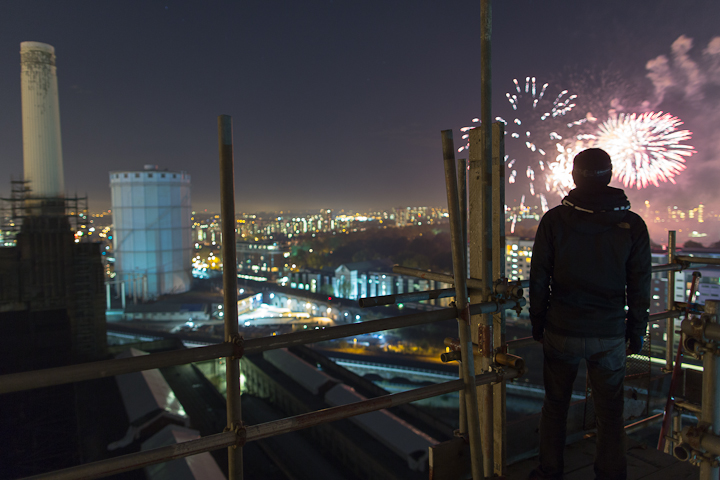
We don't need 4th of July or 5th of November as an excuse to explode things in celebration (Marc Explo).

Our work ethic

__________


The Marriage

23 06 2010

by Charles Simic

If I had an ounce of good sense
I’d stay put in the country
Rising early to hear the birds
And see the sun come up,
Taking long walks after lunch,
Stopping only to talk to a crow,
Or a dog who happens by.

The trouble is, I like to raise hell
As much as I like sitting quietly
Like a monk in his cell.
A car careening with a screech,
Carrying a party of revellers
To another late-night dive in the city,
Sends me into ecstasies.

To marry wisdom to foolishness
Has been my lifelong desire
Since I take pleasure in both their company
And attend their council.
A blessing from my parents
Who alternated bickering
And swearing love for each other.

These thoughts and others came to me
While I slept in my bed,
And, for all I know, may have been whispered
Into my ear by the black cat
Who keeps a nightly vigil by my side,
So mice don’t nibble my toes
Or take shortcuts over my pillow.

___________


Cavendish Crematorium

16 06 2010

The Silken Hotel wasn’t open yet. We were standing there at the hoarding, Silent Motion and I, with that jelly of a man in his yellow vest pointing his finger accusingly, shaking with rage in a kind of mild convulsion, the orbed camera behind him spinning around and zooming in on our faces, like an eyeball rolling back in a head, making the convulsion a complete yet disembodied visceral experience for this lamentably flabby being.

The sergeant arrived, blue lights painting the walls, tires screeching. He almost rolled out of his car “UrbEx huh? Yeah, we get your kind around here sometimes. Tell you what, see that boarded up building across the street there? Let’s see if you can get into that one!” We meekly accepted the challenge as they frantically tried to fix the zip ties on the Heras fencing we had snapped off in our aborted miniature vertical scramble.

Challenge Issued

Across the street, we found that this building, Cavendish House it was called, was boarded up exceptionally well, stone gargoyles on patrol in moody up-lighting, three stone Furies screaming insults at us as we hung from ledges over the road, tugging on widows.

Stoney stares

Furies

With a pop, a seal on one gave and Silent Motion swung it parallel to the floor. We dove through headfirst and when the window closed with a sharp bang, we were surrounded by silence. I crawled to the dirty pane on the other side of the room and peeked across the road. The sergeant was there, his belly still threatening to rip his utility vest in two. He was smiling, staring at the building and smiling. Creepy fuck.

Popped

Marauder

The exploration proceeded as we opened doors and windows for the next team of rogue adventurers, torches moving around like little bugs on walls looking for a hole to hide in. Silent motion found a generator running and hooked up to a small TV. He powered it up and we spent an hour watching an old Bollywood classic, a brief respite from the endless stairs. Room after room of blue and orange light comforted us behind the boarded up first floor. Unlikely to see, impossible to catch, invincibility ensued. Down or up? Up.

Dance music invoked

Creepy

The top of the first building (indeed we now realized there were three of these concrete monoliths, these plywooded Thatcherite government lumps of cement) had a roof that sat level with some office blocks. I peeked in the clean windows across, imaging the illicit affairs in office chairs that took place during our work hours, suits humping secretaries and capitalism. A blue church to our left looked like a plastic Disneyland air-filled jump house, replete with nostalgia for the abbey it was until Henry VIII seized it and ravaged it like a conquered Irish queen in the 16th Century.

Little things

Pink

The millennium eye approached us on the other side, that little monument we all love and love to say we hate. “Ride on that thing? Never!” Its millennium glow bounced off of the Thames, offering no apologies for its slow creep our direction. We did handstands, climbed radio antennae, pulled ourselves around in monkeyed feats of post-adolescent strength. We lost track of time. We didn’t care. Damn the horror of the night buses, we’ll ride ‘em!

The Furies descent

Eye

The lustful runs across the roof deteriorated eventually into a pink sky, and we knew that the time for morning coffee and a long walk to Elephant and Castle would soon be upon us. Time to go down. And down. And down. The building suddenly became distinctly subterranean.

Nuances of texture

It was wet here. It stunk like old dog, soaked in a summer-time sprinkler and shaking all over the children who uniquely appreciated the horrible musky shower, full of love. The empty corridors offered room for thought and made my stomach tense up, knot and twist, crying foul at the late (early?) hour. One turn revealed a large room with a safe, a thick door with twisty dials and an unsettling echo. We spun the lock, robbing the history from the place.

Sort of safe

The watery passage continued until we could stand it no longer, blistering feet soaking in the liquid filth. We went for the ProEx shot to cap off the night, twisted and intoxicated, drunk on our own success at pissing on every wall in this building. Lighting was essential, we decided, draining camera batteries and making film strips roll back on themselves in our multiple attempts to get it right.

Pr0 Shadows

Suddenly, the sharp slap of metal on tarmac stopped us cold. Voices. A quick retreat. How could it be, this UrbEx fortress infiltrated? The retreat continued into a side room where we sat, a gentle humming behind us. Suddenly, Silent Motion sprung up, hitting the hum with his torch and there is was – a meat grinder, working with no electricity to speak of, begging for fodder. I screamed a little, quickly covering my mouth to stifle the alarm, pride on the floor. The voices were closer now, finally clear enough to make out the distinct sound of someone saying “they’re over here.” I knew that voice.

Ground

We fled down the hallway once more, trying to keep the drips and splashes from reverberating, a considering how long the water ripples that announced our direction of departure would continue their hideous radial momentum. The smells of the place began to change as we moved. It smelled… like burning. When we found out why, it was already too late. The swollen bellied sergeant and the jelly-man sidekick were on either side of us, laughing as we both stared in horror at the door to what looked to be a huge furnace.

Burned

“Welcome to Cavendish Crematorium!” The sergeant yelled, spit streaming from his plump pink lips. “The last stop for nosy UrbExers!” Next to me, Silent Motion sighed, staring into the murky water.


Lurking in the Shadows

13 06 2010

My friend and colleague Alan Rapp who runs the excellent blog Critical Terrain has just finished his MFA in Design Criticism at School of Visual Arts in New York City. Alan wrote a wonderful thesis about urban exploration called The Esoteric City which I really hope he publishes soon. In the meantime, he recently gave a short presentation on his work (in which I make a few cameos!) that is really worth watching.

I am always amazed by how much overlap there is between Alan’s work and my own. Sometimes I feel like we are psychically quoting each other across the Atlantic Ocean. Telepathic communications aside, congratulations to Alan on completing the MFA program – I look forward to seeing what comes next!

While I am at it, I would also like to mention another friend, Shreen Ayob, recently put up 4-minute video on her blog Shreen Distracted shot entirely in the soon-to-be-demolished West Park Asylum that I really love. Between the Alan and Shreen, I have your evening viewing sorted for you!


London’s Olympic Waterscape Exhibit

7 06 2010

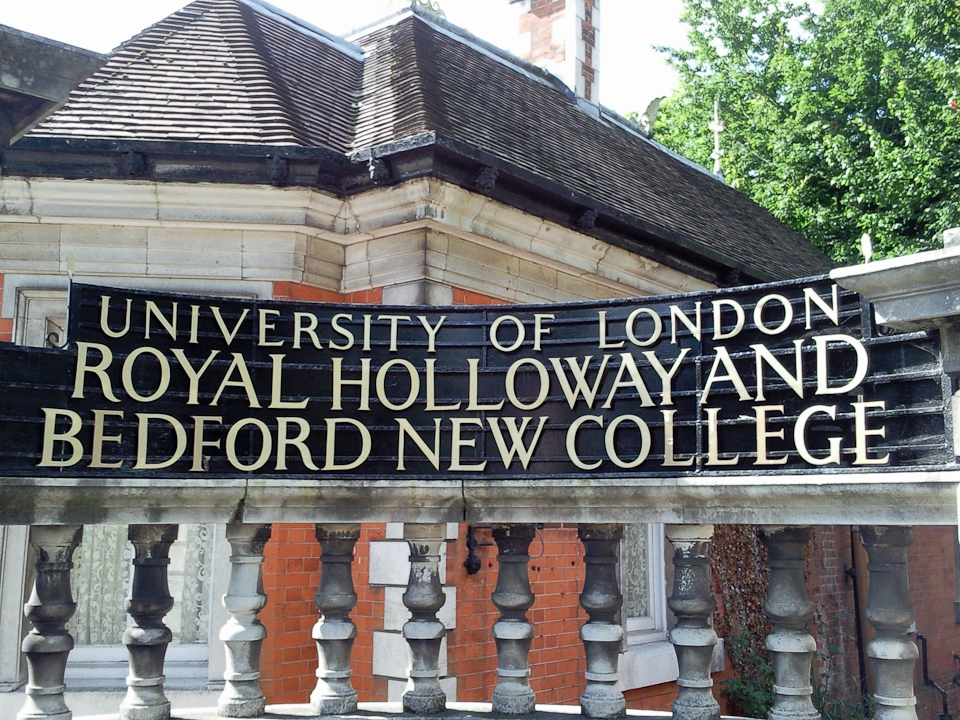
Last night we put on an exhibit at Royal Holloway, University of London as part of the Creative Campus Initiative linked to the London 2012 Olympics. The exhibit, run by Alison Hess, Ellie Miles, terri moreau, Michael Anton, Amy Cutler and myself was a huge success with far more visitors than we ever could have anticipated! Thank you so much to everyone who came out and to the rest of the team for putting on an amazing show!

The exhibit was broken into 3 parts. In the first, we displayed 10 photographs from Mike Seaborne, a photographer at the Museum of London, depicting the Olympic Waterscapes prior to construction of the stadium site. Opposite these, we displayed a number of photographs from our own journeys (undertaken as a geographic triathlon) up, down and around these waterscapes documenting the changes taking place there.

Finally, we made a 20 minute film about the past, present and future of these olympic waterscapes which I am proud to present for the first time here!

Here are some pictures from the exhibit. All photographs are by Danny Pack.


_________________________

Please also visit the project website


Blackwater London

30 05 2010

Sewers are perhaps the most enigmatic of urban infrastructures. Most citizens of modern cities are aware of their existence, yet few could accurately describe their layout or appearance.
–Matthew Gandy

Getting it right

Above me, the heavy round metal doors into this underworld shake with a pinging metallic scream that reverbs down these watery tunnels, slowly fading into a seemingly endless succession of dull thuds that migrate down the street above us, some racing black cab speeding a jilted lover home from the pub after the last trains have stopped running. This overworld scenario interests me far more interpreted from below the undercarraige of the cab, little bits of shit-sticky mud dislodging themselves  from the freshly-pried manhole cover edges, plopping onto my bald head. Cue a shuddering shake, aural spell broken.

Water races around my feet faster than the cab, pinning my waders in a strange plastic comfort to my legs, little bits of used toilet paper and raw sewage which we lovingly call “the fresh” blocked by my PVC barrier, pushing around me angrily in an effort to make it down this old river and into the Thames like salmon swimming not toward their spawning ground but the river Styx where the boat will sink halfway across and they will float lazily to the bottom, never to move again. As drainers, we learn to love the waste just as we learn to love the trash left behind in the streets of London at 4am on a Friday night. It is the detritus of passion passion for life that staves off our impending deaths, as Michael Dibdin writes in Cosi Fan Tutti:

This place reeks of mortality.
I thought it reeked of rancid oil and bad drains.
It comes to the same thing in the end.

At some point in London’s Victorian Age, the separation between “river” and “sewer” became blurred. Technically, I am standing in the River Westbourne which no one but sewer workers and daring drainers have seen for a hundred and fifty years. Despite the fact that no one has drank the water from this river since the 1400s, it remains a vital waterway of this city, a throbbing vein of live humanness, rushing underneath our unknowing feet as we run to work on the pavement above. Seeing it is a reminder that, as Gay Hawkins writes, “our rituals of cleansing and disposal are enfolded with this landscape, our personal secrets are implicated in the public secret of sanitation.” This misadventure into the bureau of public secrets is the newest in our chain of London infiltrations, our most recent attempts to make sure that this city is documented from every possible angle through experience, fear and love. Just as I wouldn’t wipe the ass of somebody else’s baby, only London’s sewers interest me.

We view the stigma of what is flushes on these journeys both literally and socially. Our preferred mode of access to these hidden waterways is hiding in plain sight and the classism of London society works in our favour, with both police and the public ignoring everyone dressed in high-vis and a hard hat, benign foreign workers who make their living in places where no “respectable” Londoner would ever step foot. Our team of 4 digs into their toolbelts of large screwdriver, t-shaped keys and crowbars to break the seals into underdiscovered territory, finding what the city forgot existed, our brazen crew seemingly as hidden as this river when we actually look like we work for a living.

Cracked

Pull this bird

The addiction to infiltration does not lay in the adrenaline rush of the experience. Infiltration creates unwieldy complications, difficult mental junctions and moments of crises that confuse, inspire and complicate our existence. My second identity as the underclass, the role that I play to gain access to urban secrets, is slowly becoming my primary identity. My clothing, my language, my social class, all now defined by my behaviour “on the job.” Leaving this tunnel late on this night (early the next morning?), we were greeted by “real” workers at a tube station who tossed slight nods our direction, eyeing us with confused interest, suspicion, respect and likely some revulsion given we were covered in underground wetness that smelled even worse than the rank pub toilet across the street.

We have been systematically exploring London’s subterranean features for the last few months, cracking every stormdrain, abandoned railway, cable tunnel and sewer we can find in the city – elements of this urban environment that Steven Smith, in his book Underground London, calls “London’s best kept secrets.” We know why. Not only are they some of the most beautiful and surreal places in the city, they are also the most foul.

Pour your heart out

The sewer is a place for alterier cartography, a place where no one may reside but where one can pass through, cameras capturing endless angles of the oldly new, remapping our mental conceptions of where the verticality of the city begins and ends. Our embodied experiences move like the stinking water, shifting from one chamber to the next, chalk marks on walls marking our way home, level after level of underground run-off continually sinking into what we imagine to be an endless succession of metal grates covered in dried up cakes of unknown substances, unidentifiable pieces of fabric and scraps of food. Matthew Gandy, in his article The Paris sewers and the rationalization of urban space contends that “by tracing the history of water in urban space, we can begin to develop a fuller understanding of changing relations between the body and urban form under the impetus of capitalist urbanization.” Pretty sure he wrote that line from the Paris sewers.

Alterier chamber

We trace these cultural lines and flows, finding here that nature and culture drift at the same rate in an interdependent foulness. London’s legendary sewer rats are in full effect tonight, running from us in a terrified scamper, climbing the round slippery walls of the tunnel in inexplicable ways and disappearing into holes we can’t even see into. I want to explore what they can see. At one point, some sort of nest is disturbed and they came at our lights, their little claws feet screeching all around us. Staying in the middle of the slimy sticky mud, shit and runoff where the rats won’t swim was clearly our best option.

We spent 4 hours sliding around these chambers, building up our immune system with aching stomachs upon exit and mouth sores to come. As we emerged I felt, as I often have, that tonight was another attempt to document my own disappearance in the course of making the city reappear in alternative iterations. As I sink deeper into my PhD, I sink deeper in this city, still so in love that there isn’t even room for another human being. I can only hope that either I or the thesis emerges at the end of this torrid love affair, unsure I will survive the potential breakup. Until then.

Own the night.
Cherish these secrets.
Wield this power.
Love this life.

Explored

Beneath your pub crawl

More playfully than righteously

________________________________________

This author’s endeavour should be to make the Past, the sense of all the dead Londons that have gone to the producing this child of all the ages, like a constant ground-bass beneath the higher notes of the Present.

-Ford Madox Ford, The Soul of London


In place/out of place

25 04 2010

Only in and through the struggle do the internalized limits become boundaries, barriers that have to be moved. And indeed, the system of classificatory schemes is constituted as an objectified, institutionalized system of classification only when it has ceased to function as a sense of limits so that the guardians of the established order must enunciate, systematize and codify the principles of production in that order, both real and represented, so as to defend them against heresy; in short, they must constitute doxa as orthodoxy.

-Pierre Bordieu, Outline of a theory of practice

Getting somewhere

One of the defining characteristic of my hometown was always the Air Force base. Military bases in general do a lot to change the character of a place.  They are places of both order and recklessness, classic (though maybe he would say too literal) depictions of Tim Cresswell‘s in place/out of place scenario where what is inside the barbed wire, tall lights and fences is in, is ordered, is surveilled, is financially injected. What is out is disordered, suspect, not be to let in. The boundaries of militarized space are, we are told, above all others, are not porous.

And yet, in both California and Hawai’i where I have lived, the in slips out in the form of drunken sailors and belligerent army thugs in Jeeps with pockets full of roofies, going out for some R&R, maybe a little tussle with the locals. They are like little political terror camps, making sure the locals know the government is that close. Then they escape to their little military islands where they are supposedly untouchable.

Trevor Paglen, a fellow geographer stateside, has been taking people on trips to photograph “secret” military installations for many years. His dissertation work photographing these locations was a huge inspiration to my PhD. Trevor was the first the start visually penetrating these spaces and looking at his photographs, I thought “what would happen if we escalated the virtual infiltration into a physical one?” If the in can go out, the boundary is porous, despite all claims to the contrary and that means the out can go in as well. So we did. And what we found was shocking.

Four stories of fun

These photos are from an abandoned hospital on March Joint Air Reserve Base, a location with no address somewhere between Riverside and Moreno Valley, California. It used to be a full Air Force Base for 78 years until 1996 when Clinton cut the operations budget and a quarter of the 6-square mile base went derelict almost overnight.

Where the fuck is that janitor?

How classified?

Not very

The empty corridors seemed endless, piles of desks and chairs the only things to be seen turn after turn. But as we moved into more discrete levels of the hospital, we began to find rooms full of artefacts, including some very expensive equipment.

I believe you have my stapler?

Bad news

Dangling

We were never modern

Pip is sure I have heart trouble

We were all enjoying the opportunity the play with expensive medical equipment. We were also enjoying the fact that everything was so well preserved in the building. Likely an effect, I assume, of being located on a military base. I mean, who would be stupid enough to go in there right? The lingering question in all of our minds though was this – why would the military leave all of this behind? We received part of the answer in the next room.

Somebody help me

The building was apparently being used for urban warfare training. The idea is to create places that emulate different urban environments to train for hostile situations in those environments. Some places, like this room above, clearly had staged scenes with fake blood. In other places, it was not as clear whether the scene was “staged”.

Is that normal?

Sometime after returning home, I was astounded to find an article in the local paper, the Press Enterprize (PE), which detailed plans to build an $80 million medical facility on the base called March LifeCare. I wonder if taxpayers are aware of what happened to the last medical investment on this base? I wonder if taxpayers know that while “Donald Ecker, managing partner of March Healthcare Development, is said to want ‘to move on a breakneck speed’ on the project” (by the way he stands to make 2.2 million on the deal according to PE) there is a derelict hospital across the street being used for wargames? I wonder if any of the patients of this “old” hospital know that their x-rays are laying around in there?

Clearly I was not the only thing out of place here.

Paint bullets

A goner for sure

March Air Reserve Base is a minimum security base in a rather decrepit state. Still, with an abandoned military prison now explored as well as a partially active base, it makes me wonder – how porous are these boundaries? And more importantly, what the fuck are they doing with our money in there? I call for the in to be outed!

Wash that cash

Outed


UrbEx in Kent

16 01 2009

August 1st. That was the day I began working on pulling together my ethnography. I took 6 1/2 months to pull together my fieldwork. By anthropology’s standards, I guess it is not bad but if this was simply a documentary I would have shot myself in the foot.

So, the good news is that this past weekend, two new friends took me to four mysterious abandoned places in Gillingham, Kent. Vanishing Days and Solar Powered we extremely generous, articulate and helpful, driving me back and forth from Napoleonic-era stone forts to World War II gun turrets to an equestrian center abandoned in 1986. It was a surreal day (as it usually is behind the camera) with this added affectation that desolate places tend to have.

I also find, the more that I explore, is that the more intact a place is, and the more recently is was abandoned, the more eerie it is. Perhaps it is easier to connect with the history of those places when you imagine the people who lived their still roaming the earth and reminiscing about the places that you are watching sink into the earth for some future archaeologist to uncover.

This weekend I will be headed to an abandoned asylum with my second group of informants. More to come.

Now back to editing these three hours of derelict beauty!


West Park and St. Ebba’s

19 01 2009

Yesterday I went for an explore with four from London. Our destination was the West Park Asylum, part of a ring of asylums around London which were at one time run by the NHS (National Health System I think). Apparently Margaret Thatcher decided these places were better off either

1. Shut down or

2. Privatized

As a result, many of the workers and patients walked away from these places leaving everything in perfect order, just as it was when the asylum was up and running. What happened next, some of the explores tell me, many of these places are not seen as worth preserving because either

1. They are two ‘new’ to be of historic value or

2. The land is simply needed for something else on this little island

Because of this, the explorers take it upon themselves to record this history, and the slow decay of these places with their cameras. Despite this, many are seen as criminals, ‘trespassing’ on this recently privatized land.

When we arrived at West Park, we quietly walked in over a broken fence, and walked around the bushes keeping an eye out for the single security guard that patrols the area. Not seeing him, we proceeded to slip into the service shaft under the building. Unfortunately, our man magically appears after only one of the four of us get in and we are escorted out.

On to plan B. We headed over the St. Ebba’s and strangely, given what had just taken place, parked in the parking lot and walked in. Although part of this hospital is still ‘live’ (meaning patients still roam the grounds) they did not seem to mind, nor did the nurses who probably had personal histories in the derelict buildings on the property and were quite aware that we were going in the archive them, in a sense.

Turns out, it was a good thing we arrived when we did because demolition has begun and half of this beautiful derelict hospital in now gone.

On to the next explore…


Guerrilla Geography ID Card Intervention

9 02 2009

In 2006, the UK Government introduced legislation that will establish a National Identity Register. By law, all citizens will be required to have National Identity cards which include biometric information. The cards have prompted fears of increased government surveillance and corporate control of personal data.

The guerrilla geography group of Britain organized a one-day intervention in Newcastle to raise awareness about the cards. I went up there at the end of January to see what all the fuss was about. Here is the link to the film:

Guerilla Geography ID Card Intervention in Newcastle from Bradley L. Garrett on Vimeo.


Overt Camouflage

13 03 2009

Yesterday, I was invited by Lutex and Hydra to explore some World War II air raid shelters near London. The experience of being in shelters invoked a lot of new feelings for me, being American and never knowing what it would feel like to have your city bombed. Although we have many cold war shelters throughout the United States, these shelters were a precautionary measure, likely never to be used.

The shelters we went to yesterday, on the other hand, were inhabited by people who had left simple, isolated artifacts in these generally empty shelters, small reminders of the hidden history of this spectacularized city. A can of something evaporated, stone benches lining the walls, a few pots and pans, now surrounded by newly forming stalactites and stalagmites of minerals dripping in from the rainy city above.

Most interesting for me was Lutex’s technique for entering the shelters though manholes in the middle of the street, which he called overt camouflage. The idea basically is that is you look like you belong there, people will assume you do. I have seen similar techniques used by street artists that a fellow student at Royal Holloway, Luke Dickens, has been studying.

Lutex mystified me with his calm, organized and rational approach to the concept. He pulled his car up to the curb, coned off the area, adorned himself with a high visibility vest and proceeded to tape of the cones to keep pedestrians out and give the site the look of a public project. He then produced two keys which we fit into the manhole, lifted it up and voila! 60 years of history is ours to experience.

I am interested in other ways overt camouflage could be used but also had another thought about this idea. Basically, this only works if you have the appearance of someone who ‘belongs’ there. This means that people with body jewelry, tattoos, even dreadlocks would become more suspect immediately.

Which leads me to suggest that the real revolutionaries may not be the kids with purple mohawks, but the people who look quite normal but work to resist the complacency of modernity in their thoughts, word and actions in very subtle ways.

Here is the video from the explore (a little present for LutEx and Hydra):


Rock-a-Hoola water Park, Mojave Desert, CA

1 05 2009

After two months of presenting, traveling and doing fieldwork in various loations, I have a 2-month long 3-in-1 report for the site. On March 26th, I presented a paper entitled Submerged Tribal Memory: the Case of the Winnemem Wintu at the 2009 American Association of Geographers conference. Despite some minor technical difficulties, the presentation went well. Check that off the list!

On the way back from Vegas, I stopped at the abandoned Rock-a Hoola Water park in the Mojave Desert smack dab in between Las Vegas and Los Angeles for a little bit of UE with sYnOnYx, a Las Vegas explorer. The park closed down in 2004 and is an eerie explore despite the recent removal of the slides form the park in recent years. Before the removal of the slides, the park was on an episode of MTV’s Rob and Big where they skate it:

With slightly less daring, I returned with my own photos:

So, with that little post, we are nowhere near up to date! I will play more catch up soon!


My PhD Research Proposal Defense

16 05 2009

I am a proponent of the idea that everything we do as academics should be public. Therefore, this post is both the text and video from my PhD research proposal defense on urban exploration. As with all research, it is a work in progress and I hope to refine it over the next 2 years!

I hope you enjoy it, please feel free to email me or comment on the blog with any comments, questions or hate letters.

__________________________________________________________________________

Heritage Infiltration: Quests to Find Myth, Mystery and Meaning through Urban Exploration

Bradley L. Garrett

Introduction to Topic
The term urban exploration conjures up a multifaceted set of interlaced images and ideas. I expect that each person reading this will have a slightly different idea of what exactly those words mean. Perhaps they even makes you cringe But for one group, individuals who call themselves urban explorers, UrbExers or simply UErs, the phrase is unabashedly precise. Urban exploration is an “interior tourism that allows the curious-minded to discover a world of behind-the-scenes sights” (Ninjalicious 2005).  In my own words, I might describe the urban exploration “scene” as a transnational enthusiasm focused on exploring and recording liminal zones and derelict places, rooted in an interest for the past and a passion for the photography of the forgotten.

I will spend the next three years getting to know urban explorers, embedding myself in their practice and hopefully becoming an UrbExer myself. Although I must admit that despite the seductiveness of my participant’s definition of their practice, I have misgivings about calling myself, or them, urban explorers. My reasons for this are rooted in the academic geographical imagination.

Firstly, what is “urban”? Can we still use the term when an exploration of built structures or human remnants takes place in a rural environment? Do we need to bound and separate the urban and the rural? Secondly, what narratives does the term “exploration” conjure up? We are all aware of the cultural baggage the terms carries: visions of colonial expeditions, invasions, subjugated populations, disease and occupation (Johnston 2000). It is language of conquest.

Because of these misgivings, I suggested a new term for what it is I have come to do every weekend. I began to call it heritage infiltration. It seemed to me that this term encapsulated the rogue adventure into humanity’s largely forgotten past that we were undertaking, while avoiding the negative associations I saw with the term urban exploration. When I suggested the new nomenclature to the urban explorers who I was working with, they hated it. In fact, they reprimanded me for suggesting that I knew better than them what it was they were doing. Consider it a lesson learned in doing ethnography: project participants are always the experts, and the researcher never has a right to make expert claims about the regulation, bounding or designation of identity markers.

In the end, I decided to use both terms (hence the title), one to describe my participant’s vision of what it is they do and one to describe my personal characterization of the experience.

Methods
So, the cat is out of the bag. I said I was doing ethnography, a term thrown around rather loosely in geography circles. Coming from anthropology, I realize the boldness of this claim. I know that building an ethnography is a deep process; maybe too deep for me to realize in three years. Ethnography, by a traditional definition, will include observation of people’s daily lives for an extended period of time (Hammersley and Atkinson 1995). Visual ethnographer Sarah Pink defines ethnography as “an approach to experiencing, interpreting and representing culture” (Pink 2007: 18). It is Pink’s definition, with the acknowledgment of personal experience in fieldwork that I find most appealing.

The experience of the researcher is often missing from ethnographic accounts, and I believe that the narration of my visceral, bodily experience as a heritage infiltrator is an important story to tell. I have realized early on that these explorations are about inscribing corporeal existence into place while absorbing enough memories, experiences, lead paint, asbestos and scars to take also the places with you.

Finding Hidden Community
It took me 8 months (beginning before I started the PhD!) to get an urban explorer to invite me on an explore here in London. The reason for this is that the urban exploration community is full of sneaks, shades, specters and rats. In fact, after offering my services as a “videographer” on an UrbEx forum board called 28 Days Later  shortly after arriving in London, I was accused of being a federal agent infiltrating the network to collect evidence for prosecution. The realization of the difficulty of gaining access to project participants has led me to use a variation of snowball sampling or respondent-driven sampling (Salganik and Heckathorn 2004). Basically, by meeting one person and building trust, I can ask them to introduce me to someone else. Using the mythological law of 7 degrees of separation, this should lead me to everyone eventually (though maybe not within 3 years)! The technique has worked well so far; after my first explore on Jan 15th 2009, the two Kent explorers I went out with called friends in London to give me the “green light”, leading to the 16 person (and ever-growing) research group I now have! This process was greatly assisted by virtual social networking sites such as facebook and internet forum boards.

Virtual Networks ←→ Physical Encounter
Online networks are quickly becoming very important for cultural research. In my case, I have chosen a community who has had their own web-based networks long before facebook, myspace or even friendster. A quick search of “Urban Exploration UK” in google brings up dozens of sites, all associated with different cliques, some quite hostile to each other. On the forums, identities are fiercely guarded. The reason for this is that law enforcement and private security firms patrol the web spaces looking for information about member identities and access points into sites. As a result, the biggest “noob” (newcomer) offences in the forums include:

1.    Not blurring out faces in a pictoral forum posting
2.    Using someone’s real name
3.    Revealing how you gained access to a site (especially when this leads to the access point then being sealed!)

Aliases and costumes have become increasingly important in recent years, I am told, with the proliferation of CCTV and the general air of suspicion regarding urban explorer’s motives, to the point that even on an explore, people will not reveal their real names. Interestingly, off of the forum boards, I have built a group of friends on facebook who, of course, have revealed to me their real names. All of our profiles are set to only be viewable by “friends”, and we frequently post pictures of explores with our faces shown, with the assumption that these posts are “internal”. In some cases, explorers will ask me not to “tag” them to keep visibility to a minimum.

As you may have guessed, being an urban explorer, at least a part of this community, requires some degree of technical prowess, a fair dose of paranoia and, I might add, a nice still camera and some skill with it if you want to build recognition on forum boards. I knew at the beginning of this project that I did not have the technical skills with a still camera to gain access to this group. I did however have videographic experience, which prompted me to begin using video to build my ethnographic stories. Ironically, I have found that video does some really fantastic things in the field and my role as a videographer is seen as anomalous but increasingly desired as I produce youtube videos that can be embedded into forum postings, one of my gifts that I give back to participants.

From Virtual Geographies to Visual Geographies

Again, claiming to be making an ethnographic film is a bold claim, but as Sarah Pink points out, “a video is ‘ethnographic’ when its viewer(s) judge that it represents information of ethnographic interest” (Pink 2007: 79). Ethnographic interviews are perhaps the most useful area for video collection and production. The reason for this is that video allows project participants to speak for themselves. Photographs, as Hastrup (1992: 10) argues, are a thin description, capturing form but not meaning. Hastrup goes on to argue that in order for the photograph to become a piece of ethnographic thick description, it must be contextualized by text, an argument also made recently by Gillian Rose (2001). Video, on the other hand, is capable of capturing experience (both yours and your participants), and does so in a way that I believe is respectful and accurate in terms of ethnographic storytelling. I hope to use both “in the field” interviews and more focused formal interviews once a sufficient level of trust has been built to request these.

By the end of my research, I expect to not only have written a thesis, but to have also produced a feature length ethnographic film, a film that my participants have expressed much more interest in than the written component.

Some Parameters
In an effort to increase participant control over the project, my parameters have been defined largely by my research groups. Basically, to be part of this project participants are expected to:

1.    Define themselves as an urban explorer and consider urban exploration an important part of their life.
2.    Actively post on an online community of like-minded individuals or at least have an avatar on the forums.
3.    Following this, participants must subscribe to the urban explorer community code of ethics.
4.    Agree to be filmed, and agree to have me use that film for my research (on whatever terms they choose i.e. face-blurring, anonymity, audio-only etc.).
5.    Agree to having their alias used to describe their practice in the film and in any writing.

Finally, in terms of location, I am following participant leads, where they take me is where I study. At the present time, it looks as if this study may involve 5 countries and dozens (if not hundreds) of locations.

Other Aspects of the Study

There are a wide range of themes connected to the topic of urban exploration that I have not touched on here including, but not limited to, ghosts and hauntings, gender roles, urban adventure (extreme sports in derelict places), policing and authority resistance, childhood play, homelessness and squatting, emotional adventure, adrenaline addiction, political and cultural nostalgia, localized mapping, dystopian fantasy, alternative archaeologies, building hacking and heritage hijacking. All of this can and should be unpacked through experience and interviews.

Why is This Worth Researching?
Urban exploration is an international movement, a shared global culture that defies language barriers, national borders, and conceptions of private ownership over space. It is a form of activism, an art, a hobby, a sport, an addiction and, to many, a way of life. Urban exploration is a way to resist the smooth spaces of the city and to seize heritage in a very personal way.

I believe that there are also deep roots in urban exploration, roots that tendril into themes about life in the city, desires for emotional freedom, the need for unmediated expression, associations with childhood memory and historic materiality, and desires for physical human connection and bonds through shared experiences of peaked emotions (Cahill and McGaugh 1998). These are issues explored by phenomenology, psychogeography, ontology and cognitive archaeology. I believe that tracing the roots of urban exploration will reveal a philosophical rabbit hole that does not end at the smooth pavement of everyday life.

It is also a topic which has been little discussed. In the course of my first few months of research, I have found two films on the topic (Faninatto 2005; Gilbert 2007), a few television shows (Duncan 2004; Wildman 2007; Zuiker, et al. 2006), a handful of popular books (Deyo and Leibowitz 2003; Ninjalicious 2005; Talling 2008; Toth 1993; Vanderbilt 2002), a single academic text (Edensor 2005), two M.A. dissertations (Lipman 2004; McRae 2008), a few journal articles (Genosko 2009; Pinder 2005) and a very large stack of zines (locally printed fanzines). Actually, the most coverage I have seen of urban exploration is in popular magazines and newspapers, where the press is almost assuredly negative. Obviously, this ever-growing and increasingly popular pastime is ripe for infiltration.

References
Cahill, L. and J. McGaugh
1998    Mechanisms of Emotional Arousal and Lasting Declarative Memory Trends Neurosci 21 (7):1-6.

Deyo, L. B. and D. Leibowitz
2003    Invisible Frontier : Exploring the Tunnels, Ruins, and Rooftops of Hidden New York. 1st ed. Three Rivers Press, New York.

Duncan, S.
2004    Urban Explorers. Hoggard Productions, United States of America.

Edensor, T.
2005    Industrial Ruins : Spaces, Aesthetics, and Materiality. Berg Publishers, Oxford, U.K.

Faninatto, R.
2005    Echoes of Forgotten Places. Scribble Media.

Genosko, G.
2009    Illness as Metonym: Writing Urban Exploration in Infiltration. Space and Culture 12(1):63-75.

Gilbert, M.
2007    Urban Explorers: Into the Darkness. Channel Z Films, United States of America.

Hammersley, M. and P. Atkinson
1995    Ethnography: Principles and Practice. 2nd ed. Routledge, London.

Hastrup, K.
1992    Anthropological Visions: Some Notes on Visual and Textual Authority. In Film as Ethnography, edited by P. I. Crawford and D. Turton. Manchester University Press in association with the Granada Centre for Visual Anthropology, Manchester.

Johnston, R. J.
2000    The Dictionary of Human Geography. 4th ed. Blackwell Publishers, Oxford, UK

Lipman, C.
2004    Tresspassing in the Ruins: Urban Exploration at the CRX, Royal Holloway, University of London.

McRae, J. D.
2008    Play City Life: Henri Lefebvre, Urban Exploration and Re-Imagined Possibilities for Urban Life M.A., Queen’s University.

Ninjalicious
2005    Access All Areas: A User’s Guide to the Art of Urban Exploration. Infilpress, Canada.

Pinder, D.
2005    Arts of Urban Exploration. Cultural Geographies 12(4):383-411.

Pink, S.
2007    Doing Visual Ethnography : Images, Media and Representation in Research. Manchester University Press in association with the Granada Centre for Visual Anthropology, New York.

Rose, G.
2001    Visual Methodologies : An Introduction to the Interpretation of Visual Materials. Sage, Thousand Oaks, California.

Salganik, M. J. and D. D. Heckathorn
2004    Sampling and Estimation in Hidden Populations Using Respondant-Driven Sampling  Sociological Methodology 34:1-48.

Talling, P.
2008    Derelict London. Random House Books, London.

Toth, J.
1993    The Mole People : Life in the Tunnels Beneath New York City. Chicago Review Press, Chicago, Ill.

Vanderbilt, T.
2002    Survival City : Adventures Among the Ruins of Atomic America. 1st ed. Princeton Architectural Press, New York, N.Y.

Wildman, D.
2007    Cities of the Underworld. The History Channel, United States of America.

Zuiker, A. E., C. Mendelsohn and A. Donahue
2006    Free Fall (Season 4, Episode 20). In CSI: Miami. CBS Paramount Television, United States of America.[


SOAS Student Protest in Central London 16th June 2009

16 06 2009

As I was leaving a day of film training with the Oxford Academy of Documentary Film in the University College London anthropology department, I ran into a protest stemming from the University of London School of Oriental and African Studies (SOAS). Having a bag full of camera equipment, it was too good to pass up.

I followed the crowd for about 10 minutes, capturing the flavor of the protest. When I got back home, I googled the issue and found out that the ISS had detained or deported a number of the University’s cleaners when it was found they were in the country illegally. Apparently these demonstrations have been taking place every day and are gaining steam.

The crowd seemed torn, with some advocating violence and others desiring peaceful protest. I wonder if this will go anywhere. Either way, it is lovely to be in a university system with students who actually take action rather than just sitting around moaning about the world’s injustices.

Oh yeah, and if you are that girl that was in the front keeping the chats going, call me!


Paris Catacombs July 2009

9 07 2009

Ever since becoming interested in UrbEx, I had heard the legends of the Paris Catacombs. It seemed to be some distant dream, the unobtainable pinnacle of UrbEx protected by cataflics and catophiles alike. But a few weeks ago, a phone call from Hydra handed me the golden key. A friend of ours in Paris (who is consequently one of the best photographers I have ever seen) invited us for a four day trip deep into the catacombs, a trip which was to cover dozens of kilometers, sleeping, eating, dreaming and crawling through the various galleries.

The trip began with a 8 hour coach ride from London, across the channel on the ferry, and into Paris at 7am. After spending the morning rounding up supplies, we crawled into the catas in the afternoon, finding them pretty much empty on a Friday. Although my gear was carefully minimized and I was in good shape for the explore, the catas required a different sort of stride than I was used to. It was low, head turned to one side, many times through deep water, waddling quickly after our guide who had endless energy and an incredible drive to explore.

photo by Hydra 2009

photo by Hydra 2009

photo by Hydra 2009

photo by Hydra 2009

The galleries underneath Paris seem to go on forever, punctuated by brief stops in various rooms (chatières) which have been lovingly dug out and maintained by the cataphiles who care for this place.

photo by Hydra 2009

photo by Hydra 2009

photo by Hydra 2009

photo by Hydra 2009

We slept in a tight chamber which became increasingly cold as the night wore on. At some point, about 2am, an explorer woke us up, looking for a place to sleep himself. He asked if we could wake him when we left but was not very amused when we started crawling at 7am again! We ran into a few other groups of people over the weekend, mostly people going down casually to party. The most interesting person we met however, was a cataphile who demonstrated the proper use of a smoke bomb to evade subterranean authorities. When we finally exited the room where he lit it, we had to feel our way along the walls and our torches only made it worse!

photo by Hydra 2009

photo by Hydra 2009

photo by Hydra 2009

photo by Hydra 2009

One of the things that struck me about the experience was the constant reminders of death. I guess this is inevitable, given that we are in a place full of the bones of the dead, a place underground where the dead are though to dwell, a place where one could die anytime. It seemed that everywhere you look, there is a skull, real or iconic, a death mask, a memorial or alter. Perhaps this is what makes this place so sacred, perhaps this is why the days I spent in the catacombs felt like a dream, like the sleep that the Buddhists call a “small death”. Perhaps this is why, for the last two days since I have been home, the catacombs still live in my dreams.

photo by Bradley L. Garrett

photo by Bradley L. Garrett

photo by Bradley L. Garrett

photo by Bradley L. Garrett

The end to our catajourney was somewhat comical. After days underground, we thought it would be funny to pop out of a manhole cover in the sidewalk and walk home. Unfortunately for us, the cover was incredibly heavy and we spent far too long trying to move it. Eventually, the police drove by and noticed the cover being moved and stopped to find out what was happening. After some assurances that we were safe and not up to mischief, they opened the cover for us, allowing for a safe exit from our 100 foot underground wander.

Our guide was an expert blagger and chatted up the police who eventually just wanted to ask questions about what was below and see our pictures and video. They even left us take some pictures of our exit and scrape with the gendarmes on our way home. I have to say that this experience, being American, was as surreal for me as the explore and I have an entirely new love and respect for France. Now maybe I should spend some time seeing it above ground!

photo by Bradley L. Garrett

photo by Bradley L. Garrett


Max Action Vs. Greg Brick

15 08 2009

Recently while reading the American Association of Geographers monthly newsletter, I ran across a new publication, a book by an American called Greg Brick called Subterranean Twin Cities. I ordered the book, as it is obviously relevant to my research, although I could find no mention of urban exploration (or urban explorers) in the synopsis or chapter headings. But then I googled the title and found this blog post by Max Action of the Action Squad. Max Action is one of the most well known American explorers, in part due to his inclusion in Melody Gilbert’s film Urban Explorers: Into the Darkness, indicating to me that he is not just inherently hostile to media like some UrbExers.

The blog posting is incredulous. It implies that Brick was indeed part of the urban exploration community in Minneapolis, a member who apparently pillaged information from forums and used it to lock up locations, making them inaccessible to everyone but himself. I do not know Max Action or Greg Brick but from his lack of references/acknowledgments to the urban explorer community (who he has obviously associated with) in both his book structure and in television interviews, I am somewhat suspicious of his motivations. On the other hand, Greg did want to meet with Max Action (who declined) and also sent him a signed copy of the book. Who is in the right here?

The most frightening claim, and the reason Max Action has apparently chosen to launch this attack against Brick, is that Brick potentially plagiarized stories from the Action Squads forum boards, rewriting the stories as personal experience. I always imagined this was possible – forums getting pillaged for pics/stories, but to be a writer actually accused of it… Ouch!

So the book is one the way in the mail. I will withhold final judgment until reading it but clearly the book will need to be reviewed in an academic journal before the dust settles.

Now to decide which journal to put it in…


Anticipating Transience – Saying Goodbye to West Park Asylum

30 08 2009

Everyday you look on the forums, there seems to be some ‘breaking’ news about one of the derelict asylums around London being damaged or demolished. London UrbExers love these asylums for their unique histories, aesthetics and affectual qualities and often on weekends you can find dozens of groups roaming their corridors. But with the (almost complete) destruction of Cane Hill, perhaps the most famous of these asylums, I began thinking about what happens when these places disappear. I also began thinking, naturally, about how the anticipated transience of a place affects our experiences while in them.

Anticipated transience is a term I heard used by geographer Dr. Caitlin Desilvey at the Royal Geographic Society / Institute of British Geographers conference last week. As soon as she said the words, they stuck in my mind and got the gears turning about experiencing ruins as braided strands of past, present and future. I could make a case for these thoughts by discussing my visit yesterday to the West Park asylum with Marc.

West Park Courtyard

West Park Courtyard

Working linearly through these three concepts, we can first imagine that we go to ruins to read their histories. Sometimes this is actually literal. Yesterday is West Park, I found countless ledgers, notepads, pamphlets and newspapers.

A shitty picture of handwritten notes

A shitty picture of handwritten notes

Images of bodies are conjured up often in ruins, particularly by people’s jettisoned clothing and empty chairs which held bodies, but these other artefacts reveal that these ghosts also had minds. Notepads with logs of playtime activities in the child ward remind us that this was a work space/place for some and of childhood memories for others. Do these people still live? Do they think of this place? Is it full of their childhood memories, inscribed in the walls, peeling off with the puke-coloured yellow wallpaper? Would these artefacts that I am photographing be important to them, do these objects contain love or demons?

Love?

Love?

Demons?

Demons?

So these histories, fair enough, are enticing, but what about the present? Here we might begin to think about our experience, not in contrast with, but interwoven with these residual emotions and fleeting memories. We go to these places to read the inscriptions, to have bodily encounters which challenge our conception of everyday experience and to eventually begin writing ourselves into the landscape by photographing it / photographing ourselves in it. But we can also imagine the tendrils of emotion that we leave behind, the shared moments of fear and excitement that are left floating in the corners like smoke in a still room.

Writing ourselves into local history?

Writing ourselves into local history?

At some point we arrive at door of the future, and this is where I really get fired up about these new ideas. Part of our enjoyment of these places is clearly because of their ephemeral qualities – every time we go back to an asylum, it is different. Some explorer moved an old typewriter a meter to get better lighting on it, some chav tagged the place up, a group of kids had a party here., security put up a new board, a fox dragged the outside in. At the same time, the surrounding foliage is doing its slow work, with ivy creeping though the windows, mold taking down the walls, trees pushing through the floorboards, rain slowly picking at the roof tiles, encouraging the mold like a cheering fan in the stadium, “Yes, it screams, we can have this back too! Quick, they are not looking!” Our excitement registers when we see these changes because of our imagination of the future, because of the anticipated transience of these places. It gives us an image our ourselves written into this decaying future, our footprints in the dust.

And this, I would argue, is exactly what is missing from interpreted historic spaces or managed heritage sites – we cannot anticipate their transience because their material and memorial trajectory is regulated. We cannot see ourselves written into their futures because we are not ‘allowed’ to write ourselves into them. This is a point that heritage managers would be remiss to ignore.

But Marc was quick to reveal yet another aspect of these possible futures; that it is not just decaying places with are in a state of exciting anticipated transience. Infiltration of live sites such as construction sites also reveal potential futures, ones that we can imagine but may be difficult to see.

With rumours swirling about the imminent death of the West Park asylum, reinforced by the loss of Cane Hill, I thought about the fact that yesterday might be my first and last visit to West Park. Although it was bittersweet, I have to say that the awareness heightened my experience, creating an impetus for appreciation that may not otherwise have been as sharp. Maybe this is the point (conscious or unconscious) of these sorts of rumours – to heighten our experiences of exploration.

A premature goodbye?

A premature goodbye?


Urban Camping in Belgium

12 10 2009
Hidden Monuments

Hidden Monuments

The time? About 11pm. The place? In the parking lot of a Carrefour supermarket somewhere near Liege, Belgium. It’s a weird place to begin the story of my recent road trip with Winchester, Statler, Tigger, Rivermonkey and Furtle but the urge to do so was prompted by something Winchester said.

As we were unpacking/repacking the vehicles for what seemed like the 20th time in a day, pulling out bags of clothes, sleeping gear, food, a pith helmet, Mary Poppins DVDs and a stuffed squawking bird, preparing for our second night sleeping in an abandoned place, Winch says ‘this is like urban camping.’

I have to agree. I have only had one such experience, a few months ago when I slept in the Paris catacombs with Marc and Hydra, but I have come to conclude, as did Winch, that this sort of camping (primarily prompted by the fact that we are all poor as dirt) surely puts ‘wilderness’ camping in a new light. I later asked the group what they thought camping in a place ‘added’ to the explore and although everyone had different ideas about this, everyone agreed that it definitely changed the nature of the explore, heightened it to some extent.

Camping with ghosts

Camping with ghosts

A recently received a new book called Interior Wilderness, a nice little collection of photographs from a guy called Ed Roppo (rustyjaw). On the back of the book, Ed writes that “abandoned buildings are a kind of wilderness turned inside-out. He also notes that “the most beautiful sites in abandonments are the result of natural processes left to operate on man-made materials”.

I wonder if part of our fascination as urbanites living in areas where nature in sometimes not readily accessible is that we can feel it in ruins. It humbles us, it reminds us of our place in the world, it reminds us that Mother Nature can take back what she has given at any time. Any small vine can collapse a concrete wall within years, sometime months, and in a few hundred, or a few thousand, as Alan Weisman so poignantly points out in his book The World Without Us, the great remnants of human civilization would be buried in the matrix of memory, almost invisible to the world, useful to the plants and animal left behind in ways we can never imagine.

I once saw a deer drinking fro a mortar hole in a large rock in Lake Elsinore, California.

Older stuff

Older stuff

I thought of the Luiseno Indian who sat there for years grinding out that hole with a pestle and wondered if they were ever curious about the possibility that this grinding slap might one day becoming a drinking hole for deer no longer hunted.

Nature climbing up

Climbing up

Nature crawling up

Crawling down

Urban camping is about adventure, yes, but it also about reminding ourselves what are place is in the world. A night in a ruin puts you in touch with reality, with homelessness, with decay, with nature, and over a few sips off good whiskey and some photograph sharing, with our friends.

Old or new?

Old or new?

I have fond childhood memories of camping, backpacking and road tripping. For me, these activities were always something done in solitude, something done alone to give one time to reflect. But this new camping that I am doing is an echo of my life in London. Social, active, full of encounter, danger, inspiration and intrigue. My research is building a piece of work (now my new solitude), but it is also building a new self, an identity that I never knew I loved. And perhaps, after all is said and done, urban camping is not about camping at all, it is about finding meaning in life.


The Primacy of Presence

14 10 2009

It’s only been two days since I have returned from Belgium and I am already fiending for my next explore. I know it’s just around the corner, I have a few invites to go places this weekend, but in the meantime, I am stuck here behind my computer writing grant applications and trying to catch up on my field notes, taking short breaks to look at pictures like this one:

Somebody's house, nobody's home

Somebody's house, nobody's home

This was a stately home that Vanishing Days took me and Marc to a few weeks ago where we all shared some angsty moments in a beautiful hallway with a spiral staircase, a dome-shaped skylight and some very large mirrors.

Space Invaders

Space Invaders

The thing about this house, and the reason, I think, why I keep going back to look at the photo, is that it was clearly not abandoned very long ago (I heard 1998 – so maybe 11 years). Generally, I find that the more recently a place was abandoned, the more intersting it it to explore, because it has some sort of presence. You can feel who was there. At times, you can feel thier grief and loss. Sometimes, it seems even more visible, some small piece of crumbling failure, a left behind artefact or scrawled note. Maybe it is the line between UrbEx and Infiltration and my need to get closer to that line is becoming greater as I have to feed that addiction.

Forgotten pet

Forgotten pet

Vanishing Days, Marc and I saw this bird trapped between door frames and shutters, to panicked to get out, not intelligent enough not to get in in the first place. We saved it, but quickly realized that there were piles of dead ones behind the windows. We were forced to accept that this was their fate, just like the house, now no one’s home, which would die a slow death. But for a day, the house was enjoyed, playful desires were realized, new shoots of life were located, and space became place. As I stare at the picture of this beautiful abode, I like to think that it appreciated our visit.

Spun

Spun

Silk

Silk


Psychogeography

19 10 2009

I was recently contacted by Emma James, a researcher at Newcastle University studying the recent re-emergence of psychogeography. The following is a short interview I did with her.

SI

SI graffiti in Amsterdam

_________________________________________________________________________________

Emma James: How / where did you first hear about the concept ‘psychogeography’?

Bradley L. Garrett – The first time I heard the term psychogeography was on the cover of a book by Merlin Coverley in the London Review Bookshop, I think I read half of it standing in the store! It was a good introduction and branched me into the work of academics working with the concept like David Pinder and Alastair Bonnett, then deeper into the Lettrist Movement, Raoul Vaneigem, Guy Debord and ‘work’ of the Situationist International (SI).

E.J. – In various articles I have read, people have observed that there has been a recent re-emergence of psychogeography in the last decade.  From your research have you found this to be true?

B.L.G. – I absolutely see a renewed interest in psychogeography. There are numerous clubs on the internet devoted to the practice and the mass-market work of Ian Sinclair and Patrick Keiller in particular really make me feel like psychogeography has ‘gone mainstream’. A quick youtube search of the term reveals that many people are using psychogeographic techniques to navigate city space in new and interesting ways all the time, such as walking the city using algorithms, applying random models to a (supposedly) fixed template, replacing one arbitrary motivation (I am walking to work) with another one (I am walking 4 streets North, 2 streets East and 1 street North until I can’t walk anymore).

E.J. – ‘Who’ do you understand to be modern practicing psychogeographers (e.g. artists, geographers, everyday civilians’ etc)?

B.L.G. – I see geographers are the preeminent drivers behind the modern psychogeographic movement, primarily because their inspiration has come from reading the work of the situationists who pioneered the concept, the problem is that a lot of them write about it without ever practicing it, which I see as a failing. But there popular writers such as Ian Sinclair and Will Self who are quite aware of the lineage and practice the techniques also produce work is much more widely read, so they might be considered the primary ‘practitioners’. But, of course, we also find a lot of artists, counter-cartographers and people on the street using these techniques, even if they are not (wholly) aware of the theory behind the practice.

The other thing I find interesting is that this ‘new’ psychogeographic movement appears to be centred primarily in Britain (and especially London), which implies to me that it may be reactionary – perhaps due to the increase in government control and surveillance that has taken place over the last 10 years, making people feel a greater need to defy order, even in small ways such as walking across a piece of grass signposted not to or speaking through a bullhorn for a day. The time and space in which this resurgence is taking place sure feels a lot to me (from my readings) like the governmental regulations and reactions that led to the founding of the SI, and ultimately to the French Wildcat revolts of 1968.

So I would say that although psychogeographers tend to invoke small actions, it would behove both academics and governments to pay attention, as these small resistances may be an indication of a larger social consciousness of boredom, restlessness or downright anger. People using psychogeographic practices are just one of the groups who dare to push back a little sooner than others.

E.J. – I understand that you are studying ‘urban explorers’.  How would you view them in relation to psychogeography (e.g. as a branch of psychogeographers?  Or just another term to use for practicing psychogeographers?)

B.L.G. – In my discussions with urban explorers, most would not want to be labeled as psychogeographers, though there are some clear similarities in their practices; both are instances of what I might call mobilities of transgression or, maybe more specifically, place hacking. Both psychogeographers and urban explorers seek to redefine and/or experience space and place on their own terms, regardless of pre-existing rules, social templates or cultural norms.

E.J. – As part of my dissertation question, I am interested in people’s motivations behind practicing psychogeography.  According to various writers there are a few different ideas, e.g. political motivations/an interest to connect with the past/as a sort of rebellion against modern consumerism e.t.c.  From your research and interaction with urban explorers, what have you found their motivations behind practicing it to be?

B.L.G. – I think that most people would find that they have a range of motivations behind anything they do that requires some effort, there is rarely just one driving force behind action, especially when that action is activistic, dangerous or trangressive. There is an investment/reward ratio at work where you think to yourself “okay, yes, I could climb that crane and get some photographs, but is the experience, or the photograph I bring home, worth the possibility of arrest?”

Most urban explorers would I think contend that they are interested in the historic background these places, though one person did tell me that they “could give a shit about the history, I just like to explore.” I have heard the suggestion that urban exploration is about bearing witness to the failure of capitalism, especially in seeing sites such as industrial ruins folding back into the landscape after their abandonment. I don’t think this is true at all. To be honest, most urban explorers are in these places to get photographs that most people do not have; to see something that no one else has seen. So it is both the experience and the production/acquisition (which is of course part of the capitalist system they are supposedly subverting) that becomes the motivation.

I would say that people who define themselves as psychogeographers are much more likely to have political motivations than people who define themselves as urban explorers, though the practices are intertwined.

E.J. – As a geographer, I have noticed that there is very little writing on psychogeography within the discipline, though I have come across a few lecturers who have tried to introduce it within the course.  Would you say that there is a valid place for psychogeography within the discipline of geography, and should it perhaps be promoted/expanded?

B.L.G. – I think that geography has a lot to learn from psychogeography, both in terms of its historical roots and trajectory and in terms of modern practice. It certainly seems like there is some resistance to the concept, great publications like Alistair Bonnett’s journal Transgressions came and went, snuffed out, I think by academia’s inability to challenge theory with practice, or maybe more fairly, academia’s inability to ground theory in practice. A similar stigma exists against participatory geographies, I think, for the same reason – essentially many academics are afraid of becoming activists, afraid of getting their hands dirty, afraid of testing an armchair theories, afraid of failure. I believe, as I think many psychogeographers would, that we should celebrate failure. We would like to think that academia is a haven for free thinking, but the Ivory Tower also has its social and cultural models.

E.J. – What is your opinion on the argument that psychogeography could be applied as a new way of re-writing and representing the city (e.g. the idea of psychogeography maps alongside ‘mainstream’ mapping)?

B.L.G. – I think that this is a wonderful idea, the thing is that psychogeography, and psychogeographers, tend to not want to be boxed in. This poses difficulties when, for instance, writing grant proposals for projects. If you were to suggest to a funding body that you were going to spend a year following the ‘densest’ flows of people off of the London Tube to try and psychogeographically map nodes of interest at different times of day in the city (as I have done for fun!) you would find this funding body likely feeling that the research has no ‘research question’ or ‘direction’. The fact of the matter is that it does have a direction, it’s just that you have taken that power of direction out of the hands of the ‘elite’ academic and put it into the hands of the anonymous city dweller. I think that there is something profound in that. That is where, I would argue, the real solid tendrils of politic challenge come from in psychogeography, not from the esoteric writing style or wandering corporeal experiences, but from having the openness to resist being the one who defines what those experiences should be.

Just as psychogeographers work to subvert political, social and cultural templates, they also, I think, would be reluctant to create those templates, making playing the dual role of being both an academic and a practicing psychogeographer a rare one.  Would we benefit from melding those illusory dichotomous positions? Absolutely.


Real Life Role Playing Game (RLRPG)

19 10 2009
Is this a game?

Is this a game?

Anthropologists have recently been writing about World of Warcraft, Second Life and other Massively Multiplayer Role Playing Games (MMORPGs). Since many of these games have millions of players, with their own economies, cultures etc., it has been suggested that people within virtual worlds have developed their own culture. As an avid World of Warcraft player, I heartily agree. But I also love playing games in real life, and, in a sense, this is what UrbEx is all about.

Yesterday Marc took me to a site which felt very much life a game, a surreal landscape of industrial waste, technological failure and a ninja Ghurka security guard. We explored it, very carefully, and all went well, but when I got home, I re-dreamed the explore, making it the game I knew it was.

I call the result a Real Life Role Playing Game or RLRPG.

In a small forest, in a quiet neighborhood, there are trails snaking their way through the tress. Different paths straddle the border between the forest and fields, inhabited by Mums with prams on this lazy Sunday, and by pairs of flatmates and friends, jogging, trying to sweat out remnants of last night’s snakebite extravaganza with girls in too-short-skirts. On one of these trails, in a black hooded cloak, walks Marc of the Cata Clan, Lvl 80 Elite Explorer, back again to conquer Pyestock for bonus explorer points before returning to his subterranean home in the Paris Catacombs.

Marc moves to the perimeter of his target, taking note of the Ghurka guard walking along side him, without looking in his direction, noticing that the Ghurka is following his movements. And eyes. He has been spotted. Marc breaks into a run, trees passing by like cars on a busy highway. With a quick glance to the side, he notices the guard is keeping pace. An elite guard. Merde.

Rookinella was right to be scared and stay home today, this guard cannot be defeated with felt or plastic pirate swords. With two glancing kicks off of the leaf cover, Marc is running up a willow tree, rebounding over the 4 meter triple barbed wire fence, his cloak hood flapping in the wind, distracting the Ghurka just long enough to pull the small blade from his leg holster. The Ghurka is cut down before he can get to his weapon, his mouth held from behind to muffle the screams of agony as he bleeds out.

Moving in

Moving in

Marc shoulders the guard (got he’s heavy for such a little man!) and sneaks stealthily into the entry point, the Stargate chapel, where his next surprise awaits. He stuffs the guard under the mesh catwalk and walks over to a large circular disk on one end of the room. With a deep breath, he grabs the edge of the Stargate and pulls it open to unleash the Goblinmerchant, a daemon; a vendor of all things fantastic and mystical.


But what’s this? The Goblinmerchant smells humans. Turning his comrade, he can see that Marc has heard them long before now. A group of 4, fumbling their way through. No wonder, with security gone now. The perimeter is being breached. If they make their way to the Stargate, all hell could break loose.

They run off, low to the ground, weighted down by field equipment and supplies pulled from the Stargate, supplied for documentation of the Cata Clan invasion. Through the dangling Cat 5 cables, past the air tunnel control room, up the rusty ladder. Four fellow explorers lie in ambush and a battle almost ensues until we realize they also hold a key to the Stargate.

The documentation begins, one room after another, small items and large machines from humanities forgotten industrial past, a legacy of materiality replaced by computer models and office jobs in Slough.

Controlling the minds of workers?

Controlling the minds of workers?

An exploded reactor, lucky we were there to prevent radiation leakage!

An exploded reactor, lucky we were there to prevent radiation leakage!

Mail delivery system

Mail delivery system

Heard the seashore in these

Heard the seashore in these

Tunnels or cables? Was I in those?

Tunnels or cables? Was I in those?

Flying over the site with a temporary upgrade

Flying over the site with a temporary upgrade

Don't look down

Don't look down

Dirty row, collected for XP

Dirty row, collected for XP

Goblinmerchant calls control to tell them the mission has been accomplished. He is awarded 3 mana potions and 5000XP points.

Phone home

Phone home

Documentation complete, Marc enters the energy capacitor, a small proton particle subfield generator, and Goblinmerchant flips the switch, firing him back to Subterranean Paris.

Impossible

Unstoppable


Au Revoire to Marc: The Dragon of Clapham

7 11 2009

So we’ll go no more a-roving
So late into the night,
Though the heart still be as loving,
And the moon still be as bright.

For the sword outwears its sheath,
And the soul outwears the breast,
And the heart must pause to breathe,
And love itself have rest.

Though the night was made for loving,
And the day returns too soon,
Yet we’ll go no more a-roving
By the light of the moon.

—   Lord Byron

DSC_4238

Innocent Stroll?

By the light of the moon, Marc and Hydra walked through the common, stopping every once and a while to blow something up. It was a quiet wintry night, a night for explorations of the soul before landscape, a post-phenomenological spectacle of Autumn ritual thought adornment. And then, the unthinkable happened. One explosion, set off by the Marc in a hysterical frenzy over his departure from the land of the mystics, shook the ground with a terrible rumble.

The grass of the common began separating, the earth seizing and shaking like a new born baby addicted to crack; trees capsized into an emerging crevice that revealed a hidden underground storage facility, untouched for 42.75 years, filled with the records of the lost souls dragged down to Dante’s 7th circle of hell.

Unexpected

An exposed vein

Where does this go?

Something new

Boxed memories?

Records of the Lotus War (Photo by LutEx)

A decision was made to explore this emerging subterranean wonder. Hydra, designated lead explorer on this spontaneously scurrilous expedition, entered the metal-lined den with trepidation; there was evidence of habitation, or at least adaptive reuse. The mole people had been here, burrowing into the earth, connecting the tunnel with another inhabited by a perpetually sleeping dragon that shook the tunnel with his deep exhalations.

The mole people were encountered soon after, mining away at the sidewalls of the tunnel, inviting collapse, but also inquiry, undertaken carefully by Marc who spoke conversational Molish. LutEx, master and commander of the underground, resided there with his Queen it seemed. They join the expedition for the promise of chocolate éclairs. Earlier that night, he tells Marc later, he mined a Jewel, and Diamond from the depths. The Diamond, as she then became known, joined the expedition on the promise of existential freedom.

As they move through the tunnels, LutEx explains that there was indeed a sleeping Dragon at the end of the tunnel, and that the mole people has constructed a wall between them and the beast to keep it’s steaming slumbering sighs from singing their eyebrows. It turned out they were not trying to dig to the Dragon, but to avoid it while working their way through the 7th circle. As Hydra commented on the quality of the construction, suddenly, running steps are heard.

Hazard?

Experiential barrier

The Goblinmerchant, vendor of the mystical, last seen at the Pyestock Stargate, emerges from the depths at breakneck speed, smashing through the wall in a brave but foolish attempt to challenge the Dragon. Little did he know, the Dragon had a guard. The Goblimerchant is caught in a time-space compression web, cast by a magical troll hidden in a subterranean enclave, forcing him back into the 7th circle, restoring the barrier the mole people had constructed, a barrier, which, it seems, the Dragon allowed to exist.

For his transgressions, the group sees the Goblinmerchant subjected to endless torture, first by having his hair pulled from the follicles by a diabolical goblin-engineered torture machine, and then tied by his feet and hung from the roof of the bunker, on show until the end of time for other daring explorers, an example of the dangers of crossing the Great Dragon of Clapham.

Caught

Torture and Punish

Born and died

Sisyphustic dilemma

With the expedition now complete, with lessons learned, The Diamond is indeed given her freedom, teleported back to the surface by a goblin transporter restored by the mole people to beam in food supplies and port.

And beaming

Beamed

As for Hydra and Marc… Last was heard they had joined LutEx and his Queen in the underworld, digging into the 8th circle of hell.


Going Pro Hobo: European UrbEx Road Trip

10 12 2009

4 explorers, 5 Countries, 2000 miles, 16 abandoned sites, 5000 photographs, 3 hours of video footage, a pocket full of loose change to live on and a car full of $7000 worth of camera gear. It’s these last two bits that I find so amusing, these are the pieces of the puzzle that turn this from a hobo trip to a pro hobo trip I suppose. That and the radical mobility of our opt-in faux homelessness.

After our last trip to Europe, I wrote about urban camping. I felt like that long weekend away was a sort of like a wilderness retreat, a little escape from work and obligations to see something unstraited. Some people choose go to a pine forest for these retreats, we go to abandoned chateaus in Belgium. Seems fair enough.

But this trip was different right from the beginning. Part of it was due to the length of our expedition, part of it due to the dynamics of the crew. We had a crew of 4 – myself, Statler, Winch and Silent Motion, all up for it in a big way. We were long inspired by the perpetual homeless adventures of Dsankt at Sleepy City which seemed to pry open a new level of UrbEx or, at the least, open up new possibilities for adventurous play. So we struck out on a Sunday night from Reading, UK, across the channel on the P&O car ferry, through the sadness of Calais, France, just across the border into Belgium to Kosmos, a hotel with a weird Russian art-deco theme that had closed in 1996 where we planned to stay the night.

Transgressive Mobilities

What a shithole

Tourism?

Getting into it

Rated 1 Star on Travelocity

Strangely enough, given what a pile of crap this place was, it was really hard to get into. Finally, after making our way in, ferrying in bags of clothes, food, whiskey and 8 bottles of Chimay looted from a road side stop, we settled in for the night, with a gorgeous view of a random Belgian valley spread out before us, full P&O shot glasses of cheap drink and a horrible rattling noise from the winds assaulting some loose flap on the roof above us.

Not broken yet

Penthouse

Winch

Winch taking in the epicness

Unstrap

The Goblinmerchant gets naked

We ended up finally dragging tables and chairs from other rooms to board up the windows which were allowing massive gust of wind and rain into our sleeping quarters. Essentially, we started doing home repairs. That night, falling asleep to Aphex Twin’s Selected Ambient Works Volume II playing softly on my phone, I had dreams about the property owner showing up weeks later to find that somebody had actually repaired their building, boarded up windows, brought in and cleaned up couches, filled the bookshelves with tea lights. I imagined them being, at first, dismayed and confused and then… amused, a small smile cracking their stoically disappointed Belgian head.

The thing I started thinking was that our move from UrbEx into pro hoboness was actually a move that benefited property owners because, as Silent Motion put it, “our sleeping in the space builds a more intimate connection with it, we become a part of the fabric.” So going pro hobo, in my mind, even the documentation aspect that you are scrolling through right now, is about place hacking, about finding intimacy in a world full of sterile engagement.

This idea was made even more funny when the property owners showed up at 8am the next morning and started putting up more fencing on the site. Between us and them, the place was going to be completely remodeled soon. We waiting 30 minutes or so for them to leave and made our hasty escape.

Although I am tempted to write about all 16 sites we went to, I can’t. The reason for this is, quite simply, that I cannot relay the epic nature of the experience to you in a blog posting, try as I might. With every day that passed, the crew got more raw, more volatile, more energetic, in a weird, confused sort of way. It was a delirious panic that I think would have even made Dionysus proud. I was drunk for most of it, partly because I do better fieldwork after a few beers and partly because the experience was so raw that it had to be shielded, it was like trying to stare into the sun. Now I know why so many homeless people drink.

Staring at the sun

Hallway

The raw light of experience

Boundaries that existed in our little UK bubble began to break down. We did not speak the language, we did not meet a single person outside of the grocery stores and petrol stations we ravaged, washing our hair in their bathroom sinks and leaving piles of trash in their parking spaces, running under the turnstiles at the restrooms that demanded 50 cents. All that existed, all that mattered was the adventure and the bond between us which grew tighter with every sip of Jupiler in the back seat of Statler’s car, with every step walked over squishy mold/carpet. We could not think about what was happening because as Dostoevsky points out “one must love life before loving it’s meaning.” And this love was on fire. We began infiltrating live sites, barbecuing dinner in wheelbarrows, lighting dozens of candles in random rooms of Nazi extermination camps and free climbing timber into bell towers in crumbling buildings to photograph the holes in the roof veiled in cloudy continental morning mist.

The films here were shit

Dinner sorted

Dinner cooked over pieces of the gas chamber

Europro

Do they know we're in here?

Winch was the primary conspirator of this little frozen-toed expedition. Always up for a challenge and a laugh, he had booked this absurd holiday in December, I think, to break our will. After all, only the broken can be admitted into the ranks of legend. After taking in a few leisure sites over the first few days, he hits us with the news – we are going after heavy industry. Now, given that I am about to give a paper on reanimating industrial spaces through urban exploration at the 2009 Theoretical Archaeology Group conference in Durham at the end of the month, I thought this is a grand idea. Until it actually started going down.

We walked up to Transfo, a power station in Belgium, to find it swarming with people. We waited until dusk. When we thought everybody had gone home, Silent Motion ninja’d his way in to the secure building past the motion sensing lights and infrared alarm system. We got in and snapped some pics for about 10 minutes before some worker ran up and started rattling the doors to the heavy equipment room. Whoops. Turns out they were not all gone, but Silent Motion clearly could give a shit and starting climbing the infrastructure of the building to get a landscape shot.

Roll me

Raw Metal

Pushing it

Ghosts of industry

On our way to Germany, we stopped to infiltrate Kokerei Zollverein, again swarming with people including professional photographers and men in suits. I swore that this infiltration would end badly. The only bad outcome, in reality, was my nausea from being meters away from workers as we snook past them and hid in the shadows. All my photos from there are shaky save two:

Up top

Fear processing factory

Pause

Pulled

After my moment of existential crisis, we made our way to an abandoned train yard Munster Gare, a glorious moment for me for some odd reason. Something about the intersections of transportation (mobility), dereliction (history, aesthetics) and remote location (opportunity for playfulness) made this my favorite site of the trip.

Titanic

I'm the captain of this ship!

moving?

The passengers

Woody

No more goods

Broken

Unnecessary

After my locomotive jizfest, we drove into Germany. I had not been since I was 19 years old when I pursued the country on a underage American-in-Europe beer run, and was dismayed to find that it was actually a really beautiful place. Mostly because the further East you go, the more derelict structures begin to dominate to landscape. I always thought of dereliction being about the failures of capitalism, but nowhere was abandonment more apparent that in East Germany, markers to the collapse of communism and the retreat of the Soviet Union. The group entered a fervor as we drove through the country side, everything began to look derelict. At one point I remember Silent Motion saying, “Hey there’s a building over there!” and Winch responding “Nice, does it has trees growing out of it?”

We had resigned ourselves to a week of squatting. It was safe to say, at this point, that we had all left our lives behind. I didn’t care about my research anymore, I just wanted to keep getting high on adrenaline. No one ever talked about their jobs, their families. We talked about girls, 4chan, about what country had the best beer (hint: it’s Belgium), about football. Even our Blackberries and iPhones served only to get us aerial photos and to update our facebook status so everyone knew how much more fun we were having than them being homeless, elite and stacked with fat kit. As we crept into East Germany, we were all broken.

I don’t mean that in a bad way. What had been broken was our expectations, our existential dilemmas, our need for unnecessary daily crisis. These things were overwhelmed by the experience of the present, by what was just around the horizon. I felt, for the first time on this project, like I had actually broken the research barrier. I was not studying UrbEx anymore, I was UrbEx. I sat in the back of the car, delirious and drunk, and saw Winch staring at his fingernails. He says “When you look at my fingernails what do you see?” I told him “Maybe the blood and sweat of old inhabitants.” He considered it and replied “I don’t want to clean them…” This was our arrival, the point at which we had committed to dreaming instead of sleeping. And with that, we moved into Berlin, into Ex-Soviet Territory. But that, my friends, is a story for another day.

Lucid

Never done


Call for Papers: Royal Geographic Society 2010 Conference

14 12 2009

CFP RGS-IBG 2010: “Urban Subversions: Conceptualising alternative urban pastimes in the modern World City”.

The deal:

Oli Mould from Loughborough University has invited me to co-convene a session at the next RGS-IBG conference and we are now accepted abstracts for papers to be presented at the session. Details can be found at Oli’s blog or below. Please do get in touch if you have something that you believe would fit well into the session!

Call for Papers:
Royal Geographical Society with the Institute of British Geographers Annual Conference, 1st – 3rd September 2010, RGS, London.

Session conveners:
Oli Mould, Department of Geography, Loughborough University.
Bradley Garrett, Department of Geography, Royal Holloway, University of London.

Session discussant:
Tim Cresswell, Department of Geography, Royal Holloway, University of London.

Sponsors:

Urban Geography Research Group
Geographies of Leisure and Tourism Research Group

Abstract:

The increase of the urbanised population (presently and in the projected future) and the rise of procedures for creating a ‘world city’ to attract the global flows of capital, means that the usage of urban space is coming under increasing tension. Not only in terms of a city’s primary functional capitalist usage, but increasingly so in terms of alternative, subversive or ‘underground’ uses. Alternative urban activities (or subcultures, practices, pastimes – what we have termed ‘urban subversions’) such as skateboarding, graffiti, parkour, exploration, guerrilla street theatre and many others, have all seen an increase in popularity (in terms of participants and coverage), but often exist uncomfortably with city authorities and in many cases are marginalised or prohibited altogether. In other cases, the march of commercialisation has seen these practices been subsumed into the capitalist regime, either by sponsorship, tight regulation or dilution of content.

In these modern complex times, these ‘alternative’ usages of the city by a variety of different groups and individuals are becoming more prevalent. This is in part due to the increase technological capabilities of citizens, with the Internet facilitating the dissemination of information, videos, ideologies and trends. This has had the effect of these practices becoming more ‘visible’ and hence is adding to the complexity of urban studies. The duality of capitalist versus subversive urban practices is no longer sustainable as the boundaries are being blurred by the practices (both physical and virtual) of urban citizens practicing these urban subversions.

Therefore, the session organisers invite papers that discuss the alternative uses of urban space by a multiplicity of practitioners. In particular, we will look for contributions from scholars who are engaged in any one of a plethora of ‘urban subversions’ and the theoretical implications for city life. This may include, but are not limited to:

  • Street Art and the City
  • Activism, urban movements and cityscapes
  • Technologies, Social networking and the mobilisation of urban sub-cultures and communities
  • Subversive Practices as Placemaking
  • Performing the Urban: Embodiment and Participation
  • Case studies and empirical cases of specific urban subversions such as parkour, skateboarding, urban exploration, urban pranks, trial riding, urban golf, graffiti and guerrilla street performance

Moreover, the session encourages presentations that blend theoretical and empirical case studies to further develop our understanding of how the urban terrain will be utilised in our increasingly urbanised future. There will also be a ‘fieldwork’ session in which participants will be encouraged to visit particular sites nearby to observe particular urban subversions (such as parkour, graffiti, skateboarding etc).

Please submit an abstract (of no more than 250 words) to o.m.mould@lboro.ac.uk or b.garrett@rhul.ac.uk by Friday 12th February 2010.


Today I am 29 years old

4 01 2010
Brad at 29

1/3 of the way done?

I have been on planet earth for 29 years today. Whether due to existential crisis or healthy reflection and introspection, I thought it would be fun this morning (6am, in my pajamas) to try and quantify my existence. Here is my shot at it:

Alive for 29 years
2 bachelors degrees
1 masters degree
3 ex-girlfriends
1 ex-wife
318 facebook friends
15 best friends
15 countries visited
250 cities visited
4 countries lived in for 3 months or more
15 previous and current addresses
68 urban explorations
42 skateboard tricks learned
30,819 photographs taken
56 mini DV tapes recorded
43 hours of HD video on hard drive
10 terabytes of digital storage filled
20 years vegetarian
15 years vegan
396 animals lives directly and indirectly saved
660 books read
590 films watched
586 websites bookmarked
3 companies owned
2 of them legal
7 websites built
16 jobs held
22 publications submitted
5 documentaries completed
1 dog, 3 cats, 1 chicken, 2 Mice, 2 rats raised
1 parrot babysat for 6 months
68 scuba dives completed
10 scuba diving qualifications received
22 U.S. National Parks visited
180 trails hiked
7 cars owned
11 computers owned
42 archaeological sites excavated
184 units/trenches dug
53,440 songs in my itunes library
$108,000 in scholarship and grant money received
$80,000 in education debt accrued
22,553 emails archived
8 public presentations given
1 PhD undertaken


Please support Scott Demuth

13 01 2010

I do not usually post things that do not directly relate to my research, but after following this story on my twitter feed and on facebook, I have decided that it warrants a full blog posting. This case is sickening and threatens the very heart of academic scholarship, please support Scott in any way you can.

On November 17, 2009, Scott DeMuth was jailed for contempt of court, since
he refused to answer questions posed to him by a federal grand jury in
Davenport, Iowa. They were interested in questioning him about his knowledge
of an unsolved Animal Liberation Front action in 2004 at the University of
Iowa. At the time, Scott was only 17 years old and was a resident of the
Twin Cities (Minnesota). Scott is a University of Minnesota graduate student
and Dakota language student whose research focuses on liberation struggles
and social movements in the U.S. and globally.  In his work, he has
researched and/or interviewed numerous activists from Native American
struggles for sovereignty and land, and environmental and animal liberation
movements in the U.S. The grand jury was interested in asking him to divulge
the names of activists, which would violate the confidentiality agreements
that he made with his research participants.

Scott took a principled stand against the grand jury’s fishing expedition,
and instead decided to go to jail rather than be party to what many
attorneys and the American Bar Association (ABA) view as a dangerous
practice that deprives people of basic constitutional freedoms. But it gets
worse. Two days later (November 19, 2009) Scott was charged with conspiracy
under the Animal Enterprise Terrorism Act (AETA) of 2006. This indictment
came just one day before the 5-year statute of limitations was to
expire.  Attorneys have speculated the indictment was rushed through to
freeze the statute of limitations, with the intent of buying them time to issue
a future indictment.   These legal maneuvers are indicative of an investigation that
has gone nowhere, and prosecutors who are desperate to locate members of the
Animal Liberation Front, no matter what legal acrobatics are required.

REGARDING GRAND JURIES:
The federal grand jury is a legal proceeding used to investigate possible
organized criminal activity rather than a specific crime. It is held in
secrecy, and does not grant rights to representation or the right to obtain
transcripts of the proceedings to those subpoenaed: those served with a
subpoena face only a federal prosecutor and 16-23 jurors who are not
screened for bias. Federal grand juries are used not to prove guilt, but to
coercively extract evidence without due process from third parties under
threat of imprisonment. They have a history of being used to intimidate and
suppress movements for social change.

REGARDING SCHOLARLY RIGHTS:
The American Sociological Association’s Code of Ethics states:

Section 11.01:
“Sociologists have an obligation to protect confidential information and not
allow information gained in confidence from being used in ways that would
unfairly compromise research participants, students, employees, clients, or
others.”

Section 11.06:
“Sociologists do not disclose confidential, personally identifiable
information concerning their research participants, other recipients of
their service which is obtained during the course of their work.”

This scholar-research participant confidentiality is the bedrock of academic
research and without it the public would lose trust in scholars seeking
important information (concerning, for example, social histories or
institutional discrimination practices), leading to the incalculable loss of
invaluable data for community preservation, public policy, and university
teaching purposes. Scott is being charged with conspiracy for invoking his
constitutional rights and heeding to professional codes of conduct.

REGARDING THE AETA:
More than 160 non-governmental organizations opposed the passage of the
AETA. The opposition includes such influential groups as the National
Lawyers Guild, American Civil Liberties Union (belatedly), New York City Bar
Association and other bar associations, Natural Resources Defense Council,
Humane Society of the U.S., and American Society for Prevention of Cruelty
to Animals (ASPCA).

The AETA:
- is excessively broad and vague and imposes disproportionately harsh
penalties

- brands animal advocates as “terrorists” and denies them equal protection
under the law

- brands civil disobedience as “terrorism” and imposes severe penalties

- has a chilling effect on all forms of protest by endangering free speech
and assembly

- interferes with investigation of federal law violations by animal
enterprises

- detracts from prosecution of real terrorism against the American people

The AETA is designed to punish actions that instill a reasonable fear in
employees of an animal enterprise, or their families. In its application,
AETA also criminalizes many First Amendment activities, such as picketing,
boycotts and undercover investigations of animal abuse if they interfere
with an animal enterprise by causing a loss of profits. It unnecessarily
expands punishments for crimes that existing federal laws already cover.
This law has created a chilling effect on constitutionally protected
activities and many activists, scholars, attorneys, and elected officials
believe that was the intention.

Our goals are simple and direct: we want the judge, prosecutor, and U.S.
attorney to dismiss all charges against Scott, protect academic freedom and
integrity, and denounce the Animal Enterprise Terrorism Act.

The newly formed Scholars for Academic Justice is developing a website and
we plan to roll it by this weekend at the latest. More on that soon.

In the meantime, here’s what you can do:

*write a statement of support for Scott (concerning the issue of academic
justice in relation to research ethics, grand juries, etc.) (in PDF format
please, send to dpellow@umn.edu)

*sign a petition supporting Scott:

http://www.ipetitions.com/petition/freescottdemuth/

*write letters to the editors of the MN Daily, the Pioneer Press, the
Star-Tribune, the Chicago Tribune, the Quad-City Times, New York Times, and
San Francisco Chronicle.

*write letters to the prosecutor, the U.S. Attorney, the judge, and
Representative Keith Ellison (see info below).

*Record a digital audio statement of support. We can help you do this via
skype, over the phone, or in-person if you are in the Twin Cities area. Just
let us know!

Please contact David Pellow at dpellow@umn.edu for more information or to

send statements of support.

Please send polite letters to the following individuals requesting that they
work to dismiss all charges against Scott, protect academic freedom and
integrity, and denounce the Animal Enterprise Terrorism Act:

U.S. District Judge John A. Jarvey
United States Courthouse
131 East 4th Street
Davenport, Iowa 52801

U.S. Attorney Nicholas Klinefeldt
United States Courthouse
131 East 4th Street
Davenport, Iowa 52801

Assistant U.S. Attorney Cliff Cronk
United States Courthouse
131 East 4th Street
Davenport, Iowa 52801

Representative Keith Ellison
2100 Plymouth Avenue North
Minneapolis, MN 55411


Unstoppable

13 01 2010


A few weeks ago, our mate Downfallen checked out base jumping in the Swiss mountains. His exploits were legendary, he climbed every high building in London and beyond. He had a superhuman capacity for adventure. One of his last feats was to launch himself off of the Burj Dubai, the tallest building in the world, setting a world record and getting arrested upon landing.

I have been dwelling on Darren’s death for days now, thinking about what makes a life worth living. As Gangstarr once sung, we do what we do for death or for glory, few of us achieve both in the same moment. Darren’s legendary status will never be lived up to but it is something to strive for. We have the ability within in all of us to achieve the unexpected, the unimaginable, we have the power within ourselves to do what we are told we cannot. I believe this is the heart of Urban Exploration.

I salute Downfallen for a life of achievement, for his humbleness in success, for his passion of experience. We can all only hope to die as he did, at his peak, in his element, unstoppable.

Peace out Darren, I did not get a chance to meet you but the Goblinmerchant bows to you.


Secret Histories of Infiltration

14 01 2010

Sometimes it's an accident

When I began exploring here in London over a year ago, I was never quite sure how secretive I needed to be about what I was getting up to. But in the interest of academic transparency, I decided to be less cautious that I might have otherwise been. I felt an obligation, being here on a generous scholarship, to put my work “out there” to be crossed-checked, criticized and appreciated. It did not go unnoticed; a couple of people challenged my decisions to openly discuss certain exploits.

To tell you the truth, now that I know these places well, I think there was never much harm done in being open about my nocturnal wanderings. But some things change. Not because writing about the places I have been is going to get them locked down, not even because they are super-secret or ultra-sensitive. The real reason is, I think, a philosophical one.

Sometimes it's not

At some point in the last few months, I started doing infiltrations. It wasn’t really intentional; I just lost sight of the line between UrbEx and infiltration.

To be honest, I am not that interested in infiltration. Being an ex-archaeologist, I get really excited about the histories of sites and love seeing them falling apart and decay. Many infiltrations take place on construction sites and I spent a good chunk of my life working in these sorts of places. I therefore don’t find a lot of magic in them – too close to my own history I suppose, though I often make the argument that they are too close to the mundane existences of those who work there, hence my indifference.

So why are we interested in these places? They might be considered the polar opposite of the derelict building, going up instead of down, though they are both in a transitional state. They are also both, in a sense, “hidden”, off the grid and not to be seen. But I think our fascination with these places lies, as with most things, in the experiential fascination and secret personal histories to be found there.

So okay, yeah I am coming out of the closet and admitting that I have done some infiltrations that I have not shared, neither here nor on facebook. I can’t share them, either because I was recorded there on CCTV at some point during the explore, or somebody I know might have a connection to these places, or… I don’t know… that’s somebody’s job site. It would be like publishing pictures of your desk after hours when you weren’t there and I sat in your chair and went through your drawers. It’s just a little too personal. Maybe this is why we like it, because in these places we touch living histories, not dead or forgotten ones.

I wonder how many other explorers have secret histories of infiltration, how many sketchy night wanders were not photographed, caught in the memory of someone a little too nervous to ever talk about it? How much of urban exploration consists of secret histories of infiltration?

Either way, I'm still in love


Solo Rooftopping in Clapham

16 01 2010

This morning, diligent as ever in my new year resolution fervor, I was at the gym at 8am. I needed it, needed time to think. I have recently been going through this crisis trying to “return from the field” and have been experiencing what can only be called withdrawals. People talk about this, but in my case, given the high-adrenaline nature of my work, I think it is actually physical. Maybe it is for everyone. My point is, I looked out the window while I was doing sit-ups and listening to a lecture on Heideggerian phenomenology and noticed that this really locked down construction site had entered the demolition process. The builders had busted out windows to throw stuff out of the top floors, right next to the scaffolding. The barbed wire was taking a beating form the work. Good news for me.

Hours later, I was having a conversation with my friend and colleague Erika Sigvardsdotter about the fact that we can never become our research, to do so would be to deny that we had bodies, to suppress our physical existence for an intellectual one. Neither extreme is healthy we decided, balance must be maintained between experience and analysis. I figured this weekend was my last chance to crawl around in this place and Erika encouraged me to go. So I did. Alone.

The other week, I went into Battersea solo to meet up with friends and found it to be… well… rather liberating. Knowing that you only have to depend on yourself, you can be as quiet as you are able. You can take your time. You can pay more attention to your experience. You can run like hell if you have to.

Since my research is about urban exploration culture, I don’t usually solo places. I also don’t usually do infiltrations. But as I mentioned in my last post, change is in the air this winter. After short walk, I was over the fence, staring at the scaff on the side of the building.

Stuff to climb. Dope.

I believe it is, at the moment, the tallest building in Clapham (maybe 10 stories?). Whatever the case, I was determined to get to the roof. Determined enough to ignore some things on the way up.

Sure thing guys

Yeah okay I got the message

On the way to the top, I ran into a brochure for the development. It was strange to think that someone may have placed it there just this afternoon; maybe giving a tour to the new owners.

Pamphlet for gentrification

If fact, the whole time I was there, I held an amazing sense of euphoria. Hours ago, people were at work here, throwing “trash” out of the windows. Now I was here while they were at home drinking beer in front of the telly. I was wearing their high-vis vest, trying on their hardhats, playing in their machines and kicking their “trash” around. It made me think of Danny Pack‘s comment on my last post;

sharing a live site with security, workers, staff and cctv cameras provides the adrenaline hit that abandoned buildings never can – its the polar opposite of the trust you gain knowing you have a certain space to yourself, if just for a few hours.

As the climb continued, the horrible Friday night cacophony from Clapham High Street turned into a whisper.

Going up

Soon I found the ladder to the roof and looked down on the day’s work that had taken place. It always amazes me how slowly a building goes up and how quickly they can come down. This building was sitting there, stagnant, a week ago; now half of it is missing.

Wave goodbye!

I become suddenly righteous behind the camera, the paladin of the forgotten, running around the rooftop screaming and capturing every angle.

Silent side streets

Not-so-silent high street

Oh look, something hanging over the high street

All pumped up on my perceived powers over time and space, I grab the metal and swing out over the high street…

You knew that was going to happen didn't you?

I spent a while sitting on the rooftop, doing nothing. Thinking. Being in love with the experience. This is the part of UrbEx you don’t usually share with people. I watched the lives moving below me, trying to not let my vision filter into some nerdy academic thought about rhythmanalysis or something. I found it difficult, until I caught this moment.

I don't want to guess, seriously.

Now, I was too high up to hear what was going on. I wondered who these people were. Did they meet tonight? Have they been together for ages? Is he offering her his jacket or getting ready to assault her? No way to tell from here. I feel bad for watching them, then I feel I have a right to. If CCTV can watch all these people, so can I. These conflicting emotions are confusing and after fighting with myself for a minute I walk away, laughing out loud at my propensities fro overanalysis, to go take pictures toward London, Dark Princess Battersea glowing off in the distance. My home. My city.

Chartered street toward the chartered Thames (nerdy Blake reference)

The walk down was quiet, I took my time and even sat to cry for a while when I thought of the memories that would collapse with this building. Urban exploration is more real than my real life.

So, here is the nightcap. I walked home from here at 2am, noticing for the first time how stupid I look when I am out drunk in my neighborhood. Everyone kept chatting with me and I wondered why. I Realized when I got home that my fucking headlight was still perched on my bowler hat. FAIL!

Anyway, a great Friday night. I look forward to more of them. Off to sleep I go at 5am, goodnight Clapham, goodnight London!


The Londinium Crew

17 01 2010

Our first big meetup of 2010, starting off the year right! The day began early and ended late, with people joining the expedition as we moved from place to place. The explore concluded in the The Cittie of Yorke pub, smiles all around. Love this crew.

Photobucket


Pro Hobo 2.0: Temporary Autonomous Zones of Urban Exploration

20 01 2010

“I am both caveman & starfaring mutant, con-man & free prince”

-Hakim Bey

Raptured by the Devil

If you are reading this, it is likely you are doing so for one of three reasons. One is that you know me and feel obligated, which we will ignore for now. Two is that you are using this text as an inspiration to act. Kudos to you. Three is that you are scared, scared of breaking your chains, of shattering the illusions set before you and you are using my reflections on experience as escapism, living vicariously through my surrealist decadence. If this third category applies to you, then this posting, this call to action, is just what you’re looking for.

Wild Children

Hakim Bey’s T.A.Z.: The temporary autonomous zone, ontological anarchy, poetic terrorism initially sounds like a purely philosophical proposition, but the TAZ is actually suggested by Bey to only take form in “geographical odorous tactile tasty physical space” (Bey 1985, pp. xi) I wish to elaborate here on some of Bey’s ideas and relate them to what I see as one of the hidden political and philosophical potentials of urban exploration, lurking around in the shadows like a dirty pirate coming to rape your mind. Bey’s description of the place of action, the place of meaningful existence that resides in between analysis and experience jives really well with my current reality. The cracks between physical encounter and intellectual stimulation comprise Bey’s “surrealist archaeology” (xii) and I, indeed, am now a practicing surrealist archaeologist.

Surrealist Archaeologist

My life over the last year, and especially my time during our last pro hobo road trip to Europe, has definitively taught me one thing: spatial barriers are an illusion, far more psychological than physical. They can all be overcome, excavated, sapped and exploded. The remaining fiery remnants are similar to little chocolate candies, a delight for children and pregnant Venus figurines. Pro hobo teaches us what Bush already knew, authority is an illusion, threats of imminent terrorism and spiritual destruction are an illusion, fear is an illusion, society is an illusion. My experience has taught me that I am the only master of my destiny and I decide what happens next.

Pro hobo in the margins

Sartre, who is rumoured to have written an average of 20 pages a day over the course of his life, has scribbled extensively on freedom. And this freedom, I claim, is what Bey wants us all to exert. I say exert rather than find because the only searching you need to do to find it is within yourself. Locate it in a derelict building in Belgium, find it in an abandoned soviet military base in Russia, find it tearing down a statue of Saddam Hussein, find it while cornering police and taking their weapons, find it in a newborn’s sparkling eyes, find it with your lover in a bathtub surrounded by candles, find it in Grandma’s attic, find it at scummy drum & bass warehouse parties, find it by making things out of felt. But for fucks sake, find it in experience. Get out of that pub, get away from this computer, turn off that goddamn television and then go do something stupid, pointless, reckless and beautiful. And don’t apologize for it. Refuse to explain yourself, refuse to give anyone your “details” when they ask why you are doing it.

We need to find the cross sections between analysis and experience yes, but that is for you to do, no one will do it for you. Mindless action is stupid, but so is mindless acceptance of explanation. Siddhartha walks the middle path.

Meaning container

Well, that's over

Bey lays it out for you my friends. “What happened was this: they lied to you, sold you ideas of good & evil, gave you distrust of your body… mesmerized you with inattention, bored you with civilization & all its usurious emotion” (3). Then, they used your placated boredom, your distrust, your fear and your ideas of good and evil to create a world in which they could contain you. They told you that it was possible only to live within their structure. Well, fuck them. If we live in democratic societies than we are the structure. If we were in danger of terrorism, I would have been caught when I started scaling buildings in the City of London or when I climbed into the drain system under Los Angeles.

On your city

In your city

I hardly think I am more intelligent than some well-trained terrorist operative with a will to die. And if that is indeed the case, only one solution remains, given the places I have been able to infiltrate. We are not attacked because the threat is overmagnified or, at worst, nonexistent.

I won’t let this turn into a political rant. To be honest I could care less what kind of bullshit our leaders are feeding us. What I care about is you and me, the people on the ground. Hey… WAKE UP! We are alive! We cannot be stopped from doing anything. If you choose to be stopped, it is not the governments fault, or your friends. It is not because you have no money or because your girlfriend cheated on you when you were 20. It is because you are a twat and you are buying into a narrative constructed by people who want to control you. It may be your state, your parents, or your church, the important thing is for you to recognize that they can only hold you down because you let them. Look to Iran for inspiration. “Smash the symbols of Empire in the name of nothing but the heart’s longing for grace” (12-13).

Grace

I suggest urban exploration as a method of subversion; a state of “delirious & obsessive play” (9) that you knew when you were young. I suggest regression and even retardation of our boundary knowledge as “our feral angels demand that we trespass, for they only manifest themselves on forbidden grounds” (22). Remember how it felt when you were young and all signs and people telling you what to do were merely suggestions? They still are. Embrace your inner child again, cultivate “antics that are sharp enough to slice moonlight” (8). You don’t need drugs or alcohol to experience unfettered joy, to launch yourself raving into the stars. Roll around in them and get burned, scream with joy when the beauty melts your eyelids to your face! You only need your body, your imagination and the willpower to seize those experiences which are available to you, regardless of what you are told is or is not possible.

Suggestion

Problem

Solution

This will to power may find you in danger, hanging from scaffolding on a building or, at worst, dead like our friends Downfallen or Ninjalicious. But that last moment will be found in bliss, because you finished your story on your own terms, with style, kicking in the door and stabbing innocents like Sir Lancelot of Monty Python in your own “particular idiom”.

_____________________________

The fact that I call urban exploration place hacking is significant on multiple levels. Firstly I imply, of course, that we can hack physical space just as computer hackers hack virtual space. But hacking also implies mobility and using mobility to define places is tricky business. We stop in places long enough to eat or take pictures. When going pro hobo, we dwell longer, staying to sleep, BBQ in wheelbarrows or play games. In these instances, our proficiency as place hackers becomes even more transparent as we reconfigure the physical space of encounter, leaving behind archaeological, tangible, physical remnants of our time there, little monuments to the fuck all. But we are always passing through. Turning to Bey again, he suggests that “the TAZ is an encampment of guerrilla ontologists”, they “strike and run away” (100). We are on it Bey, and we are running like hell.

Zerowork

Tangible

The pro hobo tour is a sacred pilgrimage, an experience that Westerners rarely find outside of the cliché roadtrip. It is a massive dérive, a journey to the far horizons of possibility, “a spiritual exercise which combines the urban & nomadic energies…into a single trajectory” (81). As we push the journey further from London, further from our homeland, our comfort food and our safe zone, as we run out of money and continually get drunker on Chimey and experience, the sheer duration “inculcates [us with] a propensity to experience the marvellous; not always in its beneficial form perhaps, but hopefully always productive of insight – whether thru architecture, the erotic, adventure, drink & drugs, danger, inspiration, whatever – into the intensity of unmediated perception and experience” (81).

Sacred Pilgrimage

Inspiration

I now recognize that these mobile transgressions are the heart of what makes urban exploration effective as a mode of spatial resistance. To stay in one place is to create a target for the state, to invite martyrdom at the expense of losing reality hackers. Look to examples of cults, hippie encampments, squatters villages. They are all too easily scoped in, laser painted targets. As Sun Tzu might advise, moving targets are difficult to hit. Keep them guessing where we will go next, where we will post next, who will be there, what will happen. Catch us if you can.

This is not just physical mobility but ontological mobility. Even though subscribers to the urban explorer code of ethics seek to leave behind no traces of our passing, they are inevitable. A dropped glove, a forgotten film canister, a helmet fallen in a well. Even if we do move without a trace, the records taken away will change perception of the space, will encourage more TAZ creations, UrbEx infiltrations and spatial disturbances. Every photograph is a call to action.

Do something about it

This action, let me now assure you, is no revolution. The point of place hacking (and this is where Bey and I may disagree) is not anarchy or revolution. The point, my friends, is insurrection to disrupt order for the distinct purposes of expressing our rights to freedom, our rights to the city and to instil fear in the suits writing policy documents in cubicles, taking frequent coffee breaks to dream about what freedom feels like out there in tasty space. Show them what it looks like, better yet, show them what it feels like. They will love you for it, even as they avert their eyes from your soiled clothing on the tube.

This post is not a call to tear down the government, that would be stupid. As Nietzsche has pointed out, the truly free spirited will not agitate for the rules to be dropped or even reformed, since it is only by breaking the rules that we realize our power. Anarchism exists in the world and those places are shitholes. What we want is to gently remind those who would question us that this is our world, these are our societies. We allow those suits to run them, and that is democracy.

Dare me to press it? Double dog dare me?

Now…

Go go something stupid and reckless; go create your own TAZ. And remember that “the architecture of suffocation and paralysis will be blown up only by our total celebration of everything” (42).

We win.


London’s Olympic Waterscape

5 02 2010

London/Water (photo by Amy Cutler)

I haven’t been out exploring for some time. My energies as of late have been devoted to writing my thesis, preparing my students for a field class in New York City in March and getting ready to begin filming our Creative Campus Initiative project London’s Olympic Waterscapes. London is set to host the 2012 Olympic games and we have been generously funded to create a June exhibit about what this means for the city’s waterways. Wicked.

Well, I am happy to report that my students are off and running with their project proposals and that we have finally started filming for the Olympics project! It started last Sunday, rather unexpectedly, when William Raban, Director of Thames Film (1986) texted me in response to my inquiry letter and asked me to come along for an interview during the final day of his exhibit in East London. Amy Cutler and I went out and had a fantastic morning chatting with one of the legends of London filmmaking who showed us rushes from his new film and told us about the similarities he sees today with when he made Thames Film, just before Margaret Thatcher tore into the city.

William Raban

William Raban on the 21st floor of Balfour Tower over East London (photo by Amy Cutler)

The fun continued today with an interview at the Olympic site with Rob McCarthy, the Olympic area coordinator for the UK Environment Agency. Rob spoke to me, Terri Moreau and Michael Anton about how he has been working in the area for 30 years and how the Olympics has money pouring into the area causing unprecedented changes to the waterways. Rob was fantastic, fielding the interview in between trains, moving locations multiple times and in the end, driving us around to the Olympic Stadium to get some footage of the construction.

Rob McCarthy teaches us a thing or two (photo by Terri Moreau)

Monday we are scheduled to sit down with Iain Sinclair, one of the literary giants of our age and an unabashed critic of the Olympic development. In the meantime, rest-assured, an exploration is planned for Sunday so you can see more pictures of decaying, decrepit and disused dreadfulness. In the meantime, imagine this as a ruin in 2013:

2013


West Park Asylum slated for housing “development”

11 02 2010
One of the most unique things to explore in and around London for the past 20 years or so has been the county asylums, many of which were shut down in the 1980s during Margaret Thatcher‘s privatization of UK government systems. Asylums like Severals, Cane Hill, Horton, Manor, Long Grove, and West Park have been places that inspired slow strolls, beautiful photography and space for quiet contemplation about local histories that we seem to have collectively forgotten.

Better housing?

In January of last year, I wrote about West Park, about how the legendary security guard lovingly called The Hammer came down on us like a ninja and walked us off the property. He was a good sec and likely the reason why the place was so beautifully preserved.

Then, in July, I wrote about it again, this time making it in after The Hammer had been laid off, probably due to the recession. I predicted at the time that this may be the end of our beloved asylum, with the economy crumbling and every developer grubbing around for areas to “redevelop” in line with the government’s plans to embed a curtain of concrete, metal and glass over the whole of greater London before the Olympic games in 2012.

Where we still play

Shiny

Well, sure enough, I just got word that Jonathan Lees, the Liberal Democrat Parliamentary Candidate for Epsom & Ewell has announced plans to level the site and build “a total of 373 new homes.”

When I posted the news story to my facebook page, I was surprised by two things. First, there was no cry of “let’s stop them!” (as my archaeologists friends might do) and second, the two comments that were posted (by UrbExers) were very reasonable in terms of letting go of the place. The first from Midnight Runner who say this “always happens but who’s going to buy their buildings in this financial climate?” and the second from Statler who said “interesting that they propose to convert the water tower into 4 dwellings, that tower has a HUGE crack down the middle of it and is held together by steel bands!”

Well thought out?

These comments reinforce my earlier postings about the UrbEx communities enjoyment of architectural transition and the lack of a need to hold on to the physicality of a place. But these comments also say something about the depth of our relationships with these places. Who else in this city has such detailed information about dangerous substances, unsafe architectural elements and archaeological points of interest?

Granted,  most of us who explore this place never saw West Park as an active asylum and maybe there are some memories here that people might want to forget. Perhaps this concept sits behind the scenes like a memory architect, quietly guiding the hand of redevelopment. We get nostalgic about the London Asylums but as David Lowenthal writes in The Past in Foreign Country “nostalgia is memory with the pain removed. The pain is today. We shed tears for the landscape we find no longer what is was, what we thought it was, or what we hoped it would be.” But does our discomfort with particular memories warrant an erasure of that past? Certainly a lesson here could be learned from Germany, a country which humbly preserves horrible memories because even memories of difficult times can help us to better understand who were are today, even if it is just about not repeating certain mistakes.

Dangerous?

The question that lingers is an important one – do we need the physical space to remain in order to remember? The UrbEx community seems content to look at thousands of photos taken and say “yeah, I was there when it was something different” yet we know an intimacy of place through experience. It seems to me a very mature response to spatial change, memory without attachment to place. But the archaeologist in me still wants to cry foul.

One comment on Lee’s blog by Dave Baker asks whether “there also been budgetary arrangements and provisioning for a photographic survey prior to demolition”. Dave, just so you know, there is probably no building in the city that has been better documented. The better question in my mind is whether our digital archiving is all that is needed to make sure these places are never forgotten. Where is the room in the agenda for experience of place?

I guess the likelihood of that argument holding weight in a society based on a commodity system is not likely to sway many hearts or minds but in terms of documentation, whenever the council would like to thank us for our wonderful work in preserving memories of these neglected places, including Rookinella’s controversial tour offered to The Independent, I am sure the UrbEx community would be happy to hear it. In the meantime Mr. Lee, just from an economic standpoint, please consider the possibility that the Asylum would make more money as a London County Asylum living museum and heritage park that as a housing development in the middle of a recession. Just a thought.

Thinking space for

Documented

Young ones

Left behind


Lust for London

13 02 2010

Let us go then, you and I.
When the evening is spread out against the sky
like a patient etherised upon a table;
Let us go, through certain half-deserted streets…
-T.S. Eliot

Passion

Hanging above bank station from a red crane that pulsates with foggy light warning off incoming aircraft, the metal making slow groaning sounds as the bitterly chill wind nudges the structure into a gentle sway, I look down at the bank of England and hear a cacophony of voices in the city.

But the voices I hear are not of the screaming hordes of city bankers, roping in whithered lovers for an evening of lust soon to be forgotten or morphed into office scandal, they are the voices of the past, explorers who walked these city streets in ours and other ages, who crawled into the dark folds of urban architectures looking for crack, photographs, walls to graph or poetry. I connect with myriad individuals who share my love for plenitude, the inanimate animated.

Dickens was a fellow nighttime crawler, a man wrapped up in a perpetual dream, an explorer of the uncanny who felt “a solemn consideration when I enter a great city by night, that every one of those darkly clustered houses encloses its own secret; that every room in every one of them encloses it’s own secret; that in every beating heart in the hundreds of thousands of breasts there is, in some of its imaginings, a secret the the heart nearest it!”

Heart of hearts

Delving

Our secret is here, looking down on the city we work in, play in; the place where we encounter life in all it monstrous forms. And Dickens stands here with me, laughing at the audacity of this adventure, an approving smirk cracking his extravagant goatee.

I used to think of infiltration as an masochistic incarnation of urban exploration, a pale shadow of experience, disconnected from roots to history or respect for those that walked before us. But up here, staring down at this city that I am courting, the only city that has replaced my perpetual desire to be intimately attached to another human being, the city of blissful isolation where everyone minds their own fucking business, I am in love with the history of this moment and with the workers who are building our future, one brick at a time.

Building our future

In our limited time here on the planet, we can choose to stumble through life, working our job, drinking our beer in front of the blaring television in the darkness of “off-time”, blissfully uncaring. We can remain wrapped in an Indian Ashram, walking circles in the garden, in perpetual meditation for meaning, eschewing the trajectory of the age. Or we can hit back, head on, at the age in which we live, mining it for meaning and finding answers to questions both small and large, wherever those journeys may take us. None of these ways of life are better than another. They are just different, little epitaphs to tombs not yet constructed.

What luck!

The last time I watched The Big Lebowsky, I was stuck anew by the opening narration from the Old Timer:

“…Sometimes there’s a man…who, well, he’s the man for his time and place. He fits right in there.”

One day I may ask for your love London, but for now, thank you for returning my lust. For the first time in my life, I fit right in there.

Always yours,

The Goblinmerchant


Ride of the vagueries (conquest of Paris)

6 03 2010

“They rolled down the Champs de Lise in these armored vehicles. They were dressed in black, carrying tripods and camera gear, saying the would explore every inch of the city. It was terrifying.” – Constant Conscious, Baker

“One of them said he had been under the Musee du Louvre bowling with skulls and I was like ‘what the fuck is happening here?’” – Achille Chevalier, Town Watchman

War games

Liberator

Marc called us from Paris where he remains in exile after murdering that poor Gurkha security guard at Pyestock. The Parisian populace was getting downright menacing he said, throwing instead of blowing kisses at President Sarkozy. The wet smooches were slapping him in the face with soppy smacks, knocking him down on every street corner, leaving him sapped of mojo. And a flaccid emperor can’t run this city, as Napoleon III learned 300 years ago, despite his glorious mustache.

Tashe

Turns out, Marc had been rummaging around (as he does) the other week and had located a fleet of abandoned military vehicles, perfect for quelling French proletariat rebellions. He imagined us piloting them down the wide toward the city centre, just as Baron Georges-Eugène Haussmann built it to be used, setting all right once again.

Under the cover of darkness, we crept in, leaving behind two operatives to secure the vegetable supplies in a adjacent quarry. I hopped into a small Humvee and ordered the doors battered down. Can’t believe they left the keys in this puppy.

Charge!

We rolled into central Paris in our new acquisitions bumping Del The Funkee Homosapien and drinking blue Chimay, throwing baguettes at hopeless romantics, police and cataphiles alike in a transparent attempt to capture hearts and minds. Implementing an age old audacious tactical maneuver passed down through the Statler family for 40 generations, we climbed every tall building in the city to survey the scene.

Seizure

Just then, Silent Motion cried out, pointing to the horizon, an almost inarticulable gasp pouring out of the side of his mouth. In the distance there was what appeared to be a rift opening in the sky.

Holy smokes!

We took decisive action, speeding over the the rift only to find that it was a reincarnation of Zuul, back from Ghostbusters I to invade Paris the same night as us. Damnation!

This parties over!

With a stroke of luck, LutEx arrived, fresh off the Eurostar, answering our Craigslist ad for reinforcements. Right then and there, he pulled out this horrendous map of some underground city where he claimed previous failed revolutionaries had gone into hiding. Clearly drunk at this point, we decided he was the man to follow.

Marc wants a gilded throne, not an oversized map (photo by Winch)

The dejected revolutionaries crawled into the underground maze through a manhole at rush hour, dragging the bodies of their dead comrades, pussing fang marks and all, hopes and dreams tied up in little canvas sacks, squirming and wiggling, screaming for acknowledgment.

Shouldn't have crossed the Rubicon

Lest our hopes get the best of us, we left them in the bags and trampled them while we danced to our failures, praying that Zuul had been lenient with the people after her extraterrestrial takeover. And that’s how Marc’s dream of a new Parisian republic died, in a bout of inebriated dirty dancing, headtorches waving in little battery powered gestures, light painting the the walls of the cave we all knew we would never be able to leave.

Here's to failure!

_____________________________________________________

This post is dedicated to that little Swedish boy that died exploring in Stockholm last week. I celebrate you for not sitting inside playing video games like your friends kid.


New York City, redefined

20 03 2010

This city is crushing my soul, I will never come back here again.
-Bradley L. Garrett, New York City, 2008

Bad idea?

I was approached by David Gilbert, one of the faculty in my department, with this simple question – would I want to come help teach the undergraduate field trip to New York City this year? David had no idea of course that when he asked me that question, images of the most horrible 3 months of my life flashed across my mind.

Yeah, I lived in New York City for exactly 3 months. That was the amount of time it took for this city to squeeze all of my ambition, money and joy from me like a sponge in a vice. My time here always makes me think of Timothy “Speed” Levitch in The Cruise when he looks across the city and says “New York City is a living organism; It evolves, it devolves, it fluctuates as a living organism. So my relationship with New York City is as vitriolic as the relationship with myself and with any other human being which means that it changes every millisecond, that it’s in constant fluctuation.” And like all my relationships, that one failed miserably.

So when I accepted the post without reservation, I surprised even myself. I guess I knew that the fact I was scared of this place would push me even more to accept. Isn’t pushing the limits of fear and sanity what my life revolves around?

I decided pretty quickly that if I were to return to the Big Apple, it would be on my terms. Meaning I had to relearn it from the inside out. So I got in contact with Alan Rapp from Critical Terrain, Julia Solis form Dark Passage and Shane Perez, one of the most well-known explorers in NYC to make sure that on this trip, New York City would be redefined.

I failed to do much research but knew that there was an abandoned hospital reported about a year ago on Roosevelt Island and woke up early on my second day here to go scope it out. I found the hospital and grabbed some photos over the fence but it was clearly under renovation and I realized wasn’t worth going into. Still, it was good to finally see the famous Renwick Hospital in person. With that, I left to go wander around the city and take some tourist photos.

Just a shell

Tourist 1

Tourist 2

Tourist 3

Tourist 4

Tourist 5

Yesterday morning I woke up, feeling frustrated and in dire need to infiltrate this city in some meaningful way. I decided that if this hospital was all I had to go on than I should at least go back and plant our Londinium flag inside.

In the early morning sun, I made my way to the F Train. I walked to the end of the platform, paced by a New York Transit Authority worker in a blue suit. It the end of the platform, he opened the gate to the tunnel, unlocked a door and disappeared into some subterranean depth.

I looked at the open gate and thought of my crew in London. I thought about Ninjalicious writing that one must always be ready for action. I thought about the gloves, camera and torch in my bag. I knew this was one of those rare moments that would come and go in an instant. I looked for cameras, saw none, and crossed the gate into the Metro tunnel, following the worker into the room. Inside the room was a stairwell where I heard him talking with someone else on an upper floor, cussing about some problem. I left the room and set down my backpack, quickly pulling out my camera, realizing I took my tripod out that morning. Oh well. Before I could hesitate, I started walking down the tunnel toward Roosevelt Island, under the East River. When trains came by, I hid behind railing, holding the camera up to grab impromptu photos. I knew they wouldn’t be beautiful, but the best explorations, I find, always end up with the worst photos. Nerves, the need for mobility and the fear of being seen always compromise good shots.

Hip Shot

There was a moment in the tunnel when I felt I had submitted to it, we became one as I slid along the wall, reveling in the silence in between trains, terrified each time I heard the rumble on the track that I knew indicated another on the way.

I don’t know how far I walked but when I got to the end of the tunnel, at the Roosevelt Island stop, I found that there was no gate and walked out quickly, stuffing my camera back in the bag. A wave of euphoria washed over me; I had walked a New York City train tunnel, right in the middle of the day. Epic. I wanted to run out of the station, up the three sets of escalators and out to freedom but I forced myself to walk calmly, my mind screaming with excitement. As the first escalator puked me out at the crest, I found myself standing in front of officer Rodriguez of the NYPD. He said “I need you to follow me” and proceeded to walk back down into the station. I responded “sure thing” and followed.

When we got back to his security hut, I was sweating. He put me in the corner of the station and stared at me until I finally looked away. “What the fuck did you think you were doing?” he said. I told him that I was a researcher here to teach a class and wanted to get some subterranean pictures for my students to see and that I had found a gate left open. He stared at me incredulously. “Why this station?” He says. “Do you know what this station is?” Clearly, I had no clue. Now I could see that he was sweating and I started to get nervous. He says “I can’t let this go… 9-11… protocol… etc.,” and started to tell me about how he was 3 years away from retiring, he had a pension to consider. What if I wasn’t who I said I was? I told him that I understood and would was behind whatever he wanted to do. The cuffs came out.

Now, I should mention that officer Rodriguez was incredibly friendly, almost apologetic when he cuffed me. He said, I just have to call the sergeant, I don’t know what to do here. Again he wailed “Why this station?” I apologized and told him I would happily wait for the sergeant.

It took ages for the sergeant to get there. Maybe an hour. I felt that officer Rodriguez and I had a good repertoire at this point and thought he might give me a break with the sergeant. Then sarge rolled in, fat-necked and scarred, looking like that captain from Starship Troopers that got his arm gnawed off by a giant bug. When he found out I had a camera full of photos he grabbed his head and cried, “oh fuck”. He had to call Homeland Security. It turns out that the photos I took were very close to a new subway power station being built. It also turn out I had photographed this power station a day earlier (above ground – the pictures still on the camera) and this was really freaking them out. The sergeant then said, “this is going to take a while, you might as well uncuff him.”

I took another hour for the security check to go through, me in the corner reading Cormack McCarthy and the cops chatting about some drama back at the station with pay raises.

The sergeant walked back out and looked down at me. “The good news is”, he said with a smile, “you are not on a terrorist watch list. The bad news is I can only offer you two options. Options one is that I place you under arrest and we do further checks while you are locked up to decide whether you can keep those photos. Option two is that you delete your photos in front of me and I give you a trespass violation.” Guess which one I took?

$50 out

So, hours later, I am sitting in Bryant park in the glorious Spring sunlight, sipping a Heineken and listening to Delphic singing “Let’s do something real”. Way ahead of you guys. I feel really good. The mission, strictly speaking, was a failure. Well, shit, they both were. But you know what, I feel like New York and I are better friends than ever. We spilled a little blood together today, I took a trespass to show her what kind of explorer I am. I showed New York that she won’t own me, crush me or rob me ever again. She knows I will go to the mat now to protect my right to exist here on my own terms. And that, my friends, is a win.


Empire

24 03 2010

Now that I had been underground in New York, I thought I might as well go aboveground as well. Luckily, I happen to be staying in a lovingly decrepit 15 story building on 5th Avenue and 31st this week with a nice view of the Empire State Building.

Not nearly high enough!

Taking the lift to the 14th floor, I walked out into what was clearly some sort of space for workers living in the hotel. Luckily they were asleep. I took a quick tour around and found a big black door marked “Emergency Exit, alarm will sound.” That’ll be the one I want. I hit the lift button just in case the alarm actually went off so I could jump in and make my escape. The lift doors opened with a ding and I hit the the metal bar on the door. With a sucking sound, the cold air rushed in, alarm free.

I stepped outside onto a lovely roof. Not the highest I have ever done by any means but it had two sketchy water towers on it to get up on more floor (though you had to lay on their sloped roofs rather awkwardly to get shots!). There were also multiple levels connected by rusty ladders which I enjoyed walking up with no hands. I spent the rest of the night laying around staring at a beautiful skyline shrouded in moonlight and soft city glow.

Water Tower Tipsy

Peep show

Nights like these


Happy Birthday to Adam Fish

29 03 2010

Tomorrow is Adam Fish’s birthday. Adam and I have worked and played together for 7 years and this birthday deserves a fitting tribute.

Legend

To the one who pulled me from the ashes of Inland Empire cultural rubble, to the one who I swim naked with, to the one who taught me how to dig up Truth and then how to smash it apart and redistribute it, to the one that taught me that dancing has no rules and needs no catalyst, to the one that fostered my narcissism, to the one I work best with, to the one who I think of at all times when facing my fears, to the one who I edit and drink in shifts with, to the one who eats all the worker’s bananas unapologetically, to the one who I have whiskey-fueled belt fights in ghost towns with, to the one who never tells me it can’t be done.

To the only one who said what needed to be said despite the fact I did not listen, to the one who I stabbed with a safety pin and rolled into Xibalba, to the one who has floated with me in the waters of 3 countries. To the one who puts demons to work, to the one who sees irony in everything and enjoys it all regardless. To the one I Burn with, now and forever, whether or not there is a Burn.

Your rebirth just a few decades ago signaled the beginning of an era which would leave the world changed. When you found me meditating in that Palapa 7 years ago, there was a further glitch in the matrix, a little Ohm slipped into the 0s and 1s. And when our ashes blow together into the wind and tangle themselves up in rotting grapefruit peels, broken ceramics and dog shit and sink into the earth to become somebody else’s midden porn, memories of our love and work will fuel the next rebirth cycle.

Happy birthday to the one who is all things, my father, my brother, my guru and my colleague. My love for you, on the anniversary of your return to earth, is boundless.

Flawless

Hard at work


Summer exhibition during the London Festival of Architecture

2 04 2010

I am proud to announce that Oliver Dawkins of Urban Orienteer has invited me to contribute an exhibition to the Transparency and the City: Public Spaces or Forgotten Places? showing at the Alan Baxter gallery in Farringdon as part of their program of events for the London Festival of Architecture 2010.

Behind the scene

For the event, I have asked 7 explorers who have worked with me diligently on my PhD project to come along and show two pieces. Our exhibit, which we are calling Urban Exploration: Behind The Scene, will include work by myself, John Dodd, Laura Brown, Marc Explo, Alistair Sean William Costello, Chris Reinstadtler, Arron Fulker and Danny Pack.

Here is a blurb I wrote for the exhibit:

The exhibit will consist of a video installation and 14 photographs depicting infiltrated urban infrastructure, derelict places and artistic play in decaying buildings. The exhibit seeks to break apart city spectacle into the realm of the embodied by exposing the wiring behind urban façade, questioning our suppositions about the role of disused and underused urban space. The installation will showcase video footage and photographs from seemingly inaccessible places that will confront assumptions about what is and isn’t possible in the city and disrupt notions that urban life is necessarily utilitarian or impossibly overcontrolled.

Urban exploration is a modern movement which challenges boundaries to locate unconventional spaces for adventurous encounter where sensual tactile sensations and heightened bodily chemical reactions dwell. What is left behind from our transgressive mobilities are just traces, ghostly whispers in playful shadows. These intangible geographical imaginations will coalesce for just moments, long enough to haunt the London Festival of Architecture, and then blend back into the night.

The exhibition will run from Monday 21st of June to Friday 2nd of July. Following a private view on the opening evening viewings are to be arranged by appointment. Full details of all the contributors involved can be found on the Urban Orienteer blog. Hope to see you all there!


Fiberglass and Tumble Weeds – Boron FPC

7 04 2010

“You should create your own icons and way of life, because nostalgia isn’t glamorous…live your life now.”

-Marilyn Monroe

Alien dump

I grew up in Riverside, California, on the Western edge of the Mojave Desert. My interest in urban exploration came from my childhood here, full of frequent trips into the Mojave exploring old mining towns to break up my rather mundane suburban childhood. Coming back to visit this year, I knew that what I needed from this trip was to rediscover what it was that brought me down the UrbEx path. So I hit the desert for some old school federal trespass.

Because of that green UFO?

My friend Joel tipped me off to the existence of Boron Federal Prison Camp, a US Air Force site that was abandoned  in 2000. I rolled into Boron on an incredibly windy day, with light rain splashing in off and on (rare here I assure you!). I found all the gates open and amazingly drove right past a dozen derelict buildings, straight up to the old water tower.

Dusty Industry

It was only when I stood at the edge of the cliff at the water tower that I realized how extensive the site really was. There were at least 30 buildings here, some multi-storied, spread out over maybe 5 or 10 acres.

Rural Sprawl

As I looked out across the flat expanse of desert toward Barstow, the wind was whipping my hair in my face and I was constantly wiping water drops off of my lens. I decided to take shelter in the only thing higher than the water tower – the stucco church.

Monument to the gods of television

Stencil worship

I stepped into the church and found myself in a silent room that had one wall painted and others covered in banal graffiti. As I stood there, I came to realize how much different this exploration felt than those I had been undertaking in Europe. It was so much lonelier. Part of this, of course, can be chalked up to the fact that I was indeed alone, but there was also a spatial dimension. It seems to me that perhaps because of the availability of space here in the desert, it is much easier to simply walk away from a place. And when that happens, an essence of loneliness particular to this dusty landscape seeps in. It is a loneliness, a sadness, so deep that even destruction of the place does nothing to erase it.

When I explore in more urban landscapes, the predominate emotion is fear-fuelled adrenaline. There is a sense of urgency that drives explores and has been one of the difficulties I have encountered in trying to get video footage of our explorations – we never really stop to take it in. We move fast, we pack multiple explores into a day. It’s like derelict architecture speed dating.

In contrast, this federal prison invited me to stop, to spend the day, to really take the time to let it scar me. It felt less like a conquest and more like an invitation to meditate on the possible pasts that led to it’s untimely death. The site encouraged more of an archaeological eye, little artefact mysteries to be uncovered around every corner. The fear of being caught here (which was very high, with possibly sever consequences) was so overwhelmingly overshadowed by the lonely introspection the place invoked that I simply sat down for some time to listen to the wind whipping power cables and slamming doors open and closed and forgot that a patrol might roll in at any moment.

I went on to explore the kitchens, mess hall, work corridors, carpentry shop, the fire station, basketball court and finally the “vehicular component factory”, whatever the fuck that means. It had been almost completely stripped out, every window broken, and despite the emptiness of the place, it continued to have a particular thickness to it. It was a place full of sad memories, left to rot our here 50 miles from the nearest city where the incarcerated inhabitants could do no harm.

Deserted

Communal loss

Barricaded

The camp seemed to be connected with a company called Unicor – a name which I think has an oddly Orwellian feel to it. There was also an active air traffic control station on site covered with live cameras which was beginning to make me a little nervous 3 hours in.

1984

Road to government vagueness

I jumped into the truck to follow my gut instinct that it was time to leave, feeling rather satisfied with my day, when I noticed a side street I had not seen before. I drove down it, finding nowhere to park (a vehicle is a serious limitation to exploration I have realized – hiding a car in the desert is usually almost impossible) and walked into what turned out to be derelict inmate housing.

Reasonable traffic conditions

As I walked down row after row of empty cul-de-sacs lined with derelict tract homes, I was pulled right back into the sadness of the place. I walked through people’s homes and looked at their landscaped yards, taking notice of which domestic plants had escaped and were thriving without human intervention. In one, I found a constructed mini-bar and waited a while for a drink to be served. In another, a brick oven filled half the backyard. I imagined summer BBQs in 120 degree heat, families of inmates coming together for a few drinks and a chat about who-was-whose bitch that week.

Patio Party

I was struck anew by the imposing affectual qualities of the place and when I reached an abandoned playground. I stopped to play alone on the teeter-totter.

Does anyone remember playing here?

By the time I left the housing area, all numbed by the weirdness of my experience, my truck was blocked in by a stereotypically overambitious security guard wearing a fake federal badge. He told me I had been filmed and that he was supposed to call the FBI (I call bullshit on that one buddy) but I think he could sense that I had come here for different reasons than he might normally encounter. We ended up chatting about the history of the place and he sent me off with a stern warning, locking the gate behind me.  After a day of modern ruins, ghosts and self reflection, I drove off into the Mojave Desert in a familiar cloud of pink dust looking for the next adventure.

Not that I'm nostalgic or anything