The Silken Hotel wasn’t open yet. We were standing there at the hoarding, Silent Motion and I, with that jelly of a man in his yellow vest pointing his finger accusingly, shaking with rage in a kind of mild convulsion, the orbed camera behind him spinning around and zooming in on our faces, like an eyeball rolling back in a head, making the convulsion a complete yet disembodied visceral experience for this lamentably flabby being.
The sergeant arrived, blue lights painting the walls, tires screeching. He almost rolled out of his car “UrbEx huh? Yeah, we get your kind around here sometimes. Tell you what, see that boarded up building across the street there? Let’s see if you can get into that one!” We meekly accepted the challenge as they frantically tried to fix the zip ties on the Heras fencing we had snapped off in our aborted miniature vertical scramble.
Challenge Issued
Across the street, we found that this building, Cavendish House it was called, was boarded up exceptionally well, stone gargoyles on patrol in moody up-lighting, three stone Furies screaming insults at us as we hung from ledges over the road, tugging on widows.
Stoney stares
Furies
With a pop, a seal on one gave and Silent Motion swung it parallel to the floor. We dove through headfirst and when the window closed with a sharp bang, we were surrounded by silence. I crawled to the dirty pane on the other side of the room and peeked across the road. The sergeant was there, his belly still threatening to rip his utility vest in two. He was smiling, staring at the building and smiling. Creepy fuck.
Popped
Marauder
The exploration proceeded as we opened doors and windows for the next team of rogue adventurers, torches moving around like little bugs on walls looking for a hole to hide in. Silent motion found a generator running and hooked up to a small TV. He powered it up and we spent an hour watching an old Bollywood classic, a brief respite from the endless stairs. Room after room of blue and orange light comforted us behind the boarded up first floor. Unlikely to see, impossible to catch, invincibility ensued. Down or up? Up.
Dance music invoked
Creepy
The top of the first building (indeed we now realized there were three of these concrete monoliths, these plywooded Thatcherite government lumps of cement) had a roof that sat level with some office blocks. I peeked in the clean windows across, imaging the illicit affairs in office chairs that took place during our work hours, suits humping secretaries and capitalism. A blue church to our left looked like a plastic Disneyland air-filled jump house, replete with nostalgia for the abbey it was until Henry VIII seized it and ravaged it like a conquered Irish queen in the 16th Century.
Little things
Pink
The millennium eye approached us on the other side, that little monument we all love and love to say we hate. “Ride on that thing? Never!” Its millennium glow bounced off of the Thames, offering no apologies for its slow creep our direction. We did handstands, climbed radio antennae, pulled ourselves around in monkeyed feats of post-adolescent strength. We lost track of time. We didn’t care. Damn the horror of the night buses, we’ll ride ‘em!
The Furies descent
Eye
The lustful runs across the roof deteriorated eventually into a pink sky, and we knew that the time for morning coffee and a long walk to Elephant and Castle would soon be upon us. Time to go down. And down. And down. The building suddenly became distinctly subterranean.
Nuances of texture
It was wet here. It stunk like old dog, soaked in a summer-time sprinkler and shaking all over the children who uniquely appreciated the horrible musky shower, full of love. The empty corridors offered room for thought and made my stomach tense up, knot and twist, crying foul at the late (early?) hour. One turn revealed a large room with a safe, a thick door with twisty dials and an unsettling echo. We spun the lock, robbing the history from the place.
Sort of safe
The watery passage continued until we could stand it no longer, blistering feet soaking in the liquid filth. We went for the ProEx shot to cap off the night, twisted and intoxicated, drunk on our own success at pissing on every wall in this building. Lighting was essential, we decided, draining camera batteries and making film strips roll back on themselves in our multiple attempts to get it right.
Pr0 Shadows
Suddenly, the sharp slap of metal on tarmac stopped us cold. Voices. A quick retreat. How could it be, this UrbEx fortress infiltrated? The retreat continued into a side room where we sat, a gentle humming behind us. Suddenly, Silent Motion sprung up, hitting the hum with his torch and there is was – a meat grinder, working with no electricity to speak of, begging for fodder. I screamed a little, quickly covering my mouth to stifle the alarm, pride on the floor. The voices were closer now, finally clear enough to make out the distinct sound of someone saying “they’re over here.” I knew that voice.
Ground
We fled down the hallway once more, trying to keep the drips and splashes from reverberating, a considering how long the water ripples that announced our direction of departure would continue their hideous radial momentum. The smells of the place began to change as we moved. It smelled… like burning. When we found out why, it was already too late. The swollen bellied sergeant and the jelly-man sidekick were on either side of us, laughing as we both stared in horror at the door to what looked to be a huge furnace.
Burned
“Welcome to Cavendish Crematorium!” The sergeant yelled, spit streaming from his plump pink lips. “The last stop for nosy UrbExers!” Next to me, Silent Motion sighed, staring into the murky water.
“They rolled down the Champs de Lise in these armored vehicles. They were dressed in black, carrying tripods and camera gear, saying the would explore every inch of the city. It was terrifying.” – Constant Conscious, Baker
“One of them said he had been under the Musee du Louvre bowling with skulls and I was like ‘what the fuck is happening here?’” – Achille Chevalier, Town Watchman
Liberator
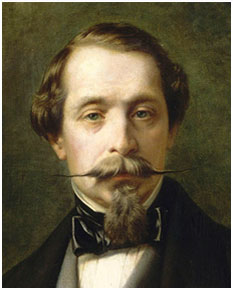
Marc called us from Paris where he remains in exile after murdering that poor Gurkha security guard at Pyestock. The Parisian populace was getting downright menacing he said, throwing instead of blowing kisses at President Sarkozy. The wet smooches were slapping him in the face with soppy smacks, knocking him down on every street corner, leaving him sapped of mojo. And a flaccid emperor can’t run this city, as Napoleon III learned 300 years ago, despite his glorious mustache.
Tashe
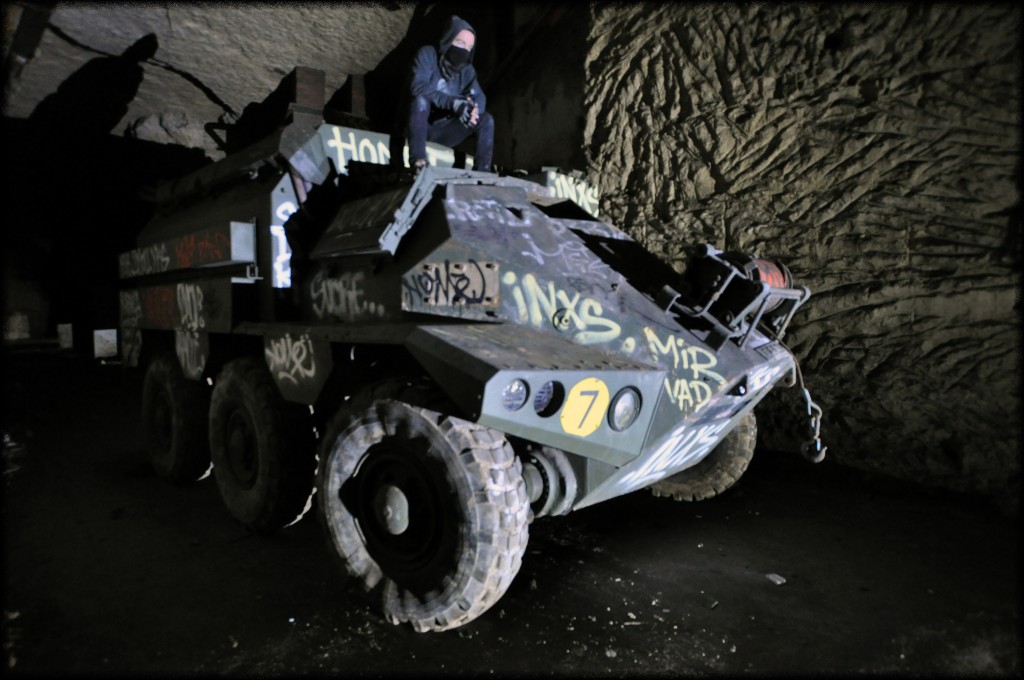
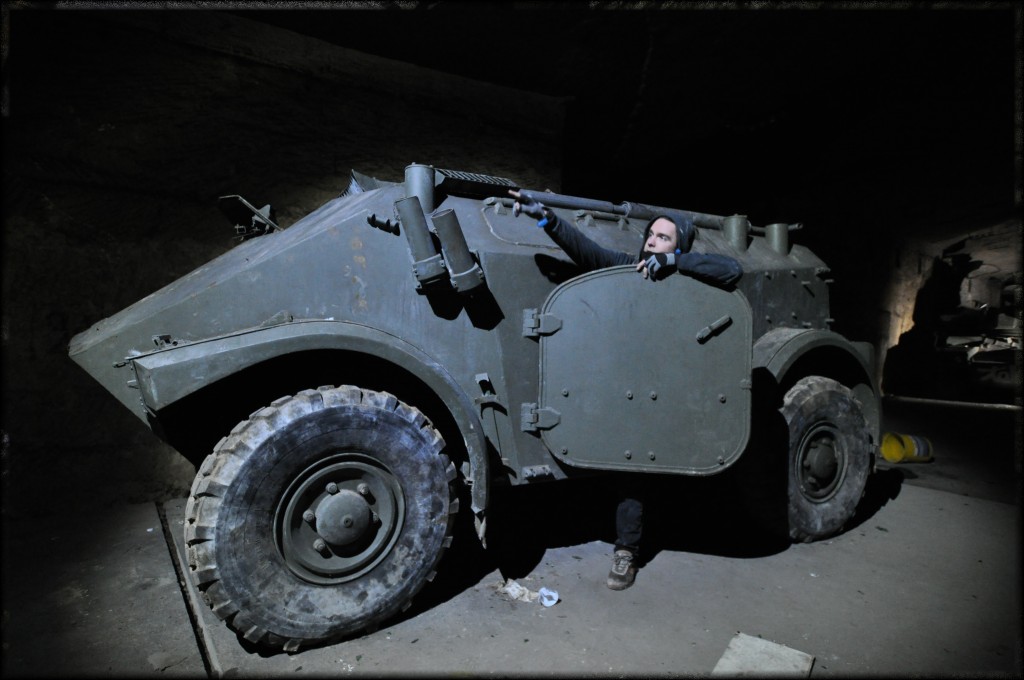
Turns out, Marc had been rummaging around (as he does) the other week and had located a fleet of abandoned military vehicles, perfect for quelling French proletariat rebellions. He imagined us piloting them down the wide toward the city centre, just as Baron Georges-Eugène Haussmann built it to be used, setting all right once again.
Under the cover of darkness, we crept in, leaving behind two operatives to secure the vegetable supplies in a adjacent quarry. I hopped into a small Humvee and ordered the doors battered down. Can’t believe they left the keys in this puppy.
Charge!
We rolled into central Paris in our new acquisitions bumping Del The Funkee Homosapien and drinking blue Chimay, throwing baguettes at hopeless romantics, police and cataphiles alike in a transparent attempt to capture hearts and minds. Implementing an age old audacious tactical maneuver passed down through the Statler family for 40 generations, we climbed every tall building in the city to survey the scene.
Seizure
Just then, Silent Motion cried out, pointing to the horizon, an almost inarticulable gasp pouring out of the side of his mouth. In the distance there was what appeared to be a rift opening in the sky.
Holy smokes!
We took decisive action, speeding over the the rift only to find that it was a reincarnation of Zuul, back from Ghostbusters I to invade Paris the same night as us. Damnation!
This parties over!
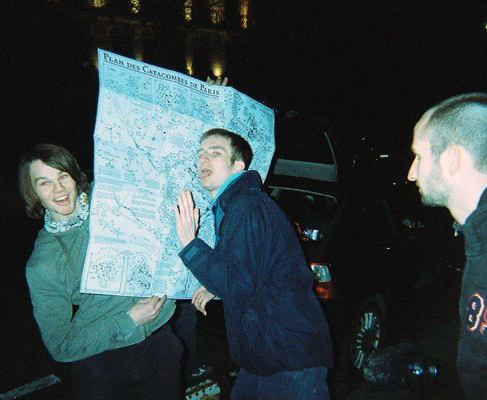
With a stroke of luck, LutEx arrived, fresh off the Eurostar, answering our Craigslist ad for reinforcements. Right then and there, he pulled out this horrendous map of some underground city where he claimed previous failed revolutionaries had gone into hiding. Clearly drunk at this point, we decided he was the man to follow.
Marc wants a gilded throne, not an oversized map (photo by Winch)
The dejected revolutionaries crawled into the underground maze through a manhole at rush hour, dragging the bodies of their dead comrades, pussing fang marks and all, hopes and dreams tied up in little canvas sacks, squirming and wiggling, screaming for acknowledgment.
Shouldn't have crossed the Rubicon
Lest our hopes get the best of us, we left them in the bags and trampled them while we danced to our failures, praying that Zuul had been lenient with the people after her extraterrestrial takeover. And that’s how Marc’s dream of a new Parisian republic died, in a bout of inebriated dirty dancing, headtorches waving in little battery powered gestures, light painting the the walls of the cave we all knew we would never be able to leave.
This post is dedicated to that little Swedish boy that died exploring in Stockholm last week. I celebrate you for not sitting inside playing video games like your friends kid.
4 explorers, 5 Countries, 2000 miles, 16 abandoned sites, 5000 photographs, 3 hours of video footage, a pocket full of loose change to live on and a car full of $7000 worth of camera gear. It’s these last two bits that I find so amusing, these are the pieces of the puzzle that turn this from a hobo trip to a pro hobo trip I suppose. That and the radical mobility of our opt-in faux homelessness.
After our last trip to Europe, I wrote about urban camping. I felt like that long weekend away was a sort of like a wilderness retreat, a little escape from work and obligations to see something unstraited. Some people choose go to a pine forest for these retreats, we go to abandoned chateaus in Belgium. Seems fair enough.
But this trip was different right from the beginning. Part of it was due to the length of our expedition, part of it due to the dynamics of the crew. We had a crew of 4 – myself, Statler, Winch and Silent Motion, all up for it in a big way. We were long inspired by the perpetual homeless adventures of Dsankt at Sleepy City which seemed to pry open a new level of UrbEx or, at the least, open up new possibilities for adventurous play. So we struck out on a Sunday night from Reading, UK, across the channel on the P&O car ferry, through the sadness of Calais, France, just across the border into Belgium to Kosmos, a hotel with a weird Russian art-deco theme that had closed in 1996 where we planned to stay the night.
Transgressive Mobilities
Tourism?
Rated 1 Star on Travelocity
Strangely enough, given what a pile of crap this place was, it was really hard to get into. Finally, after making our way in, ferrying in bags of clothes, food, whiskey and 8 bottles of Chimay looted from a road side stop, we settled in for the night, with a gorgeous view of a random Belgian valley spread out before us, full P&O shot glasses of cheap drink and a horrible rattling noise from the winds assaulting some loose flap on the roof above us.
Penthouse
Winch taking in the epicness
The Goblinmerchant gets naked
We ended up finally dragging tables and chairs from other rooms to board up the windows which were allowing massive gust of wind and rain into our sleeping quarters. Essentially, we started doing home repairs. That night, falling asleep to Aphex Twin’sSelected Ambient Works Volume II playing softly on my phone, I had dreams about the property owner showing up weeks later to find that somebody had actually repaired their building, boarded up windows, brought in and cleaned up couches, filled the bookshelves with tea lights. I imagined them being, at first, dismayed and confused and then… amused, a small smile cracking their stoically disappointed Belgian head.
The thing I started thinking was that our move from UrbEx into pro hoboness was actually a move that benefited property owners because, as Silent Motion put it, “our sleeping in the space builds a more intimate connection with it, we become a part of the fabric.” So going pro hobo, in my mind, even the documentation aspect that you are scrolling through right now, is about place hacking, about finding intimacy in a world full of sterile engagement.
This idea was made even more funny when the property owners showed up at 8am the next morning and started putting up more fencing on the site. Between us and them, the place was going to be completely remodeled soon. We waiting 30 minutes or so for them to leave and made our hasty escape.
Although I am tempted to write about all 16 sites we went to, I can’t. The reason for this is, quite simply, that I cannot relay the epic nature of the experience to you in a blog posting, try as I might. With every day that passed, the crew got more raw, more volatile, more energetic, in a weird, confused sort of way. It was a delirious panic that I think would have even made Dionysus proud. I was drunk for most of it, partly because I do better fieldwork after a few beers and partly because the experience was so raw that it had to be shielded, it was like trying to stare into the sun. Now I know why so many homeless people drink.
Staring at the sun
The raw light of experience
Boundaries that existed in our little UK bubble began to break down. We did not speak the language, we did not meet a single person outside of the grocery stores and petrol stations we ravaged, washing our hair in their bathroom sinks and leaving piles of trash in their parking spaces, running under the turnstiles at the restrooms that demanded 50 cents. All that existed, all that mattered was the adventure and the bond between us which grew tighter with every sip of Jupiler in the back seat of Statler’s car, with every step walked over squishy mold/carpet. We could not think about what was happening because as Dostoevsky points out “one must love life before loving it’s meaning.” And this love was on fire. We began infiltrating live sites, barbecuing dinner in wheelbarrows, lighting dozens of candles in random rooms of Nazi extermination camps and free climbing timber into bell towers in crumbling buildings to photograph the holes in the roof veiled in cloudy continental morning mist.
The films here were shit
Dinner cooked over pieces of the gas chamber
Do they know we're in here?
Winch was the primary conspirator of this little frozen-toed expedition. Always up for a challenge and a laugh, he had booked this absurd holiday in December, I think, to break our will. After all, only the broken can be admitted into the ranks of legend. After taking in a few leisure sites over the first few days, he hits us with the news – we are going after heavy industry. Now, given that I am about to give a paper on reanimating industrial spaces through urban exploration at the 2009 Theoretical Archaeology Group conference in Durham at the end of the month, I thought this is a grand idea. Until it actually started going down.
We walked up to Transfo, a power station in Belgium, to find it swarming with people. We waited until dusk. When we thought everybody had gone home, Silent Motion ninja’d his way in to the secure building past the motion sensing lights and infrared alarm system. We got in and snapped some pics for about 10 minutes before some worker ran up and started rattling the doors to the heavy equipment room. Whoops. Turns out they were not all gone, but Silent Motion clearly could give a shit and starting climbing the infrastructure of the building to get a landscape shot.
Raw Metal
Ghosts of industry
On our way to Germany, we stopped to infiltrate Kokerei Zollverein, again swarming with people including professional photographers and men in suits. I swore that this infiltration would end badly. The only bad outcome, in reality, was my nausea from being meters away from workers as we snook past them and hid in the shadows. All my photos from there are shaky save two:
Fear processing factory
Pulled
After my moment of existential crisis, we made our way to an abandoned train yard Munster Gare, a glorious moment for me for some odd reason. Something about the intersections of transportation (mobility), dereliction (history, aesthetics) and remote location (opportunity for playfulness) made this my favorite site of the trip.
I'm the captain of this ship!
The passengers
No more goods
Unnecessary
After my locomotive jizfest, we drove into Germany. I had not been since I was 19 years old when I pursued the country on a underage American-in-Europe beer run, and was dismayed to find that it was actually a really beautiful place. Mostly because the further East you go, the more derelict structures begin to dominate to landscape. I always thought of dereliction being about the failures of capitalism, but nowhere was abandonment more apparent that in East Germany, markers to the collapse of communism and the retreat of the Soviet Union. The group entered a fervor as we drove through the country side, everything began to look derelict. At one point I remember Silent Motion saying, “Hey there’s a building over there!” and Winch responding “Nice, does it has trees growing out of it?”
We had resigned ourselves to a week of squatting. It was safe to say, at this point, that we had all left our lives behind. I didn’t care about my research anymore, I just wanted to keep getting high on adrenaline. No one ever talked about their jobs, their families. We talked about girls, 4chan, about what country had the best beer (hint: it’s Belgium), about football. Even our Blackberries and iPhones served only to get us aerial photos and to update our facebook status so everyone knew how much more fun we were having than them being homeless, elite and stacked with fat kit. As we crept into East Germany, we were all broken.
I don’t mean that in a bad way. What had been broken was our expectations, our existential dilemmas, our need for unnecessary daily crisis. These things were overwhelmed by the experience of the present, by what was just around the horizon. I felt, for the first time on this project, like I had actually broken the research barrier. I was not studying UrbEx anymore, I was UrbEx. I sat in the back of the car, delirious and drunk, and saw Winch staring at his fingernails. He says “When you look at my fingernails what do you see?” I told him “Maybe the blood and sweat of old inhabitants.” He considered it and replied “I don’t want to clean them…” This was our arrival, the point at which we had committed to dreaming instead of sleeping. And with that, we moved into Berlin, into Ex-Soviet Territory. But that, my friends, is a story for another day.
Anthropologists have recently been writing about World of Warcraft, Second Life and other Massively Multiplayer Role Playing Games (MMORPGs). Since many of these games have millions of players, with their own economies, cultures etc., it has been suggested that people within virtual worlds have developed their own culture. As an avid World of Warcraft player, I heartily agree. But I also love playing games in real life, and, in a sense, this is what UrbEx is all about.
Yesterday Marc took me to a site which felt very much life a game, a surreal landscape of industrial waste, technological failure and a ninja Ghurka security guard. We explored it, very carefully, and all went well, but when I got home, I re-dreamed the explore, making it the game I knew it was.
I call the result a Real Life Role Playing Game or RLRPG.
In a small forest, in a quiet neighborhood, there are trails snaking their way through the tress. Different paths straddle the border between the forest and fields, inhabited by Mums with prams on this lazy Sunday, and by pairs of flatmates and friends, jogging, trying to sweat out remnants of last night’s snakebite extravaganza with girls in too-short-skirts. On one of these trails, in a black hooded cloak, walks Marc of the Cata Clan, Lvl 80 Elite Explorer, back again to conquer Pyestock for bonus explorer points before returning to his subterranean home in the Paris Catacombs.
Marc moves to the perimeter of his target, taking note of the Ghurka guard walking along side him, without looking in his direction, noticing that the Ghurka is following his movements. And eyes. He has been spotted. Marc breaks into a run, trees passing by like cars on a busy highway. With a quick glance to the side, he notices the guard is keeping pace. An elite guard. Merde.
Rookinella was right to be scared and stay home today, this guard cannot be defeated with felt or plastic pirate swords. With two glancing kicks off of the leaf cover, Marc is running up a willow tree, rebounding over the 4 meter triple barbed wire fence, his cloak hood flapping in the wind, distracting the Ghurka just long enough to pull the small blade from his leg holster. The Ghurka is cut down before he can get to his weapon, his mouth held from behind to muffle the screams of agony as he bleeds out.
Moving in
Marc shoulders the guard (got he’s heavy for such a little man!) and sneaks stealthily into the entry point, the Stargate chapel, where his next surprise awaits. He stuffs the guard under the mesh catwalk and walks over to a large circular disk on one end of the room. With a deep breath, he grabs the edge of the Stargate and pulls it open to unleash the Goblinmerchant, a daemon; a vendor of all things fantastic and mystical.
But what’s this? The Goblinmerchant smells humans. Turning his comrade, he can see that Marc has heard them long before now. A group of 4, fumbling their way through. No wonder, with security gone now. The perimeter is being breached. If they make their way to the Stargate, all hell could break loose.
They run off, low to the ground, weighted down by field equipment and supplies pulled from the Stargate, supplied for documentation of the Cata Clan invasion. Through the dangling Cat 5 cables, past the air tunnel control room, up the rusty ladder. Four fellow explorers lie in ambush and a battle almost ensues until we realize they also hold a key to the Stargate.
The documentation begins, one room after another, small items and large machines from humanities forgotten industrial past, a legacy of materiality replaced by computer models and office jobs in Slough.
Controlling the minds of workers?
An exploded reactor, lucky we were there to prevent radiation leakage!
Mail delivery system
Heard the seashore in these
Tunnels or cables? Was I in those?
Flying over the site with a temporary upgrade
Don't look down
Dirty row, collected for XP
Goblinmerchant calls control to tell them the mission has been accomplished. He is awarded 3 mana potions and 5000XP points.
Phone home
Documentation complete, Marc enters the energy capacitor, a small proton particle subfield generator, and Goblinmerchant flips the switch, firing him back to Subterranean Paris.
Ever since becoming interested in UrbEx, I had heard the legends of the Paris Catacombs. It seemed to be some distant dream, the unobtainable pinnacle of UrbEx protected by cataflics and catophiles alike. But a few weeks ago, a phone call from Hydra handed me the golden key. A friend of ours in Paris (who is consequently one of the best photographers I have ever seen) invited us for a four day trip deep into the catacombs, a trip which was to cover dozens of kilometers, sleeping, eating, dreaming and crawling through the various galleries.
The trip began with a 8 hour coach ride from London, across the channel on the ferry, and into Paris at 7am. After spending the morning rounding up supplies, we crawled into the catas in the afternoon, finding them pretty much empty on a Friday. Although my gear was carefully minimized and I was in good shape for the explore, the catas required a different sort of stride than I was used to. It was low, head turned to one side, many times through deep water, waddling quickly after our guide who had endless energy and an incredible drive to explore.
photo by Hydra 2009
photo by Hydra 2009
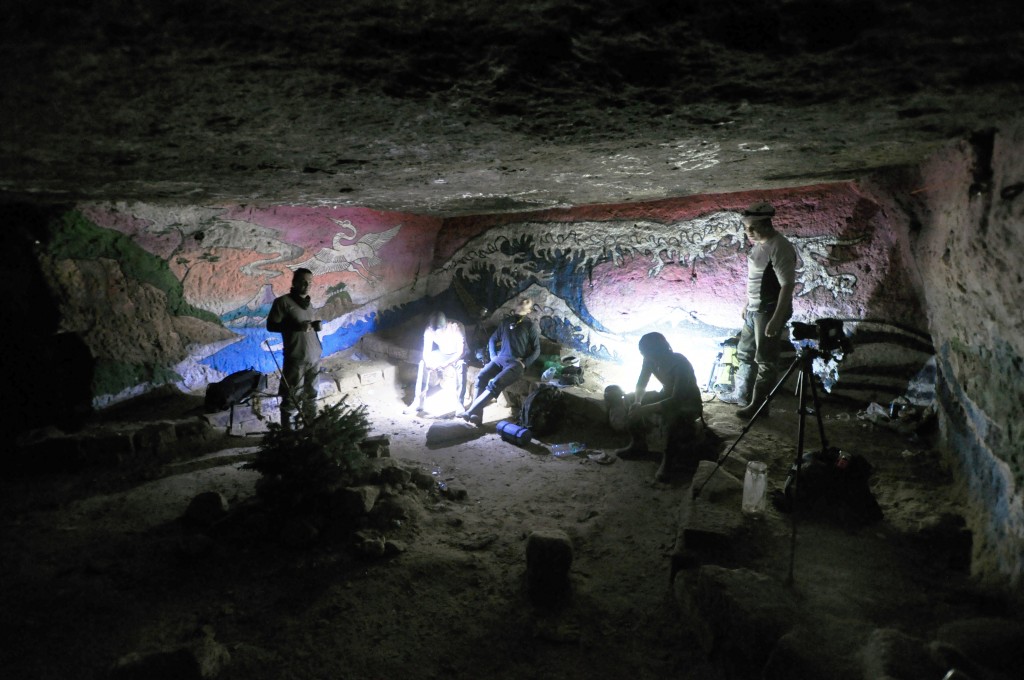
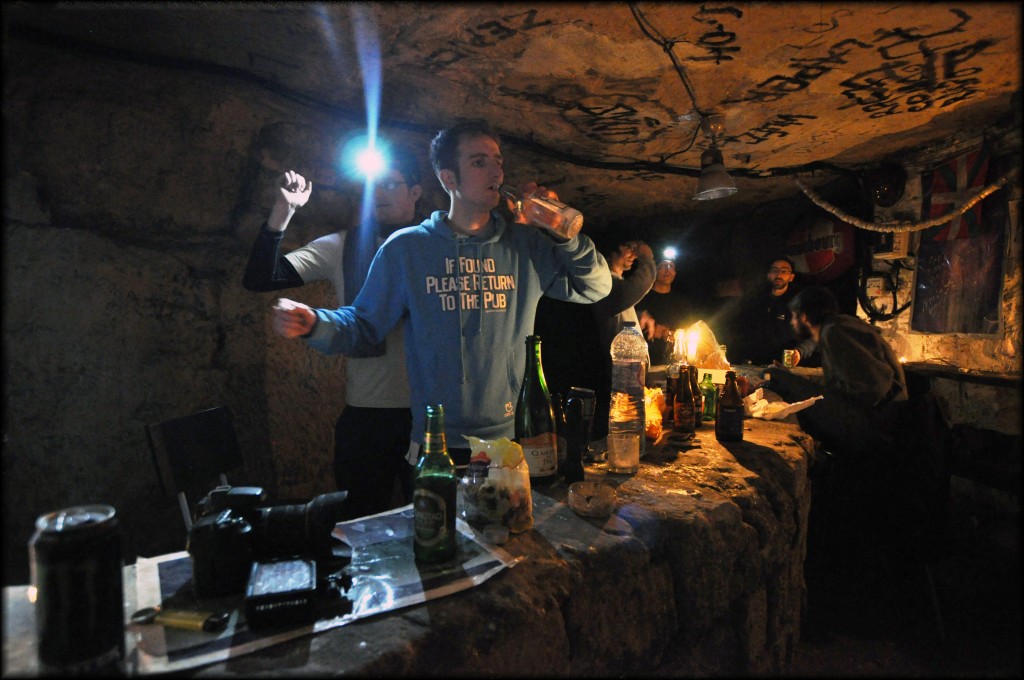
The galleries underneath Paris seem to go on forever, punctuated by brief stops in various rooms (chatières) which have been lovingly dug out and maintained by the cataphiles who care for this place.
photo by Hydra 2009
photo by Hydra 2009
We slept in a tight chamber which became increasingly cold as the night wore on. At some point, about 2am, an explorer woke us up, looking for a place to sleep himself. He asked if we could wake him when we left but was not very amused when we started crawling at 7am again! We ran into a few other groups of people over the weekend, mostly people going down casually to party. The most interesting person we met however, was a cataphile who demonstrated the proper use of a smoke bomb to evade subterranean authorities. When we finally exited the room where he lit it, we had to feel our way along the walls and our torches only made it worse!
photo by Hydra 2009
photo by Hydra 2009
One of the things that struck me about the experience was the constant reminders of death. I guess this is inevitable, given that we are in a place full of the bones of the dead, a place underground where the dead are though to dwell, a place where one could die anytime. It seemed that everywhere you look, there is a skull, real or iconic, a death mask, a memorial or alter. Perhaps this is what makes this place so sacred, perhaps this is why the days I spent in the catacombs felt like a dream, like the sleep that the Buddhists call a “small death”. Perhaps this is why, for the last two days since I have been home, the catacombs still live in my dreams.
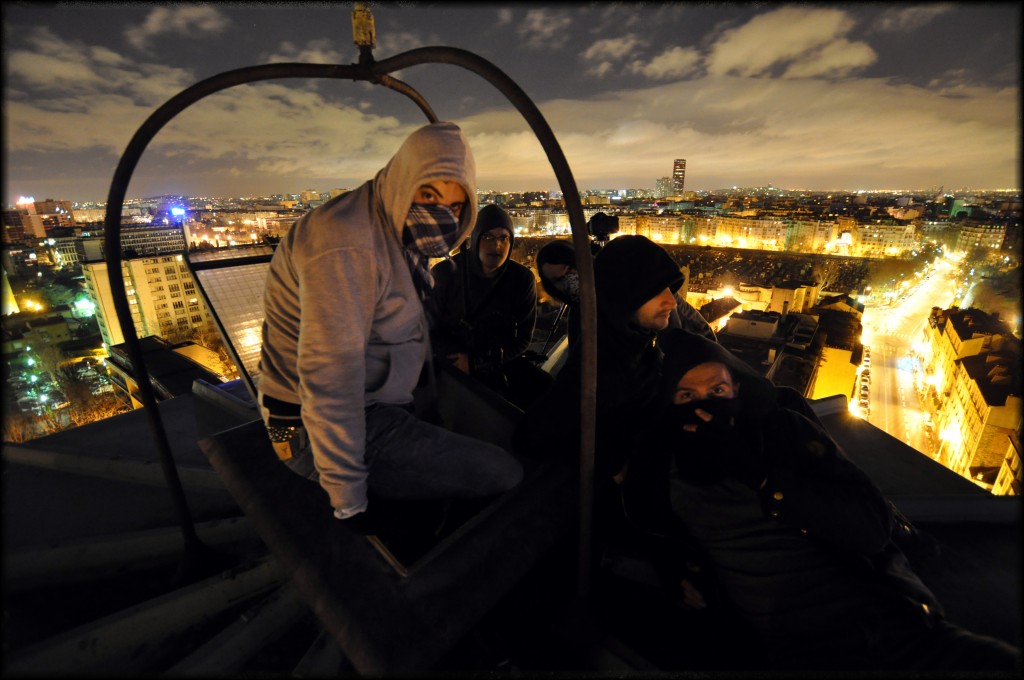
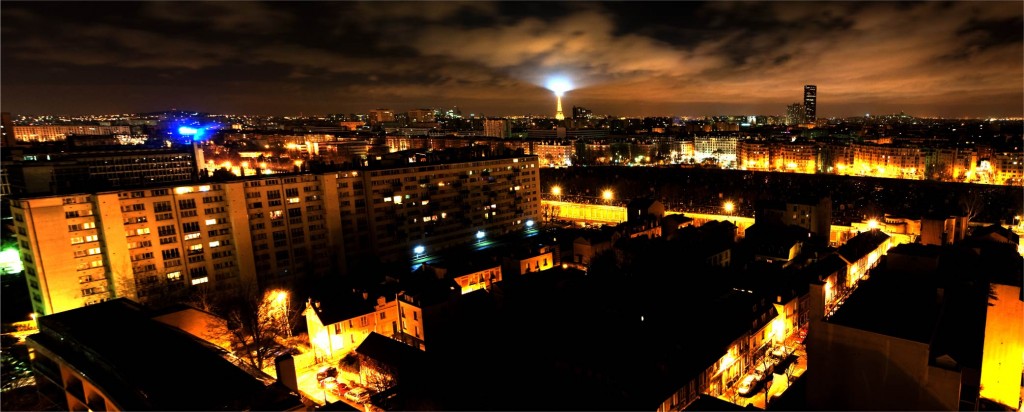
photo by Bradley L. Garrett
The end to our catajourney was somewhat comical. After days underground, we thought it would be funny to pop out of a manhole cover in the sidewalk and walk home. Unfortunately for us, the cover was incredibly heavy and we spent far too long trying to move it. Eventually, the police drove by and noticed the cover being moved and stopped to find out what was happening. After some assurances that we were safe and not up to mischief, they opened the cover for us, allowing for a safe exit from our 100 foot underground wander.
Our guide was an expert blagger and chatted up the police who eventually just wanted to ask questions about what was below and see our pictures and video. They even left us take some pictures of our exit and scrape with the gendarmes on our way home. I have to say that this experience, being American, was as surreal for me as the explore and I have an entirely new love and respect for France. Now maybe I should spend some time seeing it above ground!
I am a proponent of the idea that everything we do as academics should be public. Therefore, this post is both the text and video from my PhD research proposal defense on urban exploration. As with all research, it is a work in progress and I hope to refine it over the next 2 years!
I hope you enjoy it, please feel free to email me or comment on the blog with any comments, questions or hate letters.
Heritage Infiltration: Quests to Find Myth, Mystery and Meaning through Urban Exploration
Bradley L. Garrett
Introduction to Topic
The term urban exploration conjures up a multifaceted set of interlaced images and ideas. I expect that each person reading this will have a slightly different idea of what exactly those words mean. Perhaps they even makes you cringe But for one group, individuals who call themselves urban explorers, UrbExers or simply UErs, the phrase is unabashedly precise. Urban exploration is an “interior tourism that allows the curious-minded to discover a world of behind-the-scenes sights” (Ninjalicious 2005). In my own words, I might describe the urban exploration “scene” as a transnational enthusiasm focused on exploring and recording liminal zones and derelict places, rooted in an interest for the past and a passion for the photography of the forgotten.
I will spend the next three years getting to know urban explorers, embedding myself in their practice and hopefully becoming an UrbExer myself. Although I must admit that despite the seductiveness of my participant’s definition of their practice, I have misgivings about calling myself, or them, urban explorers. My reasons for this are rooted in the academic geographical imagination.
Firstly, what is “urban”? Can we still use the term when an exploration of built structures or human remnants takes place in a rural environment? Do we need to bound and separate the urban and the rural? Secondly, what narratives does the term “exploration” conjure up? We are all aware of the cultural baggage the terms carries: visions of colonial expeditions, invasions, subjugated populations, disease and occupation (Johnston 2000). It is language of conquest.
Because of these misgivings, I suggested a new term for what it is I have come to do every weekend. I began to call it heritage infiltration. It seemed to me that this term encapsulated the rogue adventure into humanity’s largely forgotten past that we were undertaking, while avoiding the negative associations I saw with the term urban exploration. When I suggested the new nomenclature to the urban explorers who I was working with, they hated it. In fact, they reprimanded me for suggesting that I knew better than them what it was they were doing. Consider it a lesson learned in doing ethnography: project participants are always the experts, and the researcher never has a right to make expert claims about the regulation, bounding or designation of identity markers.
In the end, I decided to use both terms (hence the title), one to describe my participant’s vision of what it is they do and one to describe my personal characterization of the experience.
Methods
So, the cat is out of the bag. I said I was doing ethnography, a term thrown around rather loosely in geography circles. Coming from anthropology, I realize the boldness of this claim. I know that building an ethnography is a deep process; maybe too deep for me to realize in three years. Ethnography, by a traditional definition, will include observation of people’s daily lives for an extended period of time (Hammersley and Atkinson 1995). Visual ethnographer Sarah Pink defines ethnography as “an approach to experiencing, interpreting and representing culture” (Pink 2007: 18). It is Pink’s definition, with the acknowledgment of personal experience in fieldwork that I find most appealing.
The experience of the researcher is often missing from ethnographic accounts, and I believe that the narration of my visceral, bodily experience as a heritage infiltrator is an important story to tell. I have realized early on that these explorations are about inscribing corporeal existence into place while absorbing enough memories, experiences, lead paint, asbestos and scars to take also the places with you.
Finding Hidden Community
It took me 8 months (beginning before I started the PhD!) to get an urban explorer to invite me on an explore here in London. The reason for this is that the urban exploration community is full of sneaks, shades, specters and rats. In fact, after offering my services as a “videographer” on an UrbEx forum board called 28 Days Later shortly after arriving in London, I was accused of being a federal agent infiltrating the network to collect evidence for prosecution. The realization of the difficulty of gaining access to project participants has led me to use a variation of snowball sampling or respondent-driven sampling (Salganik and Heckathorn 2004). Basically, by meeting one person and building trust, I can ask them to introduce me to someone else. Using the mythological law of 7 degrees of separation, this should lead me to everyone eventually (though maybe not within 3 years)! The technique has worked well so far; after my first explore on Jan 15th 2009, the two Kent explorers I went out with called friends in London to give me the “green light”, leading to the 16 person (and ever-growing) research group I now have! This process was greatly assisted by virtual social networking sites such as facebook and internet forum boards.
Virtual Networks ←→ Physical Encounter
Online networks are quickly becoming very important for cultural research. In my case, I have chosen a community who has had their own web-based networks long before facebook, myspace or even friendster. A quick search of “Urban Exploration UK” in google brings up dozens of sites, all associated with different cliques, some quite hostile to each other. On the forums, identities are fiercely guarded. The reason for this is that law enforcement and private security firms patrol the web spaces looking for information about member identities and access points into sites. As a result, the biggest “noob” (newcomer) offences in the forums include:
1. Not blurring out faces in a pictoral forum posting
2. Using someone’s real name
3. Revealing how you gained access to a site (especially when this leads to the access point then being sealed!)
Aliases and costumes have become increasingly important in recent years, I am told, with the proliferation of CCTV and the general air of suspicion regarding urban explorer’s motives, to the point that even on an explore, people will not reveal their real names. Interestingly, off of the forum boards, I have built a group of friends on facebook who, of course, have revealed to me their real names. All of our profiles are set to only be viewable by “friends”, and we frequently post pictures of explores with our faces shown, with the assumption that these posts are “internal”. In some cases, explorers will ask me not to “tag” them to keep visibility to a minimum.
As you may have guessed, being an urban explorer, at least a part of this community, requires some degree of technical prowess, a fair dose of paranoia and, I might add, a nice still camera and some skill with it if you want to build recognition on forum boards. I knew at the beginning of this project that I did not have the technical skills with a still camera to gain access to this group. I did however have videographic experience, which prompted me to begin using video to build my ethnographic stories. Ironically, I have found that video does some really fantastic things in the field and my role as a videographer is seen as anomalous but increasingly desired as I produce youtube videos that can be embedded into forum postings, one of my gifts that I give back to participants.
From Virtual Geographies to Visual Geographies
Again, claiming to be making an ethnographic film is a bold claim, but as Sarah Pink points out, “a video is ‘ethnographic’ when its viewer(s) judge that it represents information of ethnographic interest” (Pink 2007: 79). Ethnographic interviews are perhaps the most useful area for video collection and production. The reason for this is that video allows project participants to speak for themselves. Photographs, as Hastrup (1992: 10) argues, are a thin description, capturing form but not meaning. Hastrup goes on to argue that in order for the photograph to become a piece of ethnographic thick description, it must be contextualized by text, an argument also made recently by Gillian Rose (2001). Video, on the other hand, is capable of capturing experience (both yours and your participants), and does so in a way that I believe is respectful and accurate in terms of ethnographic storytelling. I hope to use both “in the field” interviews and more focused formal interviews once a sufficient level of trust has been built to request these.
By the end of my research, I expect to not only have written a thesis, but to have also produced a feature length ethnographic film, a film that my participants have expressed much more interest in than the written component.
Some Parameters
In an effort to increase participant control over the project, my parameters have been defined largely by my research groups. Basically, to be part of this project participants are expected to:
1. Define themselves as an urban explorer and consider urban exploration an important part of their life.
2. Actively post on an online community of like-minded individuals or at least have an avatar on the forums.
3. Following this, participants must subscribe to the urban explorer community code of ethics.
4. Agree to be filmed, and agree to have me use that film for my research (on whatever terms they choose i.e. face-blurring, anonymity, audio-only etc.).
5. Agree to having their alias used to describe their practice in the film and in any writing.
Finally, in terms of location, I am following participant leads, where they take me is where I study. At the present time, it looks as if this study may involve 5 countries and dozens (if not hundreds) of locations.
Other Aspects of the Study
There are a wide range of themes connected to the topic of urban exploration that I have not touched on here including, but not limited to, ghosts and hauntings, gender roles, urban adventure (extreme sports in derelict places), policing and authority resistance, childhood play, homelessness and squatting, emotional adventure, adrenaline addiction, political and cultural nostalgia, localized mapping, dystopian fantasy, alternative archaeologies, building hacking and heritage hijacking. All of this can and should be unpacked through experience and interviews.
Why is This Worth Researching?
Urban exploration is an international movement, a shared global culture that defies language barriers, national borders, and conceptions of private ownership over space. It is a form of activism, an art, a hobby, a sport, an addiction and, to many, a way of life. Urban exploration is a way to resist the smooth spaces of the city and to seize heritage in a very personal way.
I believe that there are also deep roots in urban exploration, roots that tendril into themes about life in the city, desires for emotional freedom, the need for unmediated expression, associations with childhood memory and historic materiality, and desires for physical human connection and bonds through shared experiences of peaked emotions (Cahill and McGaugh 1998). These are issues explored by phenomenology, psychogeography, ontology and cognitive archaeology. I believe that tracing the roots of urban exploration will reveal a philosophical rabbit hole that does not end at the smooth pavement of everyday life.
It is also a topic which has been little discussed. In the course of my first few months of research, I have found two films on the topic (Faninatto 2005; Gilbert 2007), a few television shows (Duncan 2004; Wildman 2007; Zuiker, et al. 2006), a handful of popular books (Deyo and Leibowitz 2003; Ninjalicious 2005; Talling 2008; Toth 1993; Vanderbilt 2002), a single academic text (Edensor 2005), two M.A. dissertations (Lipman 2004; McRae 2008), a few journal articles (Genosko 2009; Pinder 2005) and a very large stack of zines (locally printed fanzines). Actually, the most coverage I have seen of urban exploration is in popular magazines and newspapers, where the press is almost assuredly negative. Obviously, this ever-growing and increasingly popular pastime is ripe for infiltration.
References
Cahill, L. and J. McGaugh
1998 Mechanisms of Emotional Arousal and Lasting Declarative Memory Trends Neurosci 21 (7):1-6.
Deyo, L. B. and D. Leibowitz
2003 Invisible Frontier : Exploring the Tunnels, Ruins, and Rooftops of Hidden New York. 1st ed. Three Rivers Press, New York.
Duncan, S.
2004 Urban Explorers. Hoggard Productions, United States of America.
Edensor, T.
2005 Industrial Ruins : Spaces, Aesthetics, and Materiality. Berg Publishers, Oxford, U.K.
Faninatto, R.
2005 Echoes of Forgotten Places. Scribble Media.
Genosko, G.
2009 Illness as Metonym: Writing Urban Exploration in Infiltration. Space and Culture 12(1):63-75.
Gilbert, M.
2007 Urban Explorers: Into the Darkness. Channel Z Films, United States of America.
Hammersley, M. and P. Atkinson
1995 Ethnography: Principles and Practice. 2nd ed. Routledge, London.
Hastrup, K.
1992 Anthropological Visions: Some Notes on Visual and Textual Authority. In Film as Ethnography, edited by P. I. Crawford and D. Turton. Manchester University Press in association with the Granada Centre for Visual Anthropology, Manchester.
Johnston, R. J.
2000 The Dictionary of Human Geography. 4th ed. Blackwell Publishers, Oxford, UK
Lipman, C.
2004 Tresspassing in the Ruins: Urban Exploration at the CRX, Royal Holloway, University of London.
McRae, J. D.
2008 Play City Life: Henri Lefebvre, Urban Exploration and Re-Imagined Possibilities for Urban Life M.A., Queen’s University.
Ninjalicious
2005 Access All Areas: A User’s Guide to the Art of Urban Exploration. Infilpress, Canada.
Pinder, D.
2005 Arts of Urban Exploration. Cultural Geographies 12(4):383-411.
Pink, S.
2007 Doing Visual Ethnography : Images, Media and Representation in Research. Manchester University Press in association with the Granada Centre for Visual Anthropology, New York.
Rose, G.
2001 Visual Methodologies : An Introduction to the Interpretation of Visual Materials. Sage, Thousand Oaks, California.
Salganik, M. J. and D. D. Heckathorn
2004 Sampling and Estimation in Hidden Populations Using Respondant-Driven Sampling Sociological Methodology 34:1-48.
Talling, P.
2008 Derelict London. Random House Books, London.
Toth, J.
1993 The Mole People : Life in the Tunnels Beneath New York City. Chicago Review Press, Chicago, Ill.
Vanderbilt, T.
2002 Survival City : Adventures Among the Ruins of Atomic America. 1st ed. Princeton Architectural Press, New York, N.Y.
Wildman, D.
2007 Cities of the Underworld. The History Channel, United States of America.
Zuiker, A. E., C. Mendelsohn and A. Donahue
2006 Free Fall (Season 4, Episode 20). In CSI: Miami. CBS Paramount Television, United States of America.[
August 1st. That was the day I began working on pulling together my ethnography. I took 6 1/2 months to pull together my fieldwork. By anthropology’s standards, I guess it is not bad but if this was simply a documentary I would have shot myself in the foot.
So, the good news is that this past weekend, two new friends took me to four mysterious abandoned places in Gillingham, Kent. Vanishing Days and Solar Powered we extremely generous, articulate and helpful, driving me back and forth from Napoleonic-era stone forts to World War II gun turrets to an equestrian center abandoned in 1986. It was a surreal day (as it usually is behind the camera) with this added affectation that desolate places tend to have.
I also find, the more that I explore, is that the more intact a place is, and the more recently is was abandoned, the more eerie it is. Perhaps it is easier to connect with the history of those places when you imagine the people who lived their still roaming the earth and reminiscing about the places that you are watching sink into the earth for some future archaeologist to uncover.
This weekend I will be headed to an abandoned asylum with my second group of informants. More to come.
Now back to editing these three hours of derelict beauty!
I am a new Ph.D. student at Royal Holloway, University of London in cultural geography. My academic background in anthropology and archaeology. My current research is on geographies of film and I spend more time shooting film than writing at the moment. I am also writing about cyborg culture and MMORPG’s (i.e. World of Warcraft) so you may find posts on that coming up soon.
On this site, you will find both my written work and my filmic documents. Between the two, I see the blog as an interesting way to chart my progress through this Ph.D. program.
I have been procrastinating on writing a blog forever and the way I finally convinced myself to start was to promise myself I would not become a Blog addict.
So, as for what you can expect here… Weekly updates. Or monthly.
More importantly, this blog will do two important things. One is that it will serve as my storage area for work so that hopefully someone besides my family will see it! The other is that I will post links to the goodies I find during the course of my research which you might find useful.
If you made it here on purpose, congrats on finding it! If you stumbled in, welcome and feel free to take your shoes off.