Cavendish Crematorium

16 06 2010

The Silken Hotel wasn’t open yet. We were standing there at the hoarding, Silent Motion and I, with that jelly of a man in his yellow vest pointing his finger accusingly, shaking with rage in a kind of mild convulsion, the orbed camera behind him spinning around and zooming in on our faces, like an eyeball rolling back in a head, making the convulsion a complete yet disembodied visceral experience for this lamentably flabby being.

The sergeant arrived, blue lights painting the walls, tires screeching. He almost rolled out of his car “UrbEx huh? Yeah, we get your kind around here sometimes. Tell you what, see that boarded up building across the street there? Let’s see if you can get into that one!” We meekly accepted the challenge as they frantically tried to fix the zip ties on the Heras fencing we had snapped off in our aborted miniature vertical scramble.

Challenge Issued

Across the street, we found that this building, Cavendish House it was called, was boarded up exceptionally well, stone gargoyles on patrol in moody up-lighting, three stone Furies screaming insults at us as we hung from ledges over the road, tugging on widows.

Stoney stares

Furies

With a pop, a seal on one gave and Silent Motion swung it parallel to the floor. We dove through headfirst and when the window closed with a sharp bang, we were surrounded by silence. I crawled to the dirty pane on the other side of the room and peeked across the road. The sergeant was there, his belly still threatening to rip his utility vest in two. He was smiling, staring at the building and smiling. Creepy fuck.

Popped

Marauder

The exploration proceeded as we opened doors and windows for the next team of rogue adventurers, torches moving around like little bugs on walls looking for a hole to hide in. Silent motion found a generator running and hooked up to a small TV. He powered it up and we spent an hour watching an old Bollywood classic, a brief respite from the endless stairs. Room after room of blue and orange light comforted us behind the boarded up first floor. Unlikely to see, impossible to catch, invincibility ensued. Down or up? Up.

Dance music invoked

Creepy

The top of the first building (indeed we now realized there were three of these concrete monoliths, these plywooded Thatcherite government lumps of cement) had a roof that sat level with some office blocks. I peeked in the clean windows across, imaging the illicit affairs in office chairs that took place during our work hours, suits humping secretaries and capitalism. A blue church to our left looked like a plastic Disneyland air-filled jump house, replete with nostalgia for the abbey it was until Henry VIII seized it and ravaged it like a conquered Irish queen in the 16th Century.

Little things

Pink

The millennium eye approached us on the other side, that little monument we all love and love to say we hate. “Ride on that thing? Never!” Its millennium glow bounced off of the Thames, offering no apologies for its slow creep our direction. We did handstands, climbed radio antennae, pulled ourselves around in monkeyed feats of post-adolescent strength. We lost track of time. We didn’t care. Damn the horror of the night buses, we’ll ride ‘em!

The Furies descent

Eye

The lustful runs across the roof deteriorated eventually into a pink sky, and we knew that the time for morning coffee and a long walk to Elephant and Castle would soon be upon us. Time to go down. And down. And down. The building suddenly became distinctly subterranean.

Nuances of texture

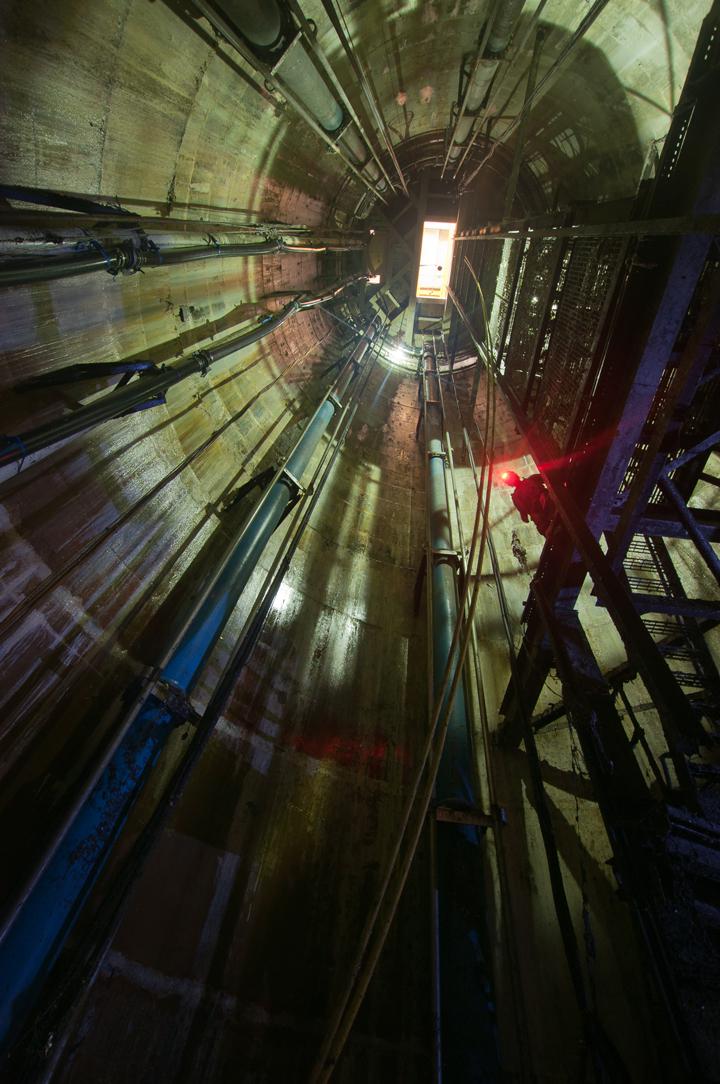
It was wet here. It stunk like old dog, soaked in a summer-time sprinkler and shaking all over the children who uniquely appreciated the horrible musky shower, full of love. The empty corridors offered room for thought and made my stomach tense up, knot and twist, crying foul at the late (early?) hour. One turn revealed a large room with a safe, a thick door with twisty dials and an unsettling echo. We spun the lock, robbing the history from the place.

Sort of safe

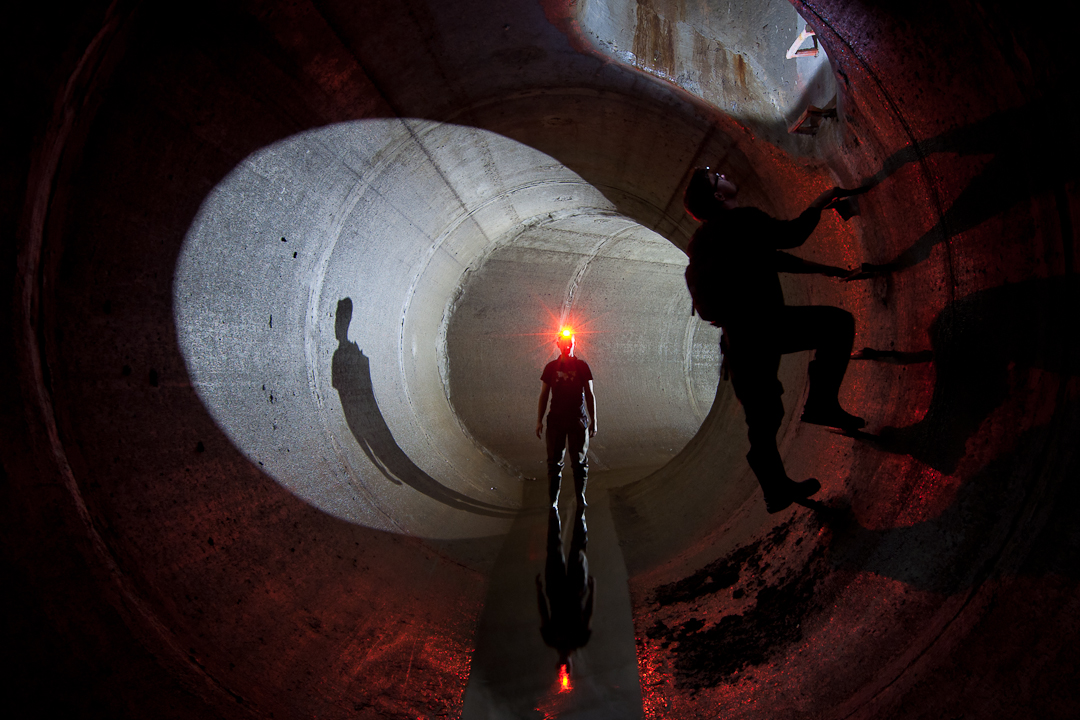
The watery passage continued until we could stand it no longer, blistering feet soaking in the liquid filth. We went for the ProEx shot to cap off the night, twisted and intoxicated, drunk on our own success at pissing on every wall in this building. Lighting was essential, we decided, draining camera batteries and making film strips roll back on themselves in our multiple attempts to get it right.

Pr0 Shadows

Suddenly, the sharp slap of metal on tarmac stopped us cold. Voices. A quick retreat. How could it be, this UrbEx fortress infiltrated? The retreat continued into a side room where we sat, a gentle humming behind us. Suddenly, Silent Motion sprung up, hitting the hum with his torch and there is was – a meat grinder, working with no electricity to speak of, begging for fodder. I screamed a little, quickly covering my mouth to stifle the alarm, pride on the floor. The voices were closer now, finally clear enough to make out the distinct sound of someone saying “they’re over here.” I knew that voice.

Ground

We fled down the hallway once more, trying to keep the drips and splashes from reverberating, a considering how long the water ripples that announced our direction of departure would continue their hideous radial momentum. The smells of the place began to change as we moved. It smelled… like burning. When we found out why, it was already too late. The swollen bellied sergeant and the jelly-man sidekick were on either side of us, laughing as we both stared in horror at the door to what looked to be a huge furnace.

Burned

“Welcome to Cavendish Crematorium!” The sergeant yelled, spit streaming from his plump pink lips. “The last stop for nosy UrbExers!” Next to me, Silent Motion sighed, staring into the murky water.


Lurking in the Shadows

13 06 2010

My friend and colleague Alan Rapp who runs the excellent blog Critical Terrain has just finished his MFA in Design Criticism at School of Visual Arts in New York City. Alan wrote a wonderful thesis about urban exploration called The Esoteric City which I really hope he publishes soon. In the meantime, he recently gave a short presentation on his work (in which I make a few cameos!) that is really worth watching.

I am always amazed by how much overlap there is between Alan’s work and my own. Sometimes I feel like we are psychically quoting each other across the Atlantic Ocean. Telepathic communications aside, congratulations to Alan on completing the MFA program – I look forward to seeing what comes next!

While I am at it, I would also like to mention another friend, Shreen Ayob, recently put up 4-minute video on her blog Shreen Distracted shot entirely in the soon-to-be-demolished West Park Asylum that I really love. Between the Alan and Shreen, I have your evening viewing sorted for you!


Blackwater London

30 05 2010

Sewers are perhaps the most enigmatic of urban infrastructures. Most citizens of modern cities are aware of their existence, yet few could accurately describe their layout or appearance.
–Matthew Gandy

Getting it right

Above me, the heavy round metal doors into this underworld shake with a pinging metallic scream that reverbs down these watery tunnels, slowly fading into a seemingly endless succession of dull thuds that migrate down the street above us, some racing black cab speeding a jilted lover home from the pub after the last trains have stopped running. This overworld scenario interests me far more interpreted from below the undercarraige of the cab, little bits of shit-sticky mud dislodging themselves  from the freshly-pried manhole cover edges, plopping onto my bald head. Cue a shuddering shake, aural spell broken.

Water races around my feet faster than the cab, pinning my waders in a strange plastic comfort to my legs, little bits of used toilet paper and raw sewage which we lovingly call “the fresh” blocked by my PVC barrier, pushing around me angrily in an effort to make it down this old river and into the Thames like salmon swimming not toward their spawning ground but the river Styx where the boat will sink halfway across and they will float lazily to the bottom, never to move again. As drainers, we learn to love the waste just as we learn to love the trash left behind in the streets of London at 4am on a Friday night. It is the detritus of passion passion for life that staves off our impending deaths, as Michael Dibdin writes in Cosi Fan Tutti:

This place reeks of mortality.
I thought it reeked of rancid oil and bad drains.
It comes to the same thing in the end.

At some point in London’s Victorian Age, the separation between “river” and “sewer” became blurred. Technically, I am standing in the River Westbourne which no one but sewer workers and daring drainers have seen for a hundred and fifty years. Despite the fact that no one has drank the water from this river since the 1400s, it remains a vital waterway of this city, a throbbing vein of live humanness, rushing underneath our unknowing feet as we run to work on the pavement above. Seeing it is a reminder that, as Gay Hawkins writes, “our rituals of cleansing and disposal are enfolded with this landscape, our personal secrets are implicated in the public secret of sanitation.” This misadventure into the bureau of public secrets is the newest in our chain of London infiltrations, our most recent attempts to make sure that this city is documented from every possible angle through experience, fear and love. Just as I wouldn’t wipe the ass of somebody else’s baby, only London’s sewers interest me.

We view the stigma of what is flushes on these journeys both literally and socially. Our preferred mode of access to these hidden waterways is hiding in plain sight and the classism of London society works in our favour, with both police and the public ignoring everyone dressed in high-vis and a hard hat, benign foreign workers who make their living in places where no “respectable” Londoner would ever step foot. Our team of 4 digs into their toolbelts of large screwdriver, t-shaped keys and crowbars to break the seals into underdiscovered territory, finding what the city forgot existed, our brazen crew seemingly as hidden as this river when we actually look like we work for a living.

Cracked

Pull this bird

The addiction to infiltration does not lay in the adrenaline rush of the experience. Infiltration creates unwieldy complications, difficult mental junctions and moments of crises that confuse, inspire and complicate our existence. My second identity as the underclass, the role that I play to gain access to urban secrets, is slowly becoming my primary identity. My clothing, my language, my social class, all now defined by my behaviour “on the job.” Leaving this tunnel late on this night (early the next morning?), we were greeted by “real” workers at a tube station who tossed slight nods our direction, eyeing us with confused interest, suspicion, respect and likely some revulsion given we were covered in underground wetness that smelled even worse than the rank pub toilet across the street.

We have been systematically exploring London’s subterranean features for the last few months, cracking every stormdrain, abandoned railway, cable tunnel and sewer we can find in the city – elements of this urban environment that Steven Smith, in his book Underground London, calls “London’s best kept secrets.” We know why. Not only are they some of the most beautiful and surreal places in the city, they are also the most foul.

Pour your heart out

The sewer is a place for alterier cartography, a place where no one may reside but where one can pass through, cameras capturing endless angles of the oldly new, remapping our mental conceptions of where the verticality of the city begins and ends. Our embodied experiences move like the stinking water, shifting from one chamber to the next, chalk marks on walls marking our way home, level after level of underground run-off continually sinking into what we imagine to be an endless succession of metal grates covered in dried up cakes of unknown substances, unidentifiable pieces of fabric and scraps of food. Matthew Gandy, in his article The Paris sewers and the rationalization of urban space contends that “by tracing the history of water in urban space, we can begin to develop a fuller understanding of changing relations between the body and urban form under the impetus of capitalist urbanization.” Pretty sure he wrote that line from the Paris sewers.

Alterier chamber

We trace these cultural lines and flows, finding here that nature and culture drift at the same rate in an interdependent foulness. London’s legendary sewer rats are in full effect tonight, running from us in a terrified scamper, climbing the round slippery walls of the tunnel in inexplicable ways and disappearing into holes we can’t even see into. I want to explore what they can see. At one point, some sort of nest is disturbed and they came at our lights, their little claws feet screeching all around us. Staying in the middle of the slimy sticky mud, shit and runoff where the rats won’t swim was clearly our best option.

We spent 4 hours sliding around these chambers, building up our immune system with aching stomachs upon exit and mouth sores to come. As we emerged I felt, as I often have, that tonight was another attempt to document my own disappearance in the course of making the city reappear in alternative iterations. As I sink deeper into my PhD, I sink deeper in this city, still so in love that there isn’t even room for another human being. I can only hope that either I or the thesis emerges at the end of this torrid love affair, unsure I will survive the potential breakup. Until then.

Own the night.
Cherish these secrets.
Wield this power.
Love this life.

Explored

Beneath your pub crawl

More playfully than righteously

________________________________________

This author’s endeavour should be to make the Past, the sense of all the dead Londons that have gone to the producing this child of all the ages, like a constant ground-bass beneath the higher notes of the Present.

-Ford Madox Ford, The Soul of London


Fiberglass and Tumble Weeds – Boron FPC

7 04 2010

“You should create your own icons and way of life, because nostalgia isn’t glamorous…live your life now.”

-Marilyn Monroe

Alien dump

I grew up in Riverside, California, on the Western edge of the Mojave Desert. My interest in urban exploration came from my childhood here, full of frequent trips into the Mojave exploring old mining towns to break up my rather mundane suburban childhood. Coming back to visit this year, I knew that what I needed from this trip was to rediscover what it was that brought me down the UrbEx path. So I hit the desert for some old school federal trespass.

Because of that green UFO?

My friend Joel tipped me off to the existence of Boron Federal Prison Camp, a US Air Force site that was abandoned  in 2000. I rolled into Boron on an incredibly windy day, with light rain splashing in off and on (rare here I assure you!). I found all the gates open and amazingly drove right past a dozen derelict buildings, straight up to the old water tower.

Dusty Industry

It was only when I stood at the edge of the cliff at the water tower that I realized how extensive the site really was. There were at least 30 buildings here, some multi-storied, spread out over maybe 5 or 10 acres.

Rural Sprawl

As I looked out across the flat expanse of desert toward Barstow, the wind was whipping my hair in my face and I was constantly wiping water drops off of my lens. I decided to take shelter in the only thing higher than the water tower – the stucco church.

Monument to the gods of television

Stencil worship

I stepped into the church and found myself in a silent room that had one wall painted and others covered in banal graffiti. As I stood there, I came to realize how much different this exploration felt than those I had been undertaking in Europe. It was so much lonelier. Part of this, of course, can be chalked up to the fact that I was indeed alone, but there was also a spatial dimension. It seems to me that perhaps because of the availability of space here in the desert, it is much easier to simply walk away from a place. And when that happens, an essence of loneliness particular to this dusty landscape seeps in. It is a loneliness, a sadness, so deep that even destruction of the place does nothing to erase it.

When I explore in more urban landscapes, the predominate emotion is fear-fuelled adrenaline. There is a sense of urgency that drives explores and has been one of the difficulties I have encountered in trying to get video footage of our explorations – we never really stop to take it in. We move fast, we pack multiple explores into a day. It’s like derelict architecture speed dating.

In contrast, this federal prison invited me to stop, to spend the day, to really take the time to let it scar me. It felt less like a conquest and more like an invitation to meditate on the possible pasts that led to it’s untimely death. The site encouraged more of an archaeological eye, little artefact mysteries to be uncovered around every corner. The fear of being caught here (which was very high, with possibly sever consequences) was so overwhelmingly overshadowed by the lonely introspection the place invoked that I simply sat down for some time to listen to the wind whipping power cables and slamming doors open and closed and forgot that a patrol might roll in at any moment.

I went on to explore the kitchens, mess hall, work corridors, carpentry shop, the fire station, basketball court and finally the “vehicular component factory”, whatever the fuck that means. It had been almost completely stripped out, every window broken, and despite the emptiness of the place, it continued to have a particular thickness to it. It was a place full of sad memories, left to rot our here 50 miles from the nearest city where the incarcerated inhabitants could do no harm.

Deserted

Communal loss

Barricaded

The camp seemed to be connected with a company called Unicor – a name which I think has an oddly Orwellian feel to it. There was also an active air traffic control station on site covered with live cameras which was beginning to make me a little nervous 3 hours in.

1984

Road to government vagueness

I jumped into the truck to follow my gut instinct that it was time to leave, feeling rather satisfied with my day, when I noticed a side street I had not seen before. I drove down it, finding nowhere to park (a vehicle is a serious limitation to exploration I have realized – hiding a car in the desert is usually almost impossible) and walked into what turned out to be derelict inmate housing.

Reasonable traffic conditions

As I walked down row after row of empty cul-de-sacs lined with derelict tract homes, I was pulled right back into the sadness of the place. I walked through people’s homes and looked at their landscaped yards, taking notice of which domestic plants had escaped and were thriving without human intervention. In one, I found a constructed mini-bar and waited a while for a drink to be served. In another, a brick oven filled half the backyard. I imagined summer BBQs in 120 degree heat, families of inmates coming together for a few drinks and a chat about who-was-whose bitch that week.

Patio Party

I was struck anew by the imposing affectual qualities of the place and when I reached an abandoned playground. I stopped to play alone on the teeter-totter.

Does anyone remember playing here?

By the time I left the housing area, all numbed by the weirdness of my experience, my truck was blocked in by a stereotypically overambitious security guard wearing a fake federal badge. He told me I had been filmed and that he was supposed to call the FBI (I call bullshit on that one buddy) but I think he could sense that I had come here for different reasons than he might normally encounter. We ended up chatting about the history of the place and he sent me off with a stern warning, locking the gate behind me.  After a day of modern ruins, ghosts and self reflection, I drove off into the Mojave Desert in a familiar cloud of pink dust looking for the next adventure.

Not that I'm nostalgic or anything


Empire

24 03 2010

Now that I had been underground in New York, I thought I might as well go aboveground as well. Luckily, I happen to be staying in a lovingly decrepit 15 story building on 5th Avenue and 31st this week with a nice view of the Empire State Building.

Not nearly high enough!

Taking the lift to the 14th floor, I walked out into what was clearly some sort of space for workers living in the hotel. Luckily they were asleep. I took a quick tour around and found a big black door marked “Emergency Exit, alarm will sound.” That’ll be the one I want. I hit the lift button just in case the alarm actually went off so I could jump in and make my escape. The lift doors opened with a ding and I hit the the metal bar on the door. With a sucking sound, the cold air rushed in, alarm free.

I stepped outside onto a lovely roof. Not the highest I have ever done by any means but it had two sketchy water towers on it to get up on more floor (though you had to lay on their sloped roofs rather awkwardly to get shots!). There were also multiple levels connected by rusty ladders which I enjoyed walking up with no hands. I spent the rest of the night laying around staring at a beautiful skyline shrouded in moonlight and soft city glow.

Water Tower Tipsy

Peep show

Nights like these


Ride of the vagueries (conquest of Paris)

6 03 2010

“They rolled down the Champs de Lise in these armored vehicles. They were dressed in black, carrying tripods and camera gear, saying the would explore every inch of the city. It was terrifying.” – Constant Conscious, Baker

“One of them said he had been under the Musee du Louvre bowling with skulls and I was like ‘what the fuck is happening here?’” – Achille Chevalier, Town Watchman

War games

Liberator

Marc called us from Paris where he remains in exile after murdering that poor Gurkha security guard at Pyestock. The Parisian populace was getting downright menacing he said, throwing instead of blowing kisses at President Sarkozy. The wet smooches were slapping him in the face with soppy smacks, knocking him down on every street corner, leaving him sapped of mojo. And a flaccid emperor can’t run this city, as Napoleon III learned 300 years ago, despite his glorious mustache.

Tashe

Turns out, Marc had been rummaging around (as he does) the other week and had located a fleet of abandoned military vehicles, perfect for quelling French proletariat rebellions. He imagined us piloting them down the wide toward the city centre, just as Baron Georges-Eugène Haussmann built it to be used, setting all right once again.

Under the cover of darkness, we crept in, leaving behind two operatives to secure the vegetable supplies in a adjacent quarry. I hopped into a small Humvee and ordered the doors battered down. Can’t believe they left the keys in this puppy.

Charge!

We rolled into central Paris in our new acquisitions bumping Del The Funkee Homosapien and drinking blue Chimay, throwing baguettes at hopeless romantics, police and cataphiles alike in a transparent attempt to capture hearts and minds. Implementing an age old audacious tactical maneuver passed down through the Statler family for 40 generations, we climbed every tall building in the city to survey the scene.

Seizure

Just then, Silent Motion cried out, pointing to the horizon, an almost inarticulable gasp pouring out of the side of his mouth. In the distance there was what appeared to be a rift opening in the sky.

Holy smokes!

We took decisive action, speeding over the the rift only to find that it was a reincarnation of Zuul, back from Ghostbusters I to invade Paris the same night as us. Damnation!

This parties over!

With a stroke of luck, LutEx arrived, fresh off the Eurostar, answering our Craigslist ad for reinforcements. Right then and there, he pulled out this horrendous map of some underground city where he claimed previous failed revolutionaries had gone into hiding. Clearly drunk at this point, we decided he was the man to follow.

Marc wants a gilded throne, not an oversized map (photo by Winch)

The dejected revolutionaries crawled into the underground maze through a manhole at rush hour, dragging the bodies of their dead comrades, pussing fang marks and all, hopes and dreams tied up in little canvas sacks, squirming and wiggling, screaming for acknowledgment.

Shouldn't have crossed the Rubicon

Lest our hopes get the best of us, we left them in the bags and trampled them while we danced to our failures, praying that Zuul had been lenient with the people after her extraterrestrial takeover. And that’s how Marc’s dream of a new Parisian republic died, in a bout of inebriated dirty dancing, headtorches waving in little battery powered gestures, light painting the the walls of the cave we all knew we would never be able to leave.

Here's to failure!

_____________________________________________________

This post is dedicated to that little Swedish boy that died exploring in Stockholm last week. I celebrate you for not sitting inside playing video games like your friends kid.


Lust for London

13 02 2010

Let us go then, you and I.
When the evening is spread out against the sky
like a patient etherised upon a table;
Let us go, through certain half-deserted streets…
-T.S. Eliot

Passion

Hanging above bank station from a red crane that pulsates with foggy light warning off incoming aircraft, the metal making slow groaning sounds as the bitterly chill wind nudges the structure into a gentle sway, I look down at the bank of England and hear a cacophony of voices in the city.

But the voices I hear are not of the screaming hordes of city bankers, roping in whithered lovers for an evening of lust soon to be forgotten or morphed into office scandal, they are the voices of the past, explorers who walked these city streets in ours and other ages, who crawled into the dark folds of urban architectures looking for crack, photographs, walls to graph or poetry. I connect with myriad individuals who share my love for plenitude, the inanimate animated.

Dickens was a fellow nighttime crawler, a man wrapped up in a perpetual dream, an explorer of the uncanny who felt “a solemn consideration when I enter a great city by night, that every one of those darkly clustered houses encloses its own secret; that every room in every one of them encloses it’s own secret; that in every beating heart in the hundreds of thousands of breasts there is, in some of its imaginings, a secret the the heart nearest it!”

Heart of hearts

Delving

Our secret is here, looking down on the city we work in, play in; the place where we encounter life in all it monstrous forms. And Dickens stands here with me, laughing at the audacity of this adventure, an approving smirk cracking his extravagant goatee.

I used to think of infiltration as an masochistic incarnation of urban exploration, a pale shadow of experience, disconnected from roots to history or respect for those that walked before us. But up here, staring down at this city that I am courting, the only city that has replaced my perpetual desire to be intimately attached to another human being, the city of blissful isolation where everyone minds their own fucking business, I am in love with the history of this moment and with the workers who are building our future, one brick at a time.

Building our future

In our limited time here on the planet, we can choose to stumble through life, working our job, drinking our beer in front of the blaring television in the darkness of “off-time”, blissfully uncaring. We can remain wrapped in an Indian Ashram, walking circles in the garden, in perpetual meditation for meaning, eschewing the trajectory of the age. Or we can hit back, head on, at the age in which we live, mining it for meaning and finding answers to questions both small and large, wherever those journeys may take us. None of these ways of life are better than another. They are just different, little epitaphs to tombs not yet constructed.

What luck!

The last time I watched The Big Lebowsky, I was stuck anew by the opening narration from the Old Timer:

“…Sometimes there’s a man…who, well, he’s the man for his time and place. He fits right in there.”

One day I may ask for your love London, but for now, thank you for returning my lust. For the first time in my life, I fit right in there.

Always yours,

The Goblinmerchant


West Park Asylum slated for housing “development”

11 02 2010
One of the most unique things to explore in and around London for the past 20 years or so has been the county asylums, many of which were shut down in the 1980s during Margaret Thatcher‘s privatization of UK government systems. Asylums like Severals, Cane Hill, Horton, Manor, Long Grove, and West Park have been places that inspired slow strolls, beautiful photography and space for quiet contemplation about local histories that we seem to have collectively forgotten.

Better housing?

In January of last year, I wrote about West Park, about how the legendary security guard lovingly called The Hammer came down on us like a ninja and walked us off the property. He was a good sec and likely the reason why the place was so beautifully preserved.

Then, in July, I wrote about it again, this time making it in after The Hammer had been laid off, probably due to the recession. I predicted at the time that this may be the end of our beloved asylum, with the economy crumbling and every developer grubbing around for areas to “redevelop” in line with the government’s plans to embed a curtain of concrete, metal and glass over the whole of greater London before the Olympic games in 2012.

Where we still play

Shiny

Well, sure enough, I just got word that Jonathan Lees, the Liberal Democrat Parliamentary Candidate for Epsom & Ewell has announced plans to level the site and build “a total of 373 new homes.”

When I posted the news story to my facebook page, I was surprised by two things. First, there was no cry of “let’s stop them!” (as my archaeologists friends might do) and second, the two comments that were posted (by UrbExers) were very reasonable in terms of letting go of the place. The first from Midnight Runner who say this “always happens but who’s going to buy their buildings in this financial climate?” and the second from Statler who said “interesting that they propose to convert the water tower into 4 dwellings, that tower has a HUGE crack down the middle of it and is held together by steel bands!”

Well thought out?

These comments reinforce my earlier postings about the UrbEx communities enjoyment of architectural transition and the lack of a need to hold on to the physicality of a place. But these comments also say something about the depth of our relationships with these places. Who else in this city has such detailed information about dangerous substances, unsafe architectural elements and archaeological points of interest?

Granted,  most of us who explore this place never saw West Park as an active asylum and maybe there are some memories here that people might want to forget. Perhaps this concept sits behind the scenes like a memory architect, quietly guiding the hand of redevelopment. We get nostalgic about the London Asylums but as David Lowenthal writes in The Past in Foreign Country “nostalgia is memory with the pain removed. The pain is today. We shed tears for the landscape we find no longer what is was, what we thought it was, or what we hoped it would be.” But does our discomfort with particular memories warrant an erasure of that past? Certainly a lesson here could be learned from Germany, a country which humbly preserves horrible memories because even memories of difficult times can help us to better understand who were are today, even if it is just about not repeating certain mistakes.

Dangerous?

The question that lingers is an important one – do we need the physical space to remain in order to remember? The UrbEx community seems content to look at thousands of photos taken and say “yeah, I was there when it was something different” yet we know an intimacy of place through experience. It seems to me a very mature response to spatial change, memory without attachment to place. But the archaeologist in me still wants to cry foul.

One comment on Lee’s blog by Dave Baker asks whether “there also been budgetary arrangements and provisioning for a photographic survey prior to demolition”. Dave, just so you know, there is probably no building in the city that has been better documented. The better question in my mind is whether our digital archiving is all that is needed to make sure these places are never forgotten. Where is the room in the agenda for experience of place?

I guess the likelihood of that argument holding weight in a society based on a commodity system is not likely to sway many hearts or minds but in terms of documentation, whenever the council would like to thank us for our wonderful work in preserving memories of these neglected places, including Rookinella’s controversial tour offered to The Independent, I am sure the UrbEx community would be happy to hear it. In the meantime Mr. Lee, just from an economic standpoint, please consider the possibility that the Asylum would make more money as a London County Asylum living museum and heritage park that as a housing development in the middle of a recession. Just a thought.

Thinking space for

Documented

Young ones

Left behind


Pro Hobo 2.0: Temporary Autonomous Zones of Urban Exploration

20 01 2010

“I am both caveman & starfaring mutant, con-man & free prince”

-Hakim Bey

Raptured by the Devil

If you are reading this, it is likely you are doing so for one of three reasons. One is that you know me and feel obligated, which we will ignore for now. Two is that you are using this text as an inspiration to act. Kudos to you. Three is that you are scared, scared of breaking your chains, of shattering the illusions set before you and you are using my reflections on experience as escapism, living vicariously through my surrealist decadence. If this third category applies to you, then this posting, this call to action, is just what you’re looking for.

Wild Children

Hakim Bey’s T.A.Z.: The temporary autonomous zone, ontological anarchy, poetic terrorism initially sounds like a purely philosophical proposition, but the TAZ is actually suggested by Bey to only take form in “geographical odorous tactile tasty physical space” (Bey 1985, pp. xi) I wish to elaborate here on some of Bey’s ideas and relate them to what I see as one of the hidden political and philosophical potentials of urban exploration, lurking around in the shadows like a dirty pirate coming to rape your mind. Bey’s description of the place of action, the place of meaningful existence that resides in between analysis and experience jives really well with my current reality. The cracks between physical encounter and intellectual stimulation comprise Bey’s “surrealist archaeology” (xii) and I, indeed, am now a practicing surrealist archaeologist.

Surrealist Archaeologist

My life over the last year, and especially my time during our last pro hobo road trip to Europe, has definitively taught me one thing: spatial barriers are an illusion, far more psychological than physical. They can all be overcome, excavated, sapped and exploded. The remaining fiery remnants are similar to little chocolate candies, a delight for children and pregnant Venus figurines. Pro hobo teaches us what Bush already knew, authority is an illusion, threats of imminent terrorism and spiritual destruction are an illusion, fear is an illusion, society is an illusion. My experience has taught me that I am the only master of my destiny and I decide what happens next.

Pro hobo in the margins

Sartre, who is rumoured to have written an average of 20 pages a day over the course of his life, has scribbled extensively on freedom. And this freedom, I claim, is what Bey wants us all to exert. I say exert rather than find because the only searching you need to do to find it is within yourself. Locate it in a derelict building in Belgium, find it in an abandoned soviet military base in Russia, find it tearing down a statue of Saddam Hussein, find it while cornering police and taking their weapons, find it in a newborn’s sparkling eyes, find it with your lover in a bathtub surrounded by candles, find it in Grandma’s attic, find it at scummy drum & bass warehouse parties, find it by making things out of felt. But for fucks sake, find it in experience. Get out of that pub, get away from this computer, turn off that goddamn television and then go do something stupid, pointless, reckless and beautiful. And don’t apologize for it. Refuse to explain yourself, refuse to give anyone your “details” when they ask why you are doing it.

We need to find the cross sections between analysis and experience yes, but that is for you to do, no one will do it for you. Mindless action is stupid, but so is mindless acceptance of explanation. Siddhartha walks the middle path.

Meaning container

Well, that's over

Bey lays it out for you my friends. “What happened was this: they lied to you, sold you ideas of good & evil, gave you distrust of your body… mesmerized you with inattention, bored you with civilization & all its usurious emotion” (3). Then, they used your placated boredom, your distrust, your fear and your ideas of good and evil to create a world in which they could contain you. They told you that it was possible only to live within their structure. Well, fuck them. If we live in democratic societies than we are the structure. If we were in danger of terrorism, I would have been caught when I started scaling buildings in the City of London or when I climbed into the drain system under Los Angeles.

On your city

In your city

I hardly think I am more intelligent than some well-trained terrorist operative with a will to die. And if that is indeed the case, only one solution remains, given the places I have been able to infiltrate. We are not attacked because the threat is overmagnified or, at worst, nonexistent.

I won’t let this turn into a political rant. To be honest I could care less what kind of bullshit our leaders are feeding us. What I care about is you and me, the people on the ground. Hey… WAKE UP! We are alive! We cannot be stopped from doing anything. If you choose to be stopped, it is not the governments fault, or your friends. It is not because you have no money or because your girlfriend cheated on you when you were 20. It is because you are a twat and you are buying into a narrative constructed by people who want to control you. It may be your state, your parents, or your church, the important thing is for you to recognize that they can only hold you down because you let them. Look to Iran for inspiration. “Smash the symbols of Empire in the name of nothing but the heart’s longing for grace” (12-13).

Grace

I suggest urban exploration as a method of subversion; a state of “delirious & obsessive play” (9) that you knew when you were young. I suggest regression and even retardation of our boundary knowledge as “our feral angels demand that we trespass, for they only manifest themselves on forbidden grounds” (22). Remember how it felt when you were young and all signs and people telling you what to do were merely suggestions? They still are. Embrace your inner child again, cultivate “antics that are sharp enough to slice moonlight” (8). You don’t need drugs or alcohol to experience unfettered joy, to launch yourself raving into the stars. Roll around in them and get burned, scream with joy when the beauty melts your eyelids to your face! You only need your body, your imagination and the willpower to seize those experiences which are available to you, regardless of what you are told is or is not possible.

Suggestion

Problem

Solution

This will to power may find you in danger, hanging from scaffolding on a building or, at worst, dead like our friends Downfallen or Ninjalicious. But that last moment will be found in bliss, because you finished your story on your own terms, with style, kicking in the door and stabbing innocents like Sir Lancelot of Monty Python in your own “particular idiom”.

_____________________________

The fact that I call urban exploration place hacking is significant on multiple levels. Firstly I imply, of course, that we can hack physical space just as computer hackers hack virtual space. But hacking also implies mobility and using mobility to define places is tricky business. We stop in places long enough to eat or take pictures. When going pro hobo, we dwell longer, staying to sleep, BBQ in wheelbarrows or play games. In these instances, our proficiency as place hackers becomes even more transparent as we reconfigure the physical space of encounter, leaving behind archaeological, tangible, physical remnants of our time there, little monuments to the fuck all. But we are always passing through. Turning to Bey again, he suggests that “the TAZ is an encampment of guerrilla ontologists”, they “strike and run away” (100). We are on it Bey, and we are running like hell.

Zerowork

Tangible

The pro hobo tour is a sacred pilgrimage, an experience that Westerners rarely find outside of the cliché roadtrip. It is a massive dérive, a journey to the far horizons of possibility, “a spiritual exercise which combines the urban & nomadic energies…into a single trajectory” (81). As we push the journey further from London, further from our homeland, our comfort food and our safe zone, as we run out of money and continually get drunker on Chimey and experience, the sheer duration “inculcates [us with] a propensity to experience the marvellous; not always in its beneficial form perhaps, but hopefully always productive of insight – whether thru architecture, the erotic, adventure, drink & drugs, danger, inspiration, whatever – into the intensity of unmediated perception and experience” (81).

Sacred Pilgrimage

Inspiration

I now recognize that these mobile transgressions are the heart of what makes urban exploration effective as a mode of spatial resistance. To stay in one place is to create a target for the state, to invite martyrdom at the expense of losing reality hackers. Look to examples of cults, hippie encampments, squatters villages. They are all too easily scoped in, laser painted targets. As Sun Tzu might advise, moving targets are difficult to hit. Keep them guessing where we will go next, where we will post next, who will be there, what will happen. Catch us if you can.

This is not just physical mobility but ontological mobility. Even though subscribers to the urban explorer code of ethics seek to leave behind no traces of our passing, they are inevitable. A dropped glove, a forgotten film canister, a helmet fallen in a well. Even if we do move without a trace, the records taken away will change perception of the space, will encourage more TAZ creations, UrbEx infiltrations and spatial disturbances. Every photograph is a call to action.

Do something about it

This action, let me now assure you, is no revolution. The point of place hacking (and this is where Bey and I may disagree) is not anarchy or revolution. The point, my friends, is insurrection to disrupt order for the distinct purposes of expressing our rights to freedom, our rights to the city and to instil fear in the suits writing policy documents in cubicles, taking frequent coffee breaks to dream about what freedom feels like out there in tasty space. Show them what it looks like, better yet, show them what it feels like. They will love you for it, even as they avert their eyes from your soiled clothing on the tube.

This post is not a call to tear down the government, that would be stupid. As Nietzsche has pointed out, the truly free spirited will not agitate for the rules to be dropped or even reformed, since it is only by breaking the rules that we realize our power. Anarchism exists in the world and those places are shitholes. What we want is to gently remind those who would question us that this is our world, these are our societies. We allow those suits to run them, and that is democracy.

Dare me to press it? Double dog dare me?

Now…

Go go something stupid and reckless; go create your own TAZ. And remember that “the architecture of suffocation and paralysis will be blown up only by our total celebration of everything” (42).

We win.


Solo Rooftopping in Clapham

16 01 2010

This morning, diligent as ever in my new year resolution fervor, I was at the gym at 8am. I needed it, needed time to think. I have recently been going through this crisis trying to “return from the field” and have been experiencing what can only be called withdrawals. People talk about this, but in my case, given the high-adrenaline nature of my work, I think it is actually physical. Maybe it is for everyone. My point is, I looked out the window while I was doing sit-ups and listening to a lecture on Heideggerian phenomenology and noticed that this really locked down construction site had entered the demolition process. The builders had busted out windows to throw stuff out of the top floors, right next to the scaffolding. The barbed wire was taking a beating form the work. Good news for me.

Hours later, I was having a conversation with my friend and colleague Erika Sigvardsdotter about the fact that we can never become our research, to do so would be to deny that we had bodies, to suppress our physical existence for an intellectual one. Neither extreme is healthy we decided, balance must be maintained between experience and analysis. I figured this weekend was my last chance to crawl around in this place and Erika encouraged me to go. So I did. Alone.

The other week, I went into Battersea solo to meet up with friends and found it to be… well… rather liberating. Knowing that you only have to depend on yourself, you can be as quiet as you are able. You can take your time. You can pay more attention to your experience. You can run like hell if you have to.

Since my research is about urban exploration culture, I don’t usually solo places. I also don’t usually do infiltrations. But as I mentioned in my last post, change is in the air this winter. After short walk, I was over the fence, staring at the scaff on the side of the building.

Stuff to climb. Dope.

I believe it is, at the moment, the tallest building in Clapham (maybe 10 stories?). Whatever the case, I was determined to get to the roof. Determined enough to ignore some things on the way up.

Sure thing guys

Yeah okay I got the message

On the way to the top, I ran into a brochure for the development. It was strange to think that someone may have placed it there just this afternoon; maybe giving a tour to the new owners.

Pamphlet for gentrification

If fact, the whole time I was there, I held an amazing sense of euphoria. Hours ago, people were at work here, throwing “trash” out of the windows. Now I was here while they were at home drinking beer in front of the telly. I was wearing their high-vis vest, trying on their hardhats, playing in their machines and kicking their “trash” around. It made me think of Danny Pack‘s comment on my last post;

sharing a live site with security, workers, staff and cctv cameras provides the adrenaline hit that abandoned buildings never can – its the polar opposite of the trust you gain knowing you have a certain space to yourself, if just for a few hours.

As the climb continued, the horrible Friday night cacophony from Clapham High Street turned into a whisper.

Going up

Soon I found the ladder to the roof and looked down on the day’s work that had taken place. It always amazes me how slowly a building goes up and how quickly they can come down. This building was sitting there, stagnant, a week ago; now half of it is missing.

Wave goodbye!

I become suddenly righteous behind the camera, the paladin of the forgotten, running around the rooftop screaming and capturing every angle.

Silent side streets

Not-so-silent high street

Oh look, something hanging over the high street

All pumped up on my perceived powers over time and space, I grab the metal and swing out over the high street…

You knew that was going to happen didn't you?

I spent a while sitting on the rooftop, doing nothing. Thinking. Being in love with the experience. This is the part of UrbEx you don’t usually share with people. I watched the lives moving below me, trying to not let my vision filter into some nerdy academic thought about rhythmanalysis or something. I found it difficult, until I caught this moment.

I don't want to guess, seriously.

Now, I was too high up to hear what was going on. I wondered who these people were. Did they meet tonight? Have they been together for ages? Is he offering her his jacket or getting ready to assault her? No way to tell from here. I feel bad for watching them, then I feel I have a right to. If CCTV can watch all these people, so can I. These conflicting emotions are confusing and after fighting with myself for a minute I walk away, laughing out loud at my propensities fro overanalysis, to go take pictures toward London, Dark Princess Battersea glowing off in the distance. My home. My city.

Chartered street toward the chartered Thames (nerdy Blake reference)

The walk down was quiet, I took my time and even sat to cry for a while when I thought of the memories that would collapse with this building. Urban exploration is more real than my real life.

So, here is the nightcap. I walked home from here at 2am, noticing for the first time how stupid I look when I am out drunk in my neighborhood. Everyone kept chatting with me and I wondered why. I Realized when I got home that my fucking headlight was still perched on my bowler hat. FAIL!

Anyway, a great Friday night. I look forward to more of them. Off to sleep I go at 5am, goodnight Clapham, goodnight London!